Exercise 5.4 Practice
00:00
Overview
Step-by-step NCERT solutions and practice problems for CBSE Class 9 Maths Circles (Exercise 5.4 Practice), providing clear algebraic methods and exam-oriented solutions.
Pythagorean Proofs of Equidistant Chords (Use Fig 5.15)
Q1: Pythagoras proof of Equidistance
Use the Baudhāyana–Pythagoras theorem to show why Theorem 6 must be true (Theorem 6: Equal chords of a circle are equidistant from the centre).
Let $AB$ and $CD$ be two equal chords of a circle with centre $O$ and radius $r$ ($AB = CD$).
Let $OM \perp AB$ and $ON \perp CD$. Since the perpendicular from the centre bisects the chord:
$$AM = \frac{AB}{2} \quad \text{and} \quad CN = \frac{CD}{2}$$
Since $AB = CD$, we have $AM = CN$.
Let $OM \perp AB$ and $ON \perp CD$. Since the perpendicular from the centre bisects the chord:
$$AM = \frac{AB}{2} \quad \text{and} \quad CN = \frac{CD}{2}$$
Since $AB = CD$, we have $AM = CN$.
In right-angled triangle $\Delta OMA$, by Baudhāyana-Pythagoras theorem:
$$OA^2 = OM^2 + AM^2 \implies r^2 = OM^2 + AM^2 \implies OM^2 = r^2 - AM^2$$
$$OA^2 = OM^2 + AM^2 \implies r^2 = OM^2 + AM^2 \implies OM^2 = r^2 - AM^2$$
In right-angled triangle $\Delta ONC$, by Baudhāyana-Pythagoras theorem:
$$OC^2 = ON^2 + CN^2 \implies r^2 = ON^2 + CN^2 \implies ON^2 = r^2 - CN^2$$
$$OC^2 = ON^2 + CN^2 \implies r^2 = ON^2 + CN^2 \implies ON^2 = r^2 - CN^2$$
Since $AM = CN \implies AM^2 = CN^2$, we can equate the two expressions:
$$OM^2 = r^2 - AM^2 = r^2 - CN^2 = ON^2 \implies OM = ON$$
Thus, equal chords are equidistant from the centre.
$$OM^2 = r^2 - AM^2 = r^2 - CN^2 = ON^2 \implies OM = ON$$
Thus, equal chords are equidistant from the centre.
Proved: OM = ON using Pythagoras theorem.
Q2: Chord Equality Proof
Consider Fig. 5.15. If $CE$ is perpendicular to $AB$, $CH$ is perpendicular to $GF$, and $CE = CH$, show that $AB = GF$.
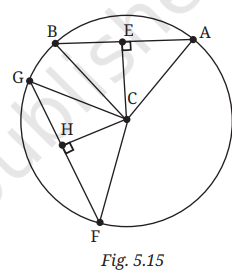
We are given a circle with centre $C$.
• $CE \perp AB$ and $CH \perp GF$ represent the perpendicular distances of chords $AB$ and $GF$ from the centre $C$.
• We are given that these distances are equal: $CE = CH$.
• $CE \perp AB$ and $CH \perp GF$ represent the perpendicular distances of chords $AB$ and $GF$ from the centre $C$.
• We are given that these distances are equal: $CE = CH$.
According to the theorem **"Chords equidistant from the centre of a circle are equal in length"**:
Since the perpendicular distances $CE$ and $CH$ are equal, the chords must be equal:
$$\mathbf{AB = GF}$$
Since the perpendicular distances $CE$ and $CH$ are equal, the chords must be equal:
$$\mathbf{AB = GF}$$
Proved: AB = GF by equidistant chord theorem.
Q3: Chord Equality using Pythagoras
Solve the previous question (Question 2) using the Baudhāyana–Pythagoras theorem.
Let the radius of the circle with centre $C$ be $r$. So $CA = CB = CG = CF = r$.
Since the perpendicular from the centre bisects the chord:
• $E$ is the midpoint of $AB \implies EB = \frac{AB}{2}$.
• $H$ is the midpoint of $GF \implies HG = \frac{GF}{2}$.
Since the perpendicular from the centre bisects the chord:
• $E$ is the midpoint of $AB \implies EB = \frac{AB}{2}$.
• $H$ is the midpoint of $GF \implies HG = \frac{GF}{2}$.
In right-angled triangle $\Delta CEB$, by Baudhāyana-Pythagoras theorem:
$$CB^2 = CE^2 + EB^2 \implies r^2 = CE^2 + \left(\frac{AB}{2}\right)^2 \implies \left(\frac{AB}{2}\right)^2 = r^2 - CE^2$$
$$CB^2 = CE^2 + EB^2 \implies r^2 = CE^2 + \left(\frac{AB}{2}\right)^2 \implies \left(\frac{AB}{2}\right)^2 = r^2 - CE^2$$
In right-angled triangle $\Delta CHG$, by Baudhāyana-Pythagoras theorem:
$$CG^2 = CH^2 + HG^2 \implies r^2 = CH^2 + \left(\frac{GF}{2}\right)^2 \implies \left(\frac{GF}{2}\right)^2 = r^2 - CH^2$$
$$CG^2 = CH^2 + HG^2 \implies r^2 = CH^2 + \left(\frac{GF}{2}\right)^2 \implies \left(\frac{GF}{2}\right)^2 = r^2 - CH^2$$
We are given $CE = CH \implies CE^2 = CH^2$. Therefore:
$$r^2 - CE^2 = r^2 - CH^2$$
Equating the two chord expressions:
$$\left(\frac{AB}{2}\right)^2 = \left(\frac{GF}{2}\right)^2 \implies \frac{AB}{2} = \frac{GF}{2} \implies \mathbf{AB = GF}$$
$$r^2 - CE^2 = r^2 - CH^2$$
Equating the two chord expressions:
$$\left(\frac{AB}{2}\right)^2 = \left(\frac{GF}{2}\right)^2 \implies \frac{AB}{2} = \frac{GF}{2} \implies \mathbf{AB = GF}$$
Proved: AB = GF using Pythagoras theorem.