Exercise 6.2 Practice
00:00
Overview
Step-by-step NCERT solutions and practice problems for CBSE Class 9 Maths Perimeter And Area (Exercise 6.2 Practice), providing clear algebraic methods and exam-oriented solutions.
Trapeziums, Heron's Formula & Geometric Area Theorems
Q1: Rectangle Triangle Area
Find the area of triangle $ADE$ in Fig. 6.31, where $ABCD$ is a rectangle of dimensions $10\text{ cm} \times 8\text{ cm}$, and $E$ is a point on $BC$.
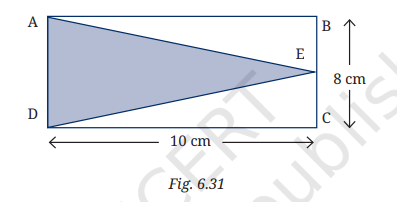
For triangle $ADE$:
• Let the base of the triangle be $AD$. Since $ABCD$ is a rectangle, $AD = BC = 8\text{ cm}$.
• The height of the triangle is the perpendicular distance from the vertex $E$ (which lies on $BC$) to the line containing $AD$.
• This distance is exactly the horizontal width of the rectangle, which is $AB = CD = 10\text{ cm}$.
$$\text{Area}(\Delta ADE) = \frac{1}{2} \times \text{base} \times \text{height} = \frac{1}{2} \times 8 \times 10 = \mathbf{40\text{ sq. cm}}$$
Area = 40 sq. cm
Q2: Isosceles Trapezium Area
The parallel sides of a trapezium are $40\text{ cm}$ and $20\text{ cm}$. If its non-parallel sides are both equal, each being $26\text{ cm}$, find the area of the trapezium.
Let the trapezium be $ABCD$ with parallel sides $AB = 40\text{ cm}$, $CD = 20\text{ cm}$, and non-parallel sides $AD = BC = 26\text{ cm}$.
Draw perpendiculars $DP$ and $CQ$ from $D$ and $C$ to $AB$.
• $PQ = CD = 20\text{ cm}$.
• Since $AD = BC$, the triangles $APD$ and $BQC$ are congruent, so $AP = BQ$.
• $AP + PQ + BQ = 40 \implies 2AP + 20 = 40 \implies AP = 10\text{ cm}$.
Draw perpendiculars $DP$ and $CQ$ from $D$ and $C$ to $AB$.
• $PQ = CD = 20\text{ cm}$.
• Since $AD = BC$, the triangles $APD$ and $BQC$ are congruent, so $AP = BQ$.
• $AP + PQ + BQ = 40 \implies 2AP + 20 = 40 \implies AP = 10\text{ cm}$.
In right-angled triangle $APD$, use Pythagoras theorem to find height $h = DP$:
$$h = \sqrt{AD^2 - AP^2} = \sqrt{26^2 - 10^2} = \sqrt{676 - 100} = \sqrt{576} = 24\text{ cm}$$
$$h = \sqrt{AD^2 - AP^2} = \sqrt{26^2 - 10^2} = \sqrt{676 - 100} = \sqrt{576} = 24\text{ cm}$$
Now, calculate the area:
$$\text{Area} = \frac{1}{2} \times (\text{sum of parallel sides}) \times \text{height}$$
$$\text{Area} = \frac{1}{2} \times (40 + 20) \times 24 = 30 \times 24 = \mathbf{720\text{ sq. cm}}$$
$$\text{Area} = \frac{1}{2} \times (\text{sum of parallel sides}) \times \text{height}$$
$$\text{Area} = \frac{1}{2} \times (40 + 20) \times 24 = 30 \times 24 = \mathbf{720\text{ sq. cm}}$$
Area = 720 sq. cm
Q3: Heron's Formula basic
Find the area of a triangle, given that its sides are $8\text{ cm}$ and $11\text{ cm}$ long, and its perimeter is $32\text{ cm}$.
Let the sides be $a = 8\text{ cm}$, $b = 11\text{ cm}$.
$$\text{Perimeter } = a + b + c = 32 \implies 8 + 11 + c = 32 \implies c = \mathbf{13\text{ cm}}$$
$$\text{Perimeter } = a + b + c = 32 \implies 8 + 11 + c = 32 \implies c = \mathbf{13\text{ cm}}$$
$$\text{Semi-perimeter } s = \frac{32}{2} = 16\text{ cm}$$
By Heron's Formula:
$$\text{Area} = \sqrt{s(s-a)(s-b)(s-c)} = \sqrt{16(16-8)(16-11)(16-13)}$$
$$\text{Area} = \sqrt{16 \times 8 \times 5 \times 3} = \sqrt{16 \times 4 \times 2 \times 5 \times 3} = 8\sqrt{30}\text{ sq. cm} \approx \mathbf{43.8\text{ sq. cm}}$$
By Heron's Formula:
$$\text{Area} = \sqrt{s(s-a)(s-b)(s-c)} = \sqrt{16(16-8)(16-11)(16-13)}$$
$$\text{Area} = \sqrt{16 \times 8 \times 5 \times 3} = \sqrt{16 \times 4 \times 2 \times 5 \times 3} = 8\sqrt{30}\text{ sq. cm} \approx \mathbf{43.8\text{ sq. cm}}$$
Area = 8√30 sq. cm (≈ 43.8 sq. cm)
Q4: Triangular Plot Ratio
The sides of a triangular plot are in the ratio $3: 5: 7$, and its perimeter is $300\text{ m}$. Find its area.
Let the sides be $3x$, $5x$, and $7x$.
$$\text{Perimeter } = 3x + 5x + 7x = 300 \implies 15x = 300 \implies x = 20$$
Thus, the sides are:
$a = 3(20) = 60\text{ m}$, $b = 5(20) = 100\text{ m}$, $c = 7(20) = 140\text{ m}$
$$\text{Perimeter } = 3x + 5x + 7x = 300 \implies 15x = 300 \implies x = 20$$
Thus, the sides are:
$a = 3(20) = 60\text{ m}$, $b = 5(20) = 100\text{ m}$, $c = 7(20) = 140\text{ m}$
$$\text{Semi-perimeter } s = \frac{300}{2} = 150\text{ m}$$
By Heron's Formula:
$$\text{Area} = \sqrt{s(s-a)(s-b)(s-c)} = \sqrt{150(150-60)(150-100)(150-140)}$$
$$\text{Area} = \sqrt{150 \times 90 \times 50 \times 10} = \sqrt{6,750,000} = \mathbf{1500\sqrt{3}\text{ sq. m}} \approx \mathbf{2598.08\text{ sq. m}}$$
By Heron's Formula:
$$\text{Area} = \sqrt{s(s-a)(s-b)(s-c)} = \sqrt{150(150-60)(150-100)(150-140)}$$
$$\text{Area} = \sqrt{150 \times 90 \times 50 \times 10} = \sqrt{6,750,000} = \mathbf{1500\sqrt{3}\text{ sq. m}} \approx \mathbf{2598.08\text{ sq. m}}$$
Area = 1500√3 sq. m (≈ 2598.1 sq. m)
Q5: Rhombus Diagonals
One diagonal of a rhombus is twice as long as the other diagonal. If the rhombus has area $128\text{ cm}^2$, find the length of the shorter diagonal.
Let the shorter diagonal be $d_1$. Then the longer diagonal is $d_2 = 2d_1$.
$$\text{Area of Rhombus} = \frac{1}{2} \times d_1 \times d_2$$
$$128 = \frac{1}{2} \times d_1 \times (2d_1)$$
$$128 = d_1^2 \implies d_1 = \sqrt{128} = \mathbf{8\sqrt{2}\text{ cm}} \approx \mathbf{11.31\text{ cm}}$$
$$\text{Area of Rhombus} = \frac{1}{2} \times d_1 \times d_2$$
$$128 = \frac{1}{2} \times d_1 \times (2d_1)$$
$$128 = d_1^2 \implies d_1 = \sqrt{128} = \mathbf{8\sqrt{2}\text{ cm}} \approx \mathbf{11.31\text{ cm}}$$
Shorter diagonal = 8√2 cm (≈ 11.31 cm)
Q6: Parallelogram Sharing Base
$ABCD$ is a parallelogram. $P$ and $Q$ are any two points on side $AB$. What can you say about the ratio $\text{Area}(\Delta PCD) : \text{Area}(\Delta QCD)$?
Both triangles $PCD$ and $QCD$ share the exact same base, $CD$.
The opposite vertices $P$ and $Q$ lie on the line $AB$, which is parallel to $CD$ (since $ABCD$ is a parallelogram).
The opposite vertices $P$ and $Q$ lie on the line $AB$, which is parallel to $CD$ (since $ABCD$ is a parallelogram).
Since both triangles lie between the same parallel lines, their heights (the perpendicular distance between parallel lines $AB$ and $CD$) are equal.
$$\text{Area} = \frac{1}{2} \times \text{base} \times \text{height}$$
Since their bases and heights are identical, **their areas are equal**:
$$\text{Area}(\Delta PCD) = \text{Area}(\Delta QCD)$$
Therefore, the ratio is **$1 : 1$**.
$$\text{Area} = \frac{1}{2} \times \text{base} \times \text{height}$$
Since their bases and heights are identical, **their areas are equal**:
$$\text{Area}(\Delta PCD) = \text{Area}(\Delta QCD)$$
Therefore, the ratio is **$1 : 1$**.
Ratio = 1 : 1 (Equal Areas)
Q7: Parallelogram Diagonal Area Proof
$O$ is any point on the diagonal $PR$ of a parallelogram $PQRS$. Prove that the areas of triangles $PSO$ and $PQO$ are equal.
Since diagonal $PR$ divides the parallelogram $PQRS$ into two congruent triangles $\Delta PSR$ and $\Delta PQR$:
$$\text{Area}(\Delta PSR) = \text{Area}(\Delta PQR) \quad \text{--- (Equation 1)}$$
$$\text{Area}(\Delta PSR) = \text{Area}(\Delta PQR) \quad \text{--- (Equation 1)}$$
Consider the point $O$ on diagonal $PR$.
Triangles $\Delta OSR$ and $\Delta OQR$ share the same base $OR$.
Since $PQRS$ is a parallelogram, vertices $S$ and $Q$ are symmetric about the diagonal $PR$. The perpendicular heights from $S$ and $Q$ to diagonal $PR$ are equal.
Therefore:
$$\text{Area}(\Delta OSR) = \text{Area}(\Delta OQR) \quad \text{--- (Equation 2)}$$
Subtract Equation 2 from Equation 1:
$$\text{Area}(\Delta PSR) - \text{Area}(\Delta OSR) = \text{Area}(\Delta PQR) - \text{Area}(\Delta OQR)$$
$$\mathbf{\text{Area}(\Delta PSO) = \text{Area}(\Delta PQO)}$$
$$\text{Area}(\Delta PSR) - \text{Area}(\Delta OSR) = \text{Area}(\Delta PQR) - \text{Area}(\Delta OQR)$$
$$\mathbf{\text{Area}(\Delta PSO) = \text{Area}(\Delta PQO)}$$
Proved: Area(PSO) = Area(PQO)
Q8: Varignon's Theorem
If the mid-points of the sides of a 4-gon (quadrilateral) are joined in order, prove that the area of the parallelogram thus formed will be half of the area of the given 4-gon.
Let $ABCD$ be the 4-gon. Let $E, F, G, H$ be the midpoints of sides $AB, BC, CD, DA$ respectively.
Join diagonal $BD$.
• In $\Delta ABD$, $H$ and $E$ are midpoints of $AD$ and $AB$. By Midpoint Theorem, $HE \parallel BD$ and $HE = \frac{1}{2}BD$.
• Since $\Delta AHE \sim \Delta ADB$ with a scale factor of $1/2$, the ratio of their areas is $(1/2)^2 = 1/4$:
$$\text{Area}(\Delta AHE) = \frac{1}{4}\text{Area}(\Delta ABD)$$
Similarly:
$$\text{Area}(\Delta CGF) = \frac{1}{4}\text{Area}(\Delta CBD)$$
Adding these two equations:
$$\text{Area}(\Delta AHE) + \text{Area}(\Delta CGF) = \frac{1}{4}\left[\text{Area}(\Delta ABD) + \text{Area}(\Delta CBD)\right] = \frac{1}{4}\text{Area}(ABCD)$$
$$\text{Area}(\Delta CGF) = \frac{1}{4}\text{Area}(\Delta CBD)$$
Adding these two equations:
$$\text{Area}(\Delta AHE) + \text{Area}(\Delta CGF) = \frac{1}{4}\left[\text{Area}(\Delta ABD) + \text{Area}(\Delta CBD)\right] = \frac{1}{4}\text{Area}(ABCD)$$
By same logic for diagonal $AC$:
$$\text{Area}(\Delta BEF) + \text{Area}(\Delta DGH) = \frac{1}{4}\text{Area}(ABCD)$$
$$\text{Area}(\Delta BEF) + \text{Area}(\Delta DGH) = \frac{1}{4}\text{Area}(ABCD)$$
Sum of the areas of the four corner triangles:
$$\text{Total Corner Area} = \frac{1}{4}\text{Area}(ABCD) + \frac{1}{4}\text{Area}(ABCD) = \frac{1}{2}\text{Area}(ABCD)$$
Therefore:
$$\text{Area}(EFGH) = \text{Area}(ABCD) - \text{Total Corner Area} = \text{Area}(ABCD) - \frac{1}{2}\text{Area}(ABCD) = \mathbf{\frac{1}{2}\text{Area}(ABCD)}$$
$$\text{Total Corner Area} = \frac{1}{4}\text{Area}(ABCD) + \frac{1}{4}\text{Area}(ABCD) = \frac{1}{2}\text{Area}(ABCD)$$
Therefore:
$$\text{Area}(EFGH) = \text{Area}(ABCD) - \text{Total Corner Area} = \text{Area}(ABCD) - \frac{1}{2}\text{Area}(ABCD) = \mathbf{\frac{1}{2}\text{Area}(ABCD)}$$
Proved: Area(EFGH) = 1/2 Area(ABCD)
Q9: Median Area Split
In $\Delta ABC$, the midpoint of $BC$ is $D$. Median $AD$ is drawn. $P$ is any point on $AD$ (Fig. 6.32). Show that $\text{Area}(\Delta ABP) = \text{Area}(\Delta ACP)$.
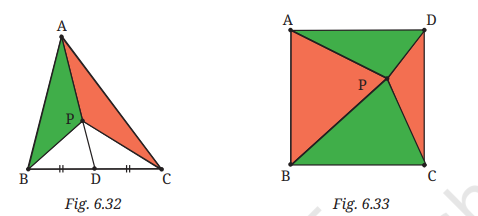
• In $\Delta ABC$, $AD$ is the median. A median divides a triangle into two triangles of equal area:
$$\text{Area}(\Delta ABD) = \text{Area}(\Delta ACD) \quad \text{--- (Equation 1)}$$
$$\text{Area}(\Delta ABD) = \text{Area}(\Delta ACD) \quad \text{--- (Equation 1)}$$
• In $\Delta PBC$, $PD$ is the median (since $D$ is the midpoint of $BC$):
$$\text{Area}(\Delta PBD) = \text{Area}(\Delta PCD) \quad \text{--- (Equation 2)}$$
$$\text{Area}(\Delta PBD) = \text{Area}(\Delta PCD) \quad \text{--- (Equation 2)}$$
Subtract Equation 2 from Equation 1:
$$\text{Area}(\Delta ABD) - \text{Area}(\Delta PBD) = \text{Area}(\Delta ACD) - \text{Area}(\Delta PCD)$$
$$\mathbf{\text{Area}(\Delta ABP) = \text{Area}(\Delta ACP)}$$
$$\text{Area}(\Delta ABD) - \text{Area}(\Delta PBD) = \text{Area}(\Delta ACD) - \text{Area}(\Delta PCD)$$
$$\mathbf{\text{Area}(\Delta ABP) = \text{Area}(\Delta ACP)}$$
Proved: Area(ABP) = Area(ACP)
Q10: Square Regions Ratio
Given a square $ABCD$, let $P$ be a point within it. Join $PA, PB, PC, PD$ (Fig. 6.33). What is the ratio of the areas of the red region ($\Delta PAB$ and $\Delta PCD$) and the green region ($\Delta PBC$ and $\Delta PDA$)?
Let the side length of the square be $s$. The total area of the square is $s^2$.
Draw perpendicular lines from $P$ to the sides:
• Let $h_1$ be the perpendicular distance from $P$ to $AB$, and $h_2$ be the distance from $P$ to $CD$. Clearly, $h_1 + h_2 = s$.
Draw perpendicular lines from $P$ to the sides:
• Let $h_1$ be the perpendicular distance from $P$ to $AB$, and $h_2$ be the distance from $P$ to $CD$. Clearly, $h_1 + h_2 = s$.
Calculate the sum of the areas of the red region:
$$\text{Area}(\Delta PAB) + \text{Area}(\Delta PCD) = \frac{1}{2} \times s \times h_1 + \frac{1}{2} \times s \times h_2 = \frac{1}{2} s (h_1 + h_2) = \frac{1}{2} s^2$$
$$\text{Area}(\Delta PAB) + \text{Area}(\Delta PCD) = \frac{1}{2} \times s \times h_1 + \frac{1}{2} \times s \times h_2 = \frac{1}{2} s (h_1 + h_2) = \frac{1}{2} s^2$$
Since the total area is $s^2$, the area of the green region must be:
$$\text{Area(Green)} = s^2 - \frac{1}{2}s^2 = \frac{1}{2} s^2$$
$$\text{Area(Green)} = s^2 - \frac{1}{2}s^2 = \frac{1}{2} s^2$$
The ratio of red region to green region is:
$$\frac{1}{2}s^2 : \frac{1}{2}s^2 = \mathbf{1 : 1}$$
$$\frac{1}{2}s^2 : \frac{1}{2}s^2 = \mathbf{1 : 1}$$
Ratio = 1 : 1 (Equal Areas)
Q11: Parallel Shift Proof
In $\Delta ABC$, $D$ is the midpoint of $AB$. $P$ is any point on $BC$, and $Q$ is a point on $AB$ such that $CQ \parallel PD$. $PQ$ is joined (Fig. 6.34). Prove that $\text{Area}(\Delta BPQ) = \frac{1}{2}\text{Area}(\Delta ABC)$.
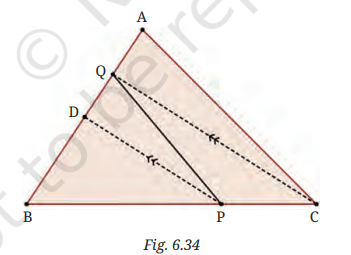
Since $D$ is the midpoint of $AB$, the line $CD$ is a median of $\Delta ABC$:
$$\text{Area}(\Delta BDC) = \frac{1}{2}\text{Area}(\Delta ABC) \quad \text{--- (Equation 1)}$$
$$\text{Area}(\Delta BDC) = \frac{1}{2}\text{Area}(\Delta ABC) \quad \text{--- (Equation 1)}$$
We are given $CQ \parallel PD$.
Consider the two triangles $\Delta PCD$ and $\Delta PQD$:
• They share the common base $PD$.
• Their vertices $C$ and $Q$ lie on line $CQ$, which is parallel to $PD$.
Therefore, they have equal area:
$$\text{Area}(\Delta PCD) = \text{Area}(\Delta PQD) \quad \text{--- (Equation 2)}$$
Consider the two triangles $\Delta PCD$ and $\Delta PQD$:
• They share the common base $PD$.
• Their vertices $C$ and $Q$ lie on line $CQ$, which is parallel to $PD$.
Therefore, they have equal area:
$$\text{Area}(\Delta PCD) = \text{Area}(\Delta PQD) \quad \text{--- (Equation 2)}$$
Observe the area of $\Delta BPQ$:
$$\text{Area}(\Delta BPQ) = \text{Area}(\Delta BDP) + \text{Area}(\Delta PQD)$$
Substitute Equation 2:
$$\text{Area}(\Delta BPQ) = \text{Area}(\Delta BDP) + \text{Area}(\Delta PCD) = \text{Area}(\Delta BDC)$$
$$\text{Area}(\Delta BPQ) = \text{Area}(\Delta BDP) + \text{Area}(\Delta PQD)$$
Substitute Equation 2:
$$\text{Area}(\Delta BPQ) = \text{Area}(\Delta BDP) + \text{Area}(\Delta PCD) = \text{Area}(\Delta BDC)$$
Substitute Equation 1:
$$\mathbf{\text{Area}(\Delta BPQ) = \frac{1}{2}\text{Area}(\Delta ABC)}$$
$$\mathbf{\text{Area}(\Delta BPQ) = \frac{1}{2}\text{Area}(\Delta ABC)}$$
Proved: Area(BPQ) = 1/2 Area(ABC)