CLASS 9 MATHEMATICS
GANITA MANJARI
A focused companion for chapterwise study, rapid recall and practice
An independent chapterwise revision companion
Prepared as a supplementary study and practice resource
Copyright, Edition & Metadata Notice
Mathematical learning materials are prepared for study and revision. Readers should also consult their prescribed textbook, teacher and current school instructions. Any corrections or updates may be reflected in later editions.
| SERIES SJMaths Learning Series |
LEVEL Class 9 Mathematics |
COVERAGE Chapters 1–14 |
| RESOURCE Quick Revision Notes |
EDITION Digital edition · 2026 |
IMPRINT SJMaths |
About this book & suggested learning methodology
A chapterwise companion for understanding, practising and revising Class 9 mathematics.
Mathematics becomes easier to revise when ideas are organised, examples are worked through carefully and practice follows understanding. These notes bring the fourteen chapters together in one chapterwise resource, following the sequence used in the supplied Ganita Manjari manuscript.
How to use this book for maximum retention
A repeatable routine for each chapter.
Use the reader navigation menu to move between chapters. Because digital books reflow to fit the reader's screen and font settings, use the table of contents and chapter links to locate a section.
| □ Can I explain the main idea in my own words? | □ Can I solve a similar example without help? |
| □ Have I checked signs, calculations and units? | □ Have I revisited the questions I got wrong? |
Complete Table of Contents: Chapters 1 to 14
Fourteen chapters, arranged in the sequence of the Ganita Manjari manuscript.
Chapter-end question sets (Recall & Apply, Standard NCERT, Challenge) and their corresponding detailed stepwise solutions.
These notes revise Chapter 1 (The Use of Coordinates), Chapter 2 (Introduction to Linear Polynomials) and Chapter 3 (The World of Numbers) Chapter 4 (Exploring Algebraic Identities) Chapter 5 (Circles) and Chapter 6 (Measuring Space: Perimeter and Area) and Chapter 7 (The Mathematics of Maybe: Introduction to Probability) and Chapter 8 (Exploring Sequences and Progressions) Chapter 9 (Propositions and their Converses) and Chapter 10 (How Quantities Combine: Understanding Data) and Chapter 11 (The World of Algorithms) and Chapter 12 (Quadrilaterals) and Chapter 13 (Two Variables, One Line) and Chapter 14 (Surface Area and Volume) in the order of your NCERT textbook. Each section begins with a boxed summary you can recall in half a minute, followed by the key points and solved examples, with every solution written one step to a line. Cover the solution and try each example first. Finish with the chapter-end questions, and check them against the answers at the back.
| Idea | Statement |
|---|---|
| Ordered pair | ( x , y ) with x first. ( a , b ) and ( b , a ) are different points unless a = b . |
| Axes, origin | Perpendicular lines X ′ O X and Y ′ O Y meeting at O (0, 0) . |
| Abscissa, ordinate | x is the distance from the y -axis; y is the distance from the x -axis. |
| Points on axes | ( k , 0) on the x -axis; (0, k ) on the y -axis. In no quadrant. |
| Quadrants | I (+, +) , II (−, +) , III (−, −) , IV (+, −) . |
| Distance | √(( x 2 − x 1 ) 2 + ( y 2 − y 1 ) 2 ) . From the origin: √( x 2 + y 2 ) . |
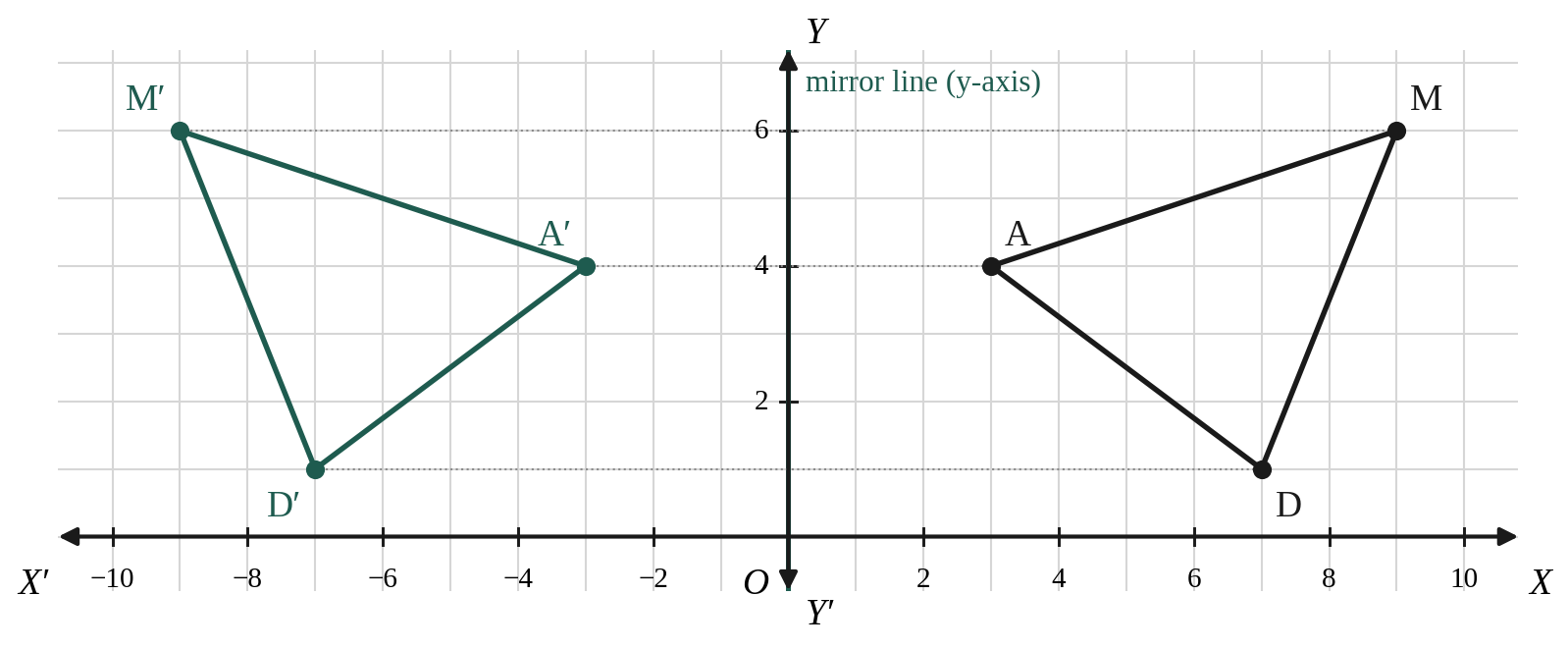
| Reflection | x -axis ( x , − y ) ; y -axis (− x , y ) ; origin (− x , − y ) . Lengths unchanged. |
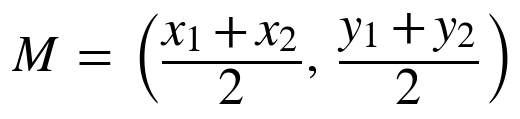
| Midpoint | (( x 1 + x 2 )/2, ( y 1 + y 2 )/2) . End point: x 2 = 2 x M − x 1 , y 2 = 2 y M − y 1 . |
| Trisection | One-third and two-thirds of the change in x and in y from A . |
| Collinear | Longest distance = sum of the other two, or equal steepness. |
| Period | Contribution |
|---|---|
| c. 2600 BCE | Sindhu–Sarasvatī cities are laid out on regular grids. |
| c. 800 BCE | Baudhāyana’s Śulba Sūtras: grid layouts and the theorem behind the distance formula. |
| c. 4th century BCE | Ujjayinī taken as the prime meridian (0° longitude); Ptolemy (c. 150 CE) calls it “Ozine”. |
| 499 CE | Āryabhaṭa uses sines to fix positions of celestial bodies. |
| 628 CE | Brahmagupta treats zero and negative numbers as numbers; this makes four quadrants possible. |
| 1637 CE | Descartes: a point of a plane is fixed by two perpendicular distances from two axes. |
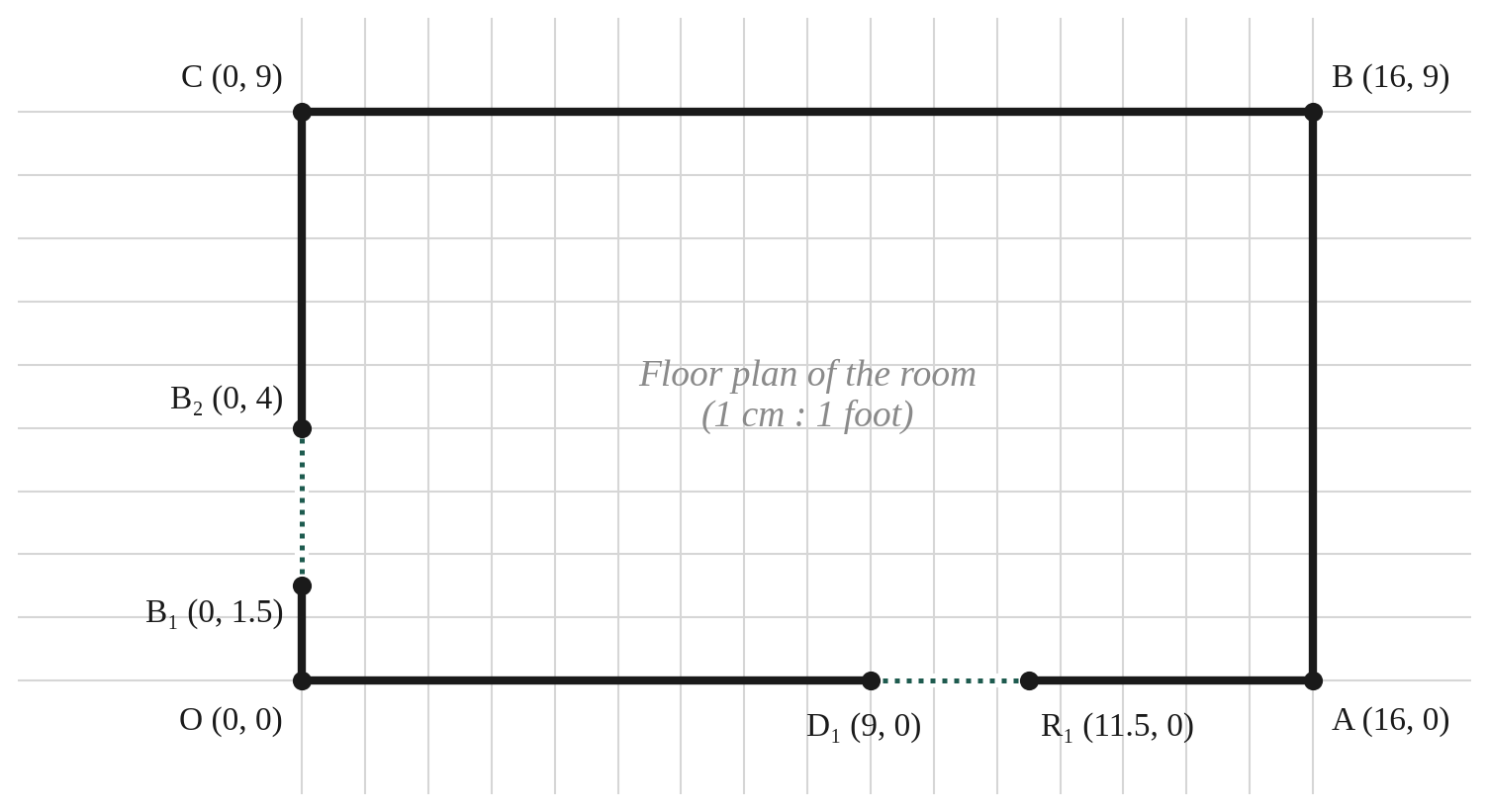
A map drawn to a scale such as 1 cm : 1 foot makes one map unit stand for one real unit.
A floor map is two-dimensional: it shows length and breadth only. Height (of a window or a table top) is a third direction and cannot be marked.
Points on the bottom wall have y = 0; points on the left wall have x = 0.
Two points on one wall are separated by the difference of the coordinate that changes.
In a city grid, (4, 3) and (3, 4) are different crossings.
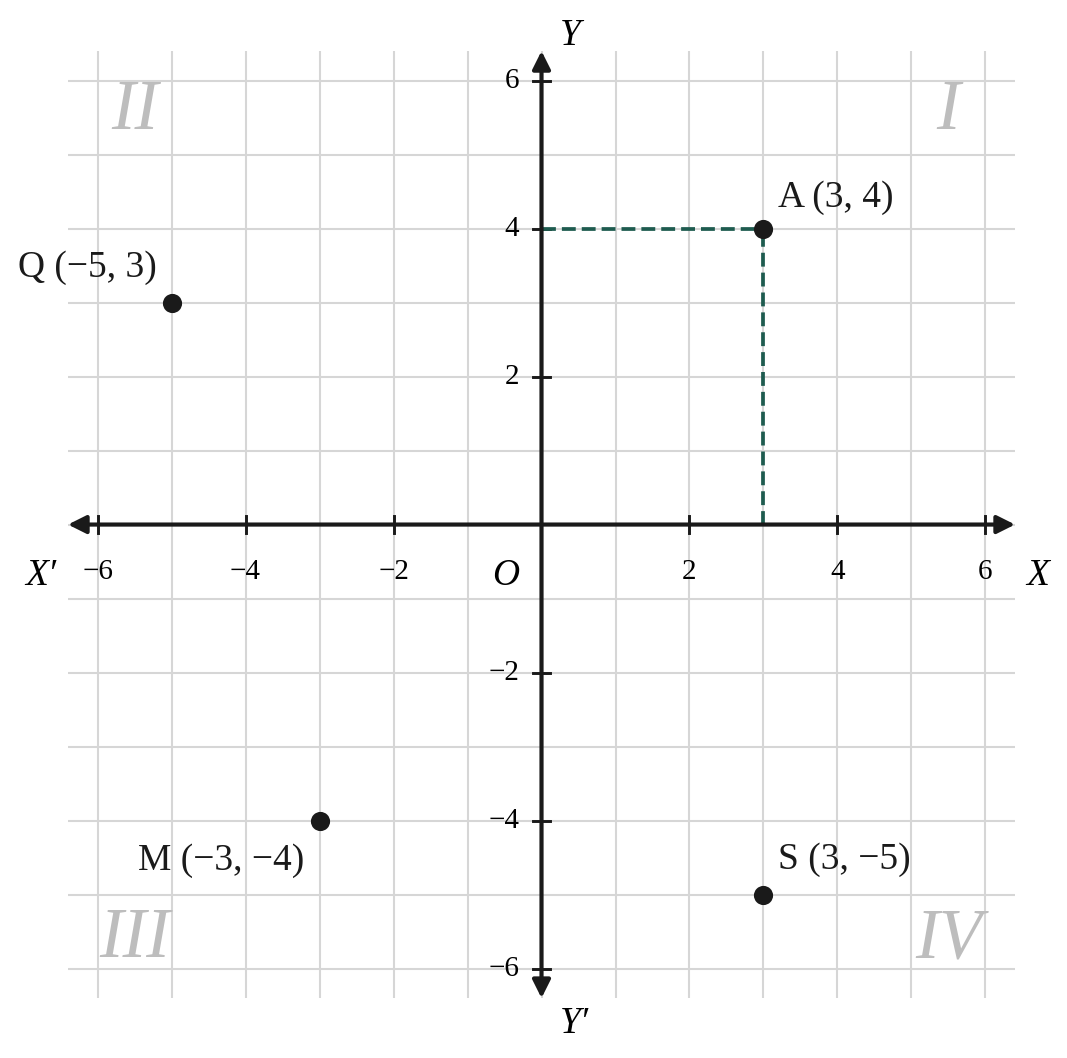
A number line is one-dimensional; two perpendicular number lines give the two-dimensional plane.
Right of O and above O are positive; left and below are negative.
Watch out: (0, 6) is on the y-axis. It is the y-value that is 0 on the x-axis.
| Quadrant | Position | Signs of ( x , y ) | Example |
|---|---|---|---|
| I | upper right | (+, +) | (3, 4) |
| II | upper left | (−, +) | (−5, 3) |
| III | lower left | (−, −) | (−3, −4) |
| IV | lower right | (+, −) | (3, −5) |
The line parallel to the y-axis through x = c contains the points (c, y); the line parallel to the x-axis through y = c contains (x, c).
Without negative numbers only Quadrant I and the positive parts of the axes could be described.
Watch out: (0, −5) is on the negative y-axis, not in Quadrant III.
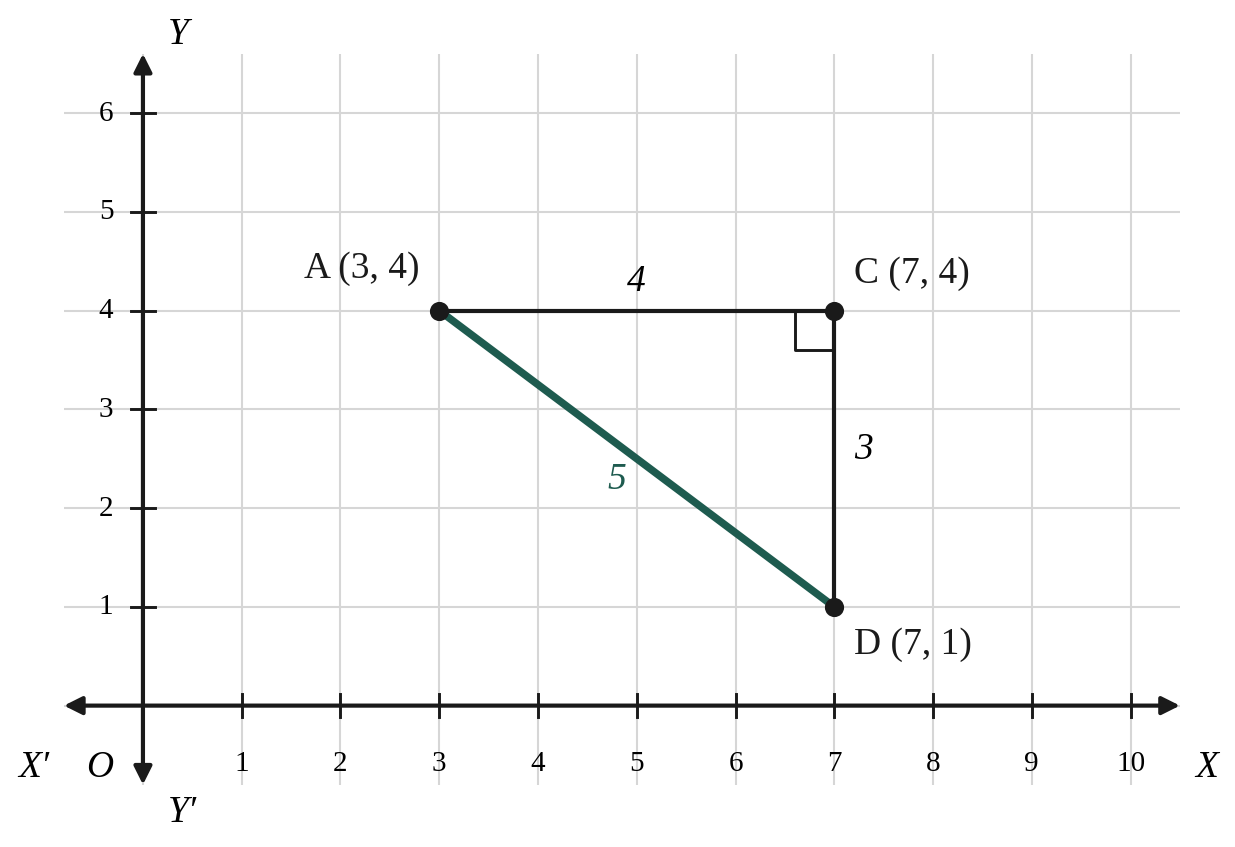
Same y (horizontal): distance = |x2 − x1|. Same x (vertical): distance = |y2 − y1|.
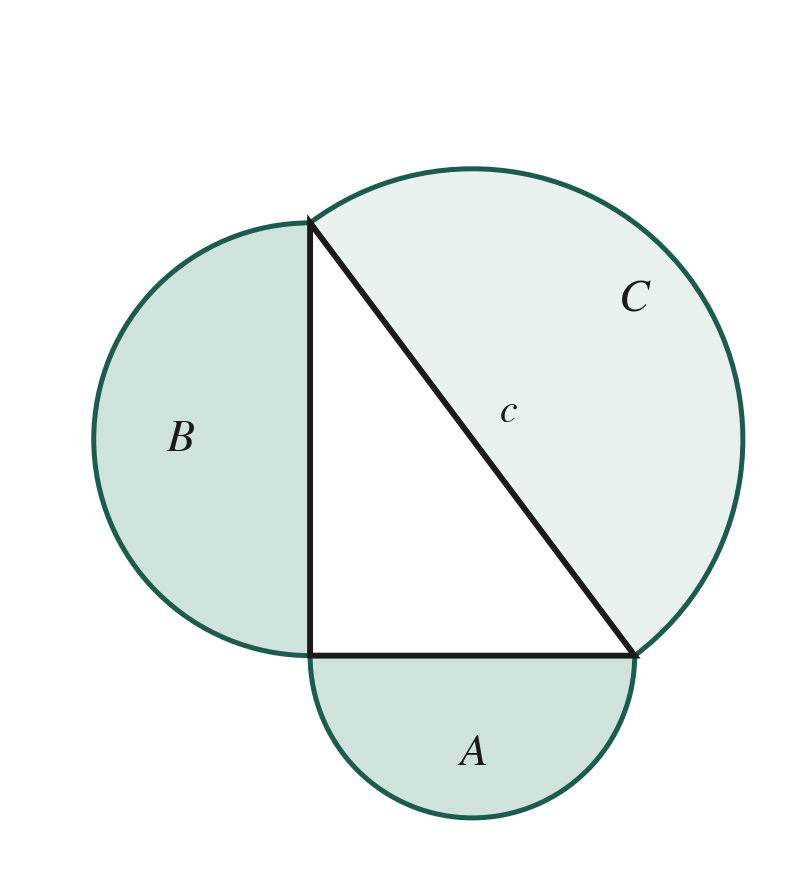
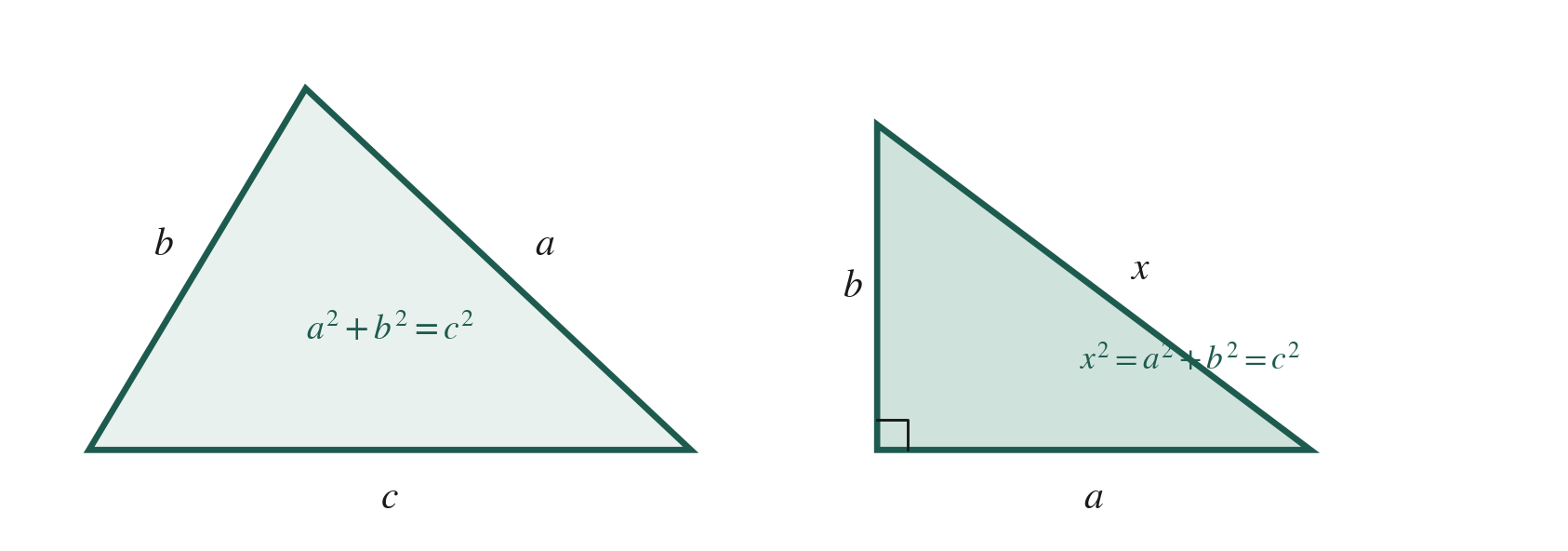
Slanted: draw the right triangle whose legs are |x2 − x1| and |y2 − y1|. The Baudhāyana–Pythagoras theorem, (hypotenuse)² = sum of the squares of the legs, gives the formula below.
| Figure | Test using distances |
|---|---|
| Isosceles triangle | Two sides equal |
| Equilateral triangle | Three sides equal |
| Right triangle | (longest side)² = sum of the squares of the other two |
| Rhombus | Four sides equal |
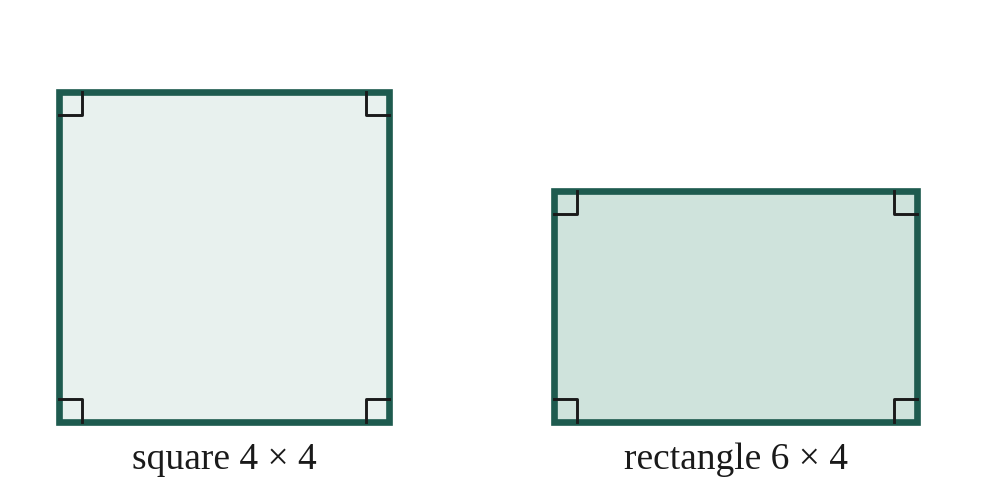
| Rectangle | Opposite sides equal and diagonals equal |
| Square | Four sides equal and diagonals equal |
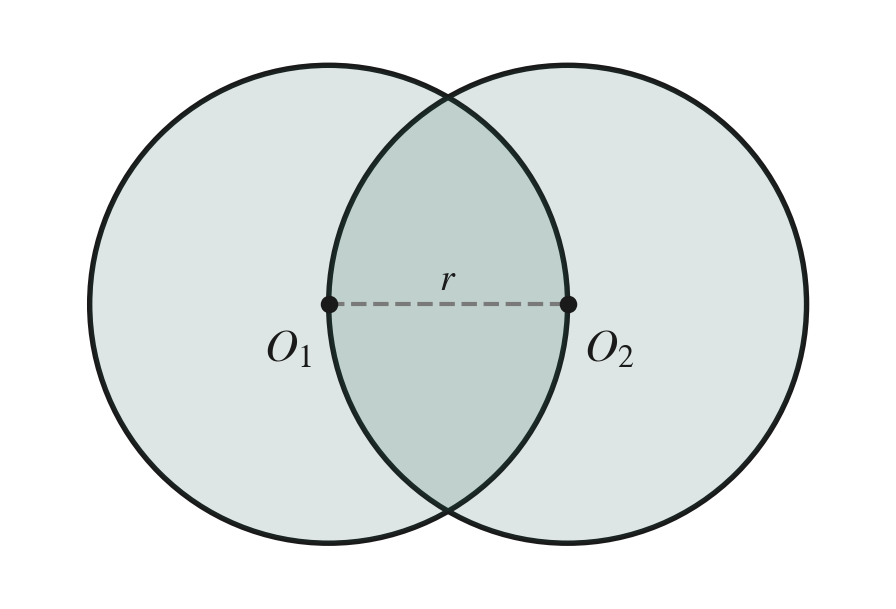
Circles. P is inside, on or outside a circle (centre O, radius r) when OP < r, OP = r or OP > r. Two circles with centres d apart and radii r1, r2 cross at two points if |r1 − r2| < d < r1 + r2, and touch if d = r1 + r2.
| Reflection in | Rule | Example: (3, −5) |
|---|---|---|
| the x -axis | ( x , y ) → ( x , − y ) | (3, 5) |
| the y -axis | ( x , y ) → (− x , y ) | (−3, −5) |
| the origin | ( x , y ) → (− x , − y ) | (−3, 5) |
The axis you reflect in keeps its own coordinate: the x-axis keeps x, the y-axis keeps y.
Reflecting in the x-axis and then the y-axis (either order) is the same as reflecting in the origin.
Trisection: one step = (change in x)/3 and (change in y)/3. P is one step from A, Q is two steps. Check: P is the midpoint of AQ.
Triangle from its midpoints: add the equal-vertex pairs. If D, E, F are the midpoints of AB, BC, CA, then xA + xB = 2xD and so on; add all three sums, halve to get xA + xB + xC, then subtract each pair to find the third vertex.
Distances: the longest of AB, BC, CA equals the sum of the other two.
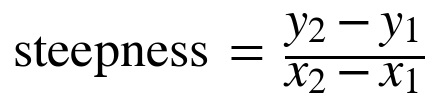
Steepness (slope): the steepness of AB equals the steepness of BC.
| Idea | Statement |
|---|---|
| Polynomial, degree | One variable, non-negative whole-number powers. Degree = highest power: 0 constant, 1 linear, 2 quadratic, 3 cubic. |
| Value at x = k | Replace x by k and simplify: P ( k ) . |
| Linear polynomial | a x + b , a ≠ 0 . Zero: x = − b / a . |
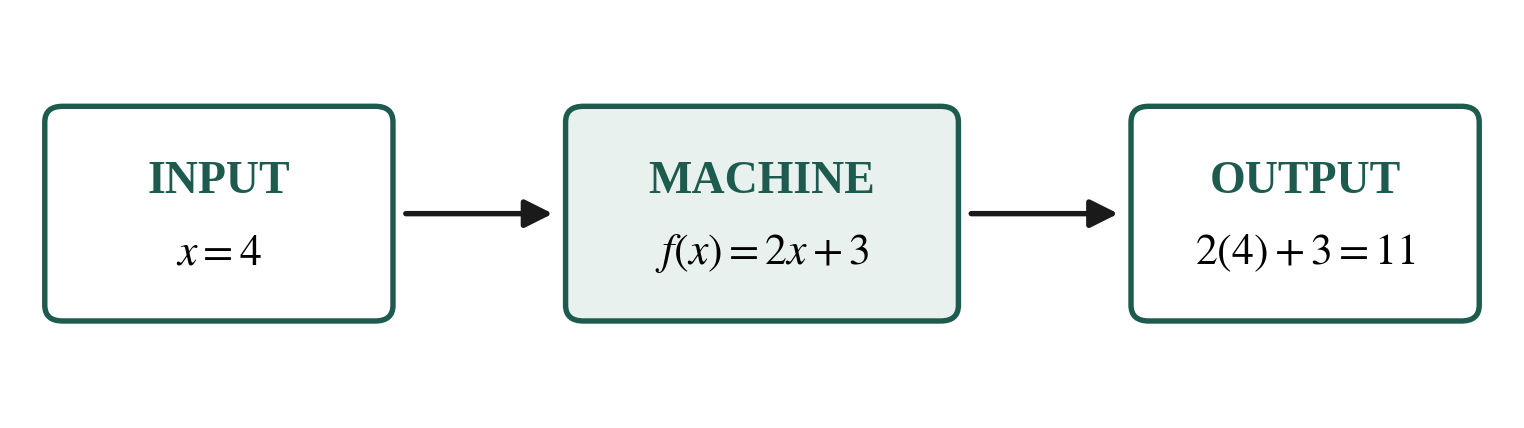
| Function machine | f ( x ) = a x + b : multiply the input by a , then add b . |
| Linear pattern | Constant difference d . n -th term = d n + c , with c = first term − d . |
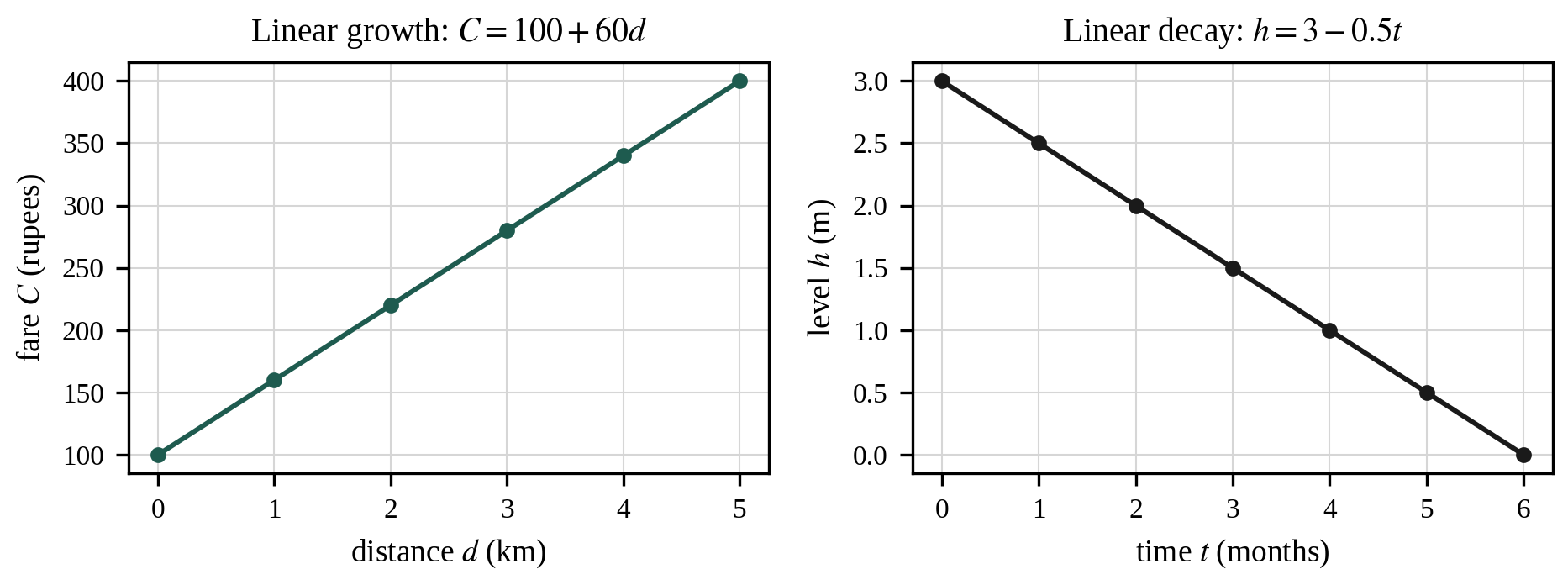
| Growth and decay | y = b + a t : a > 0 growth, a < 0 decay. b = starting value. |
| Master relation | y = a x + b : a = slope (rate), b = y-intercept (initial value). |
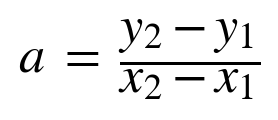
| From two data points | a = ( y 2 − y 1 )/( x 2 − x 1 ) , then b = y 1 − a x 1 . |
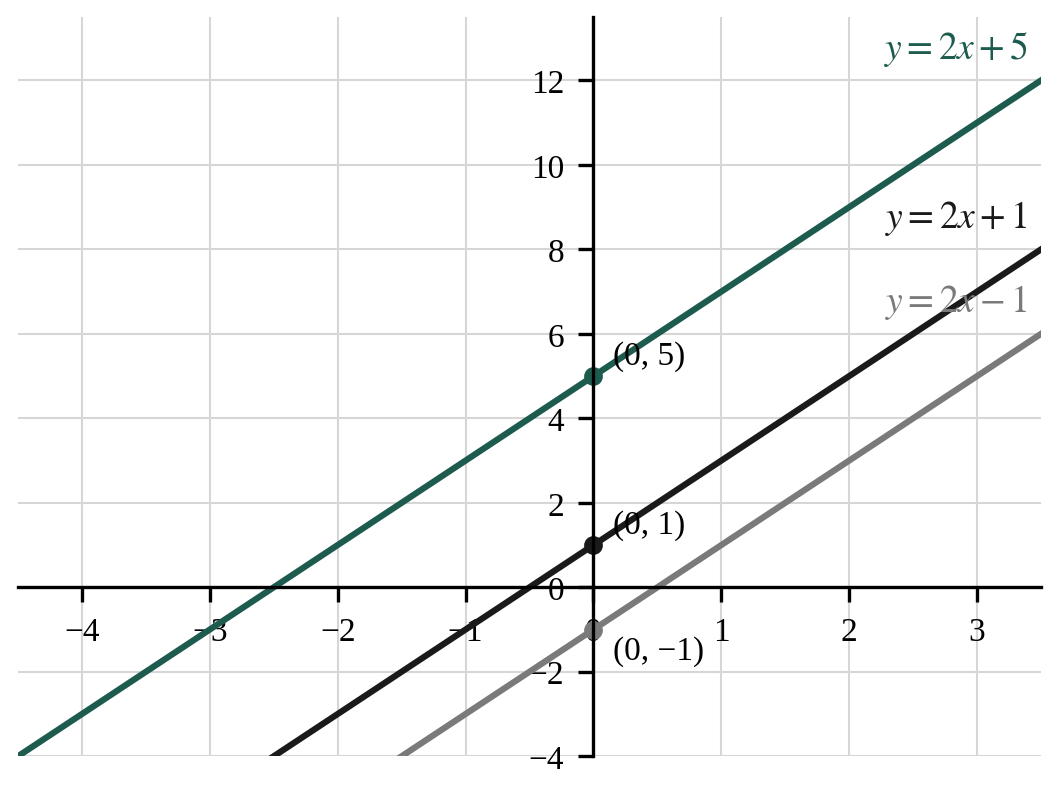
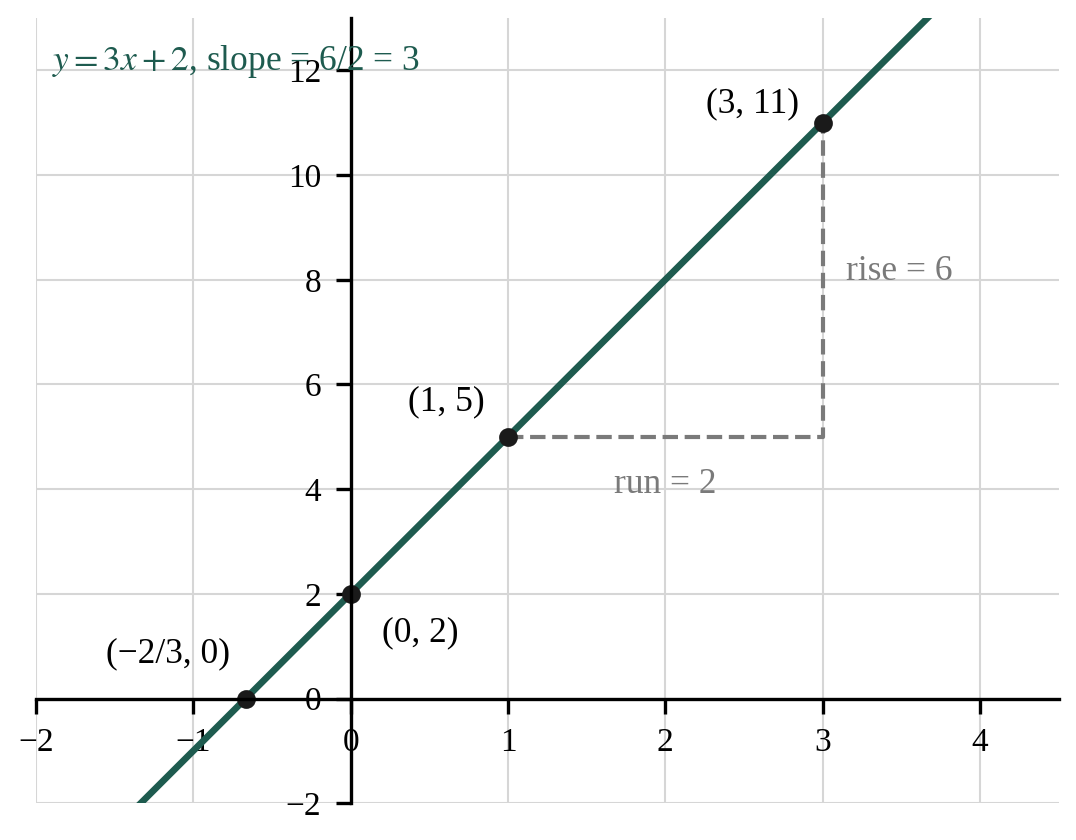
| Graph | Straight line. y-intercept (0, b ) ; x-intercept (− b / a , 0) . y = a x passes through the origin. |
| Parallel lines | Same a , different b . |
| Degree | Name | Example |
|---|---|---|
| 0 | Constant | P ( x ) = 8 , written 8 x 0 |
| 1 | Linear | P ( z ) = 3 z + 7 |
| 2 | Quadratic | P ( x ) = x 2 + 5 x + 1 |
| 3 | Cubic | P ( y ) = 5 y 3 + y 2 + 2 y − 1 |
A missing term has coefficient 0: in 4z3 + 5z2 − 11 the coefficient of z is 0.
The sign belongs to the coefficient: in x4 − 3x3 the coefficient of x3 is −3.
The value of P(x) at x = k is P(k): replace x by k.
A linear polynomial has exactly one zero: ax + b = 0 gives x = −b/a.
Word problems: let a letter stand for the unknown, write an equation from the story, solve it, then check it against the story.
| Stage n | 1 | 2 | 3 | 4 | n |
|---|---|---|---|---|---|
| Tiles | 1 | 3 | 5 | 7 | 2 n − 1 |
Find d, then c, then check the rule with n = 1 and n = 2.
Increasing pattern: d > 0. Decreasing pattern: d < 0, for example 120 − 9n.
When a decaying quantity runs out, solve b + at = 0.
Always state the unit of the rate: “per month”, “per day”, “per year”.
Two data points fix the relation. Write y1 = ax1 + b and y2 = ax2 + b, subtract to get a, then substitute to get b.
Check the answer with the second data point.
y-intercept: the line cuts the y-axis at (0, b).
x-intercept: put y = 0. The line cuts the x-axis at (−b/a, 0), the zero of ax + b.
Slope: a > 0 rises from left to right; a < 0 falls; a larger |a| is steeper. When b = 0 the line y = ax passes through the origin.
Parallel lines have the same a and different b.
| Idea | Statement |
|---|---|
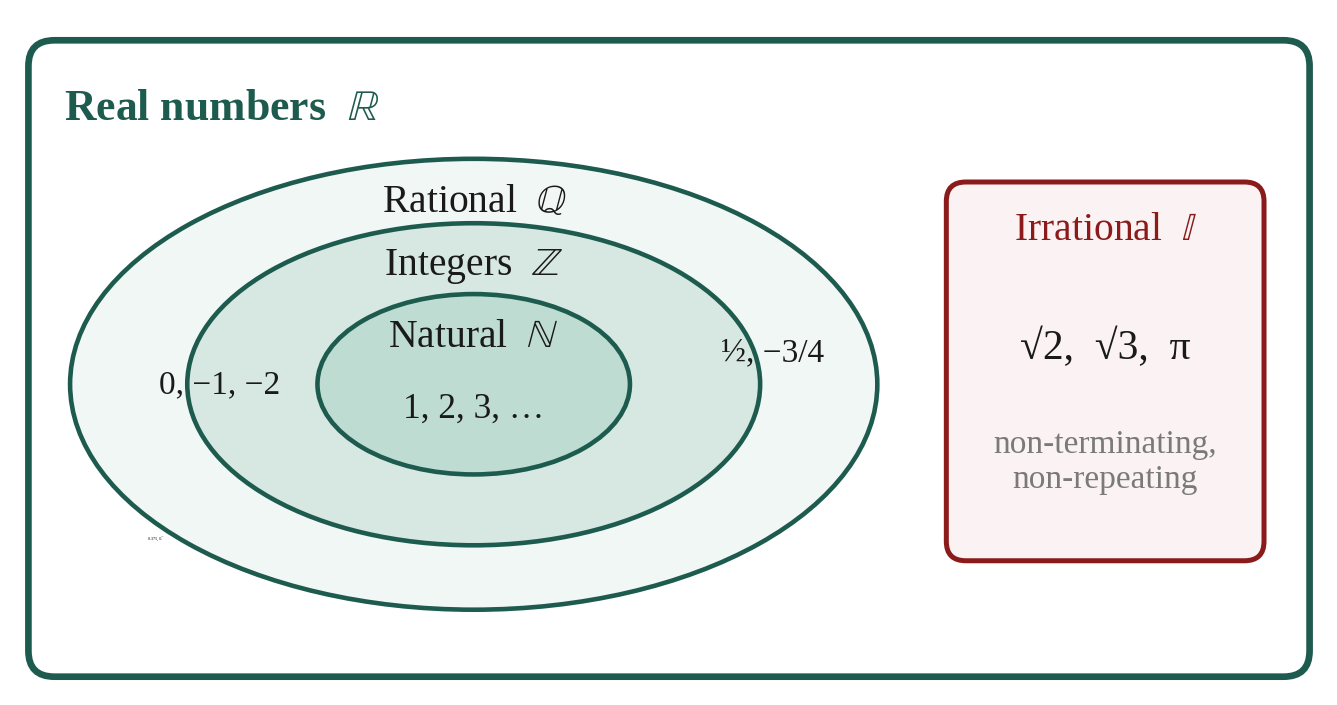
| Natural numbers N | {1, 2, 3, …} , born from one-to-one correspondence. |
| Zero | a − a = 0 ; a + 0 = a ; a − 0 = a ; a × 0 = 0 . |
| Integers Z | {…, −2, −1, 0, 1, 2, …} . Positive: fortune (dhana). Negative: debt (ṛiṇa). |
| Sign rules | (+)(+) = + , (−)(−) = + , (+)(−) = − . |
| Rational numbers Q | p / q with p , q integers and q ≠ 0 . Every integer n = n /1 . Lowest terms: gcd ( p , q ) = 1 . |
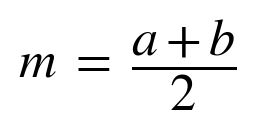
| Density | Between rationals a and b lies their average ( a + b )/2 . Distance between them: | a − b | . |
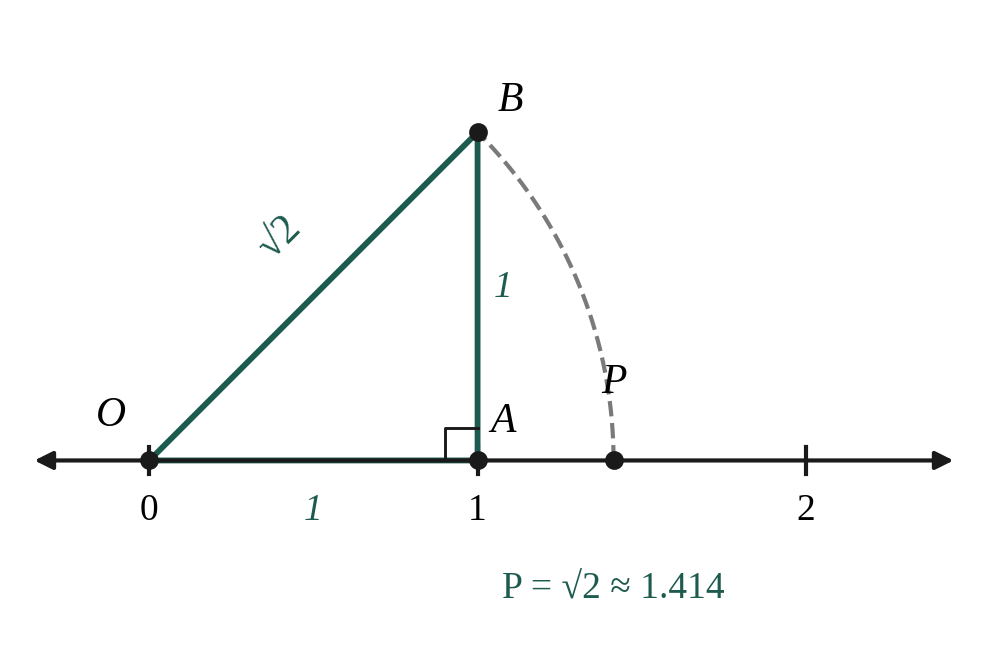
| Irrational numbers | Cannot be written as p / q : for example √2, √3, π. Proved by contradiction. |
| Real numbers R | Rational and irrational numbers together: every point of the number line. |
| Decimals | Rational: terminating or repeating. Irrational: non-terminating and non-repeating. |
| Terminating test | In lowest terms p / q terminates when q = 2 m × 5 n . |
| Repeating to p / q | Multiply by 10 k ( k = length of the repeating block) and subtract. |
Lebombo bone (~35,000 years ago): 29 deliberate notches, probably a lunar-phase tally.
Ishango bone (~20,000 BCE, near the Nile): columns of marks grouping the primes 11, 13, 17, 19 and doublings.
Lothal and Harappa: standard cubic weights and measures supported long-distance trade.
Vedic and Buddhist texts named large powers of 10: up to 1012 (parārdha) and, in the Lalitavistara, up to 1053 (tallakṣaṇa).
Babylonians and Mayans used a blank or a mark as a placeholder; Indian mathematicians treated zero as a number that can be added, subtracted and multiplied.
The Bakhśhālī manuscript (early centuries CE) shows the earliest zero as a solid dot, the bindu.
Śhūnyatā, the philosophical idea of emptiness, helped Āryabhaṭa and Brahmagupta accept zero.
| Product | Sign | Example |
|---|---|---|
| positive × positive | positive | 3 × 4 = 12 |
| negative × negative | positive | (−3) × (−4) = 12 |
| positive × negative | negative | 3 × (−4) = −12 |
Why (−)(−) = +: a negative is a debt; taking away 4 debts of ₹3 leaves you ₹12 richer, so (−3) × (−4) = +12.
Use brackets around a negative number inside an expression, and add or subtract signed numbers carefully.
Every integer is rational: n = n/1.
A rational number has many forms: −1/3 = −2/6 = −10/30. The standard form is lowest terms, with gcd(p, q) = 1.
Absolute value |x| is the distance of x from 0 on the number line. The distance between a and b is |a − b|.
Density: between any two rational numbers there is always another, namely their average. So there are infinitely many in between.
Proof by contradiction: assume the opposite, reach an impossible conclusion, and so reject the assumption.
Āryabhaṭa (499 CE) gave the approximation π ≈ 3927/1250 = 3.1416 and called it āsanna, “approximate”.
Mādhava (14th century, Kerala) found an infinite series for π, since an irrational number needs an unending process:
0.101001000… never terminates and never repeats: irrational.
| Type | Decimal form | Example |
|---|---|---|
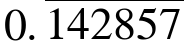
| Rational | Terminating or repeating block | 3/8 = 0.375; 1/7 = |
| Irrational | Non-terminating and non-repeating | √2 = 1.41421356…; π = 3.14159265… |
Terminating test: write p/q in lowest terms. The decimal terminates exactly when q = 2m × 5n (no other prime factors).
Cyclic number: 1/7 = . Multiplying 142857 by 1 to 6 only rotates its digits, for example 142857 × 2 = 285714.
Repeating to fraction: let x be the decimal; multiply by 10k where k is the number of repeating digits; subtract to remove the repeating part.
Express as p/q.
Express as p/q.
Express as p/q.
* Express as p/q.
| No. | Identity |
|---|---|
| 1 | ( x + y ) 2 = x 2 + 2 x y + y 2 |
| 2 | ( x − y ) 2 = x 2 − 2 x y + y 2 |
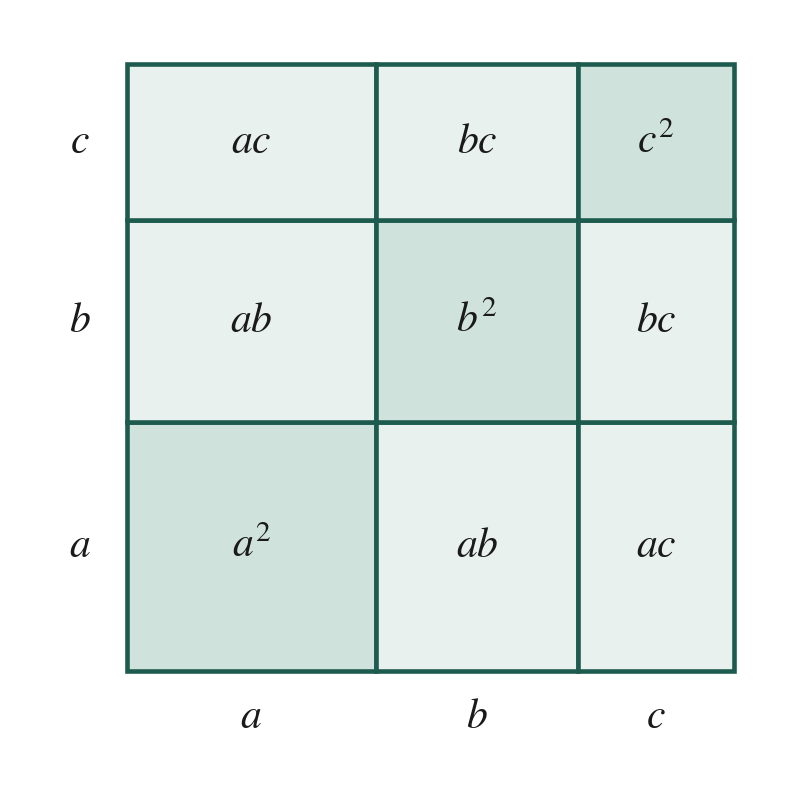
| 3 | ( x + y + z ) 2 = x 2 + y 2 + z 2 + 2 x y + 2 y z + 2 z x |
| 4 | ( x + y )( x − y ) = x 2 − y 2 |
| 5 | ( x + a )( x + b ) = x 2 + ( a + b ) x + a b |
| 6 | ( a x + b )( c x + d ) = a c x 2 + ( a d + b c ) x + b d |
| 7 | ( x + y ) 3 = x 3 + 3 x 2 y + 3 x y 2 + y 3 |
| 8 | ( x − y ) 3 = x 3 − 3 x 2 y + 3 x y 2 − y 3 |
| 9 | x 3 + y 3 = ( x + y )( x 2 − x y + y 2 ) |
| 10 | x 3 − y 3 = ( x − y )( x 2 + x y + y 2 ) |
| 11 | x 3 + y 3 + z 3 − 3 x y z = ( x + y + z )( x 2 + y 2 + z 2 − x y − y z − z x ) |
Equation: x2 − 1 = 24 holds only for x = 5 and x = −5.
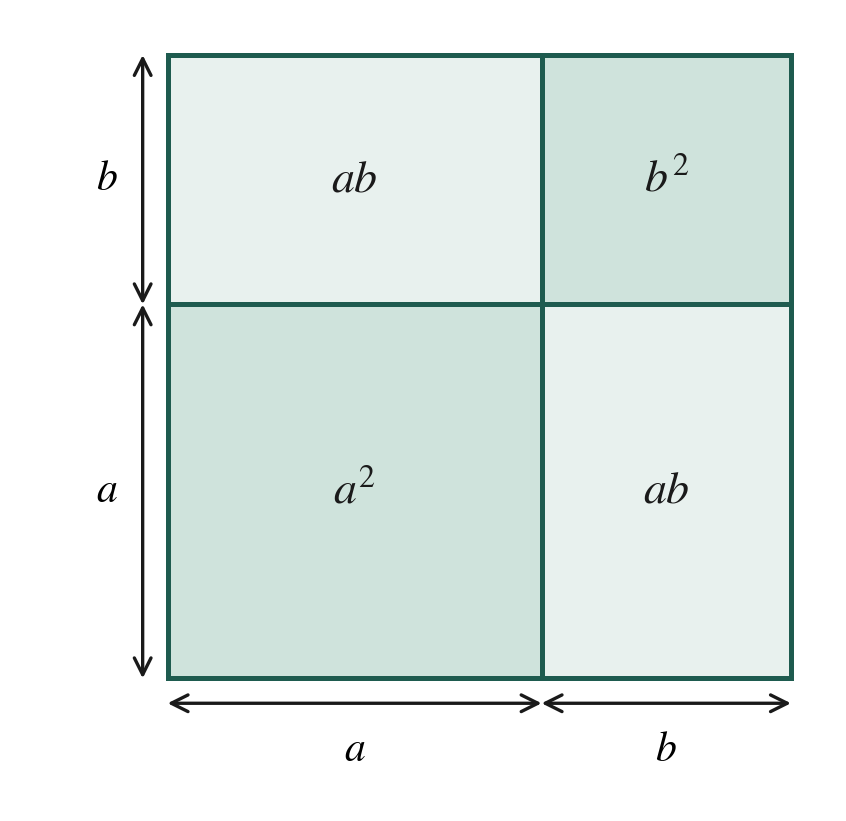
Identity: (a + b)2 = a2 + 2ab + b2 holds for all values of a and b: positive, negative, zero or rational.
Identities can be read both ways: expand when you multiply, factorise when you reverse.
Area of the big square = (a + b)2.
The same area = a2 + ab + ab + b2 = a2 + 2ab + b2.
Mental squares: split a number into a round number and a small one.
To factorise a trinomial, first take out any common factor.
Then check whether two terms are perfect squares and the middle term is twice the product of their roots.
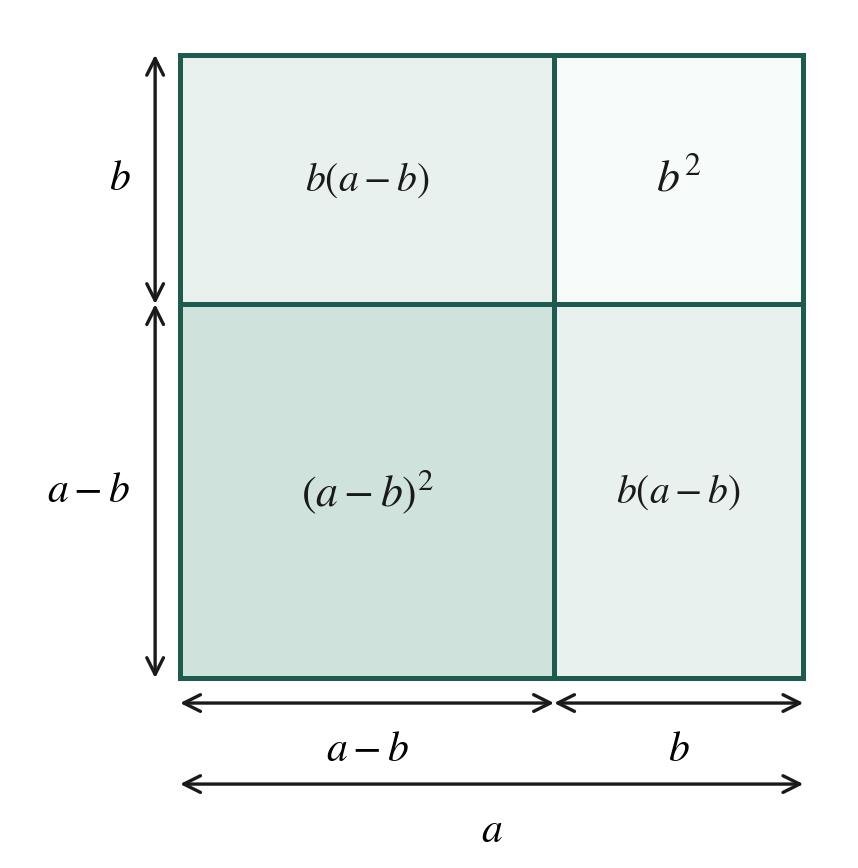
For the first identity put d = b + c, expand (a + d)2, then expand d2.
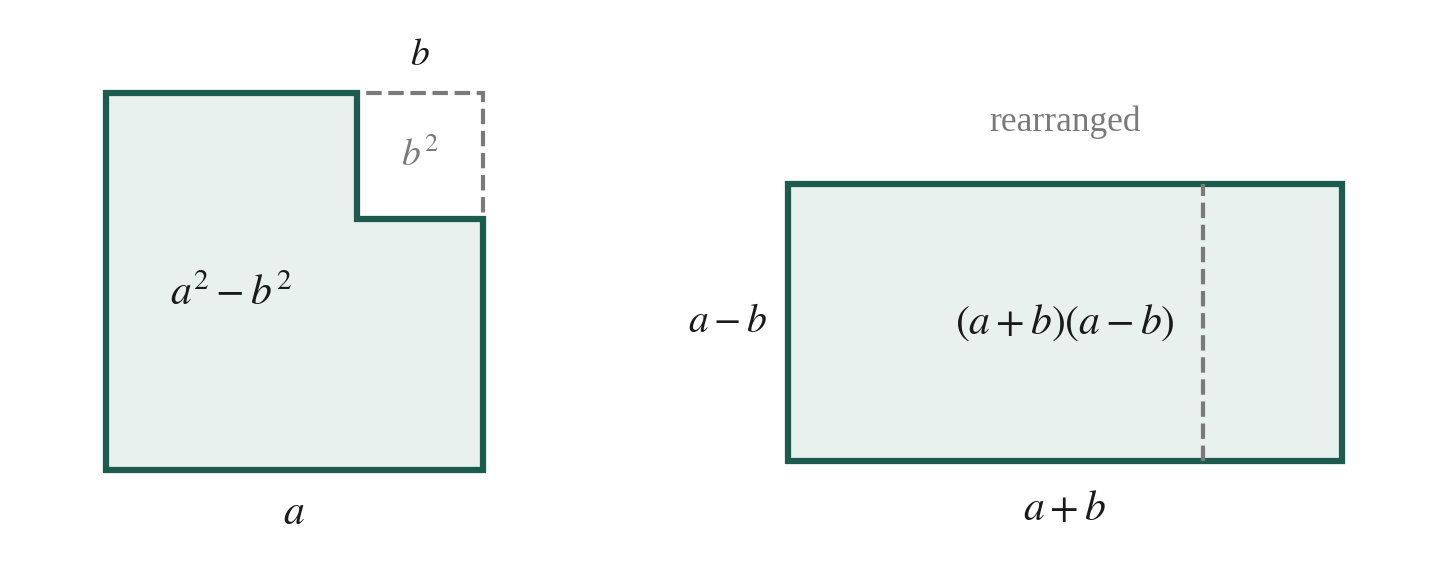
Śhrīdharāchārya’s method (750 CE): from a2 − b2 = (a + b)(a − b) we get N2 = (N + b)(N − b) + b2. Choose b so that N + b or N − b is a round number.
Keep the sign with each term when a term is negative: (3x − 2y + 4z)2 has b = −2y.
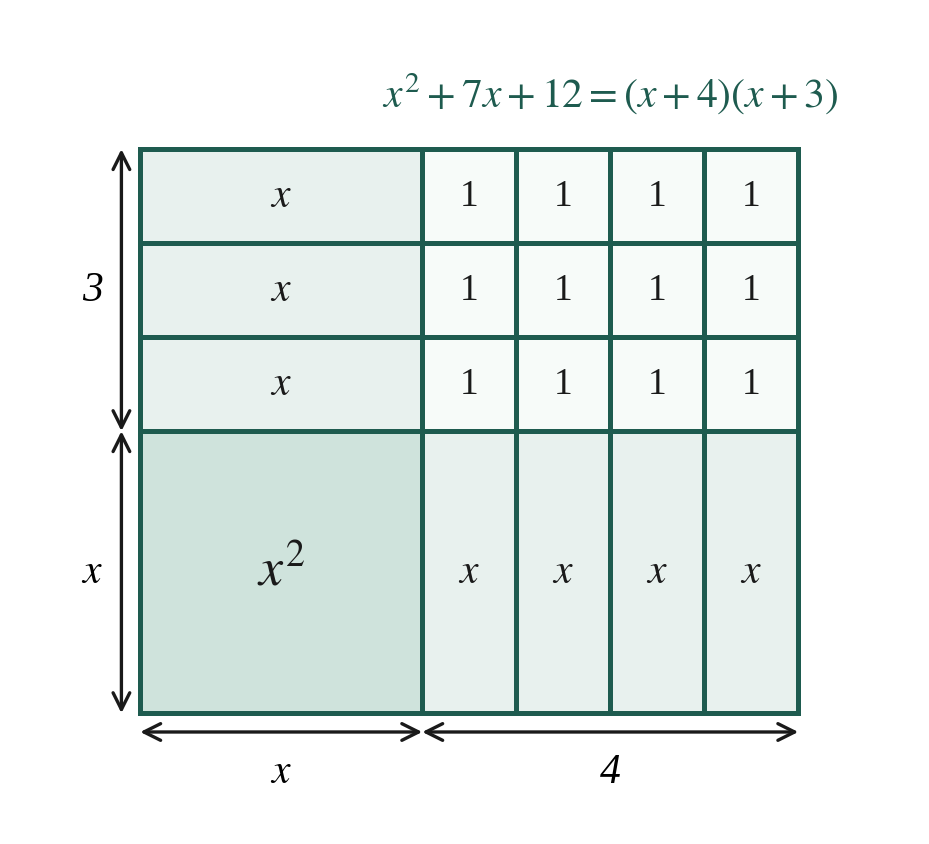
To factorise x2 + Bx + C, find two numbers a and b with sum B and product C.
Then split the middle term and group in pairs.
For px2 + qx + r, find two numbers whose product is pr and whose sum is q.
Signs: if C > 0 both numbers have the sign of B; if C < 0 they have opposite signs.
A cube of edge a + b splits into cubes a3 and b3 and six cuboids: three of a2b and three of ab2.
In x2 − xy + y2 and x2 + xy + y2 the middle sign is opposite to the sign in the bracket on the left for the sum of cubes, and the same for the difference of cubes.
If x + y + z = 0, then x3 + y3 + z3 = 3xyz.
| Idea | Statement |
|---|---|
| Circle, locus | All points at a fixed distance r from the centre. A locus is the set of points satisfying a condition. |
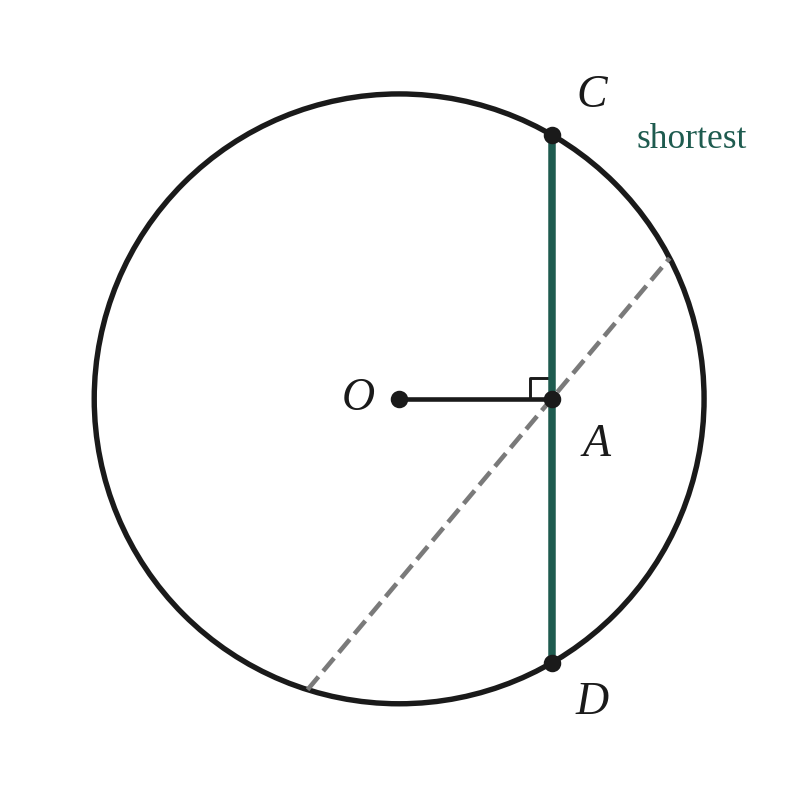
| Chord, diameter | Chord joins two points of the circle. Diameter = 2 r is the longest chord. |
| Symmetry | Rotation by any angle about the centre; reflection in every diameter. |
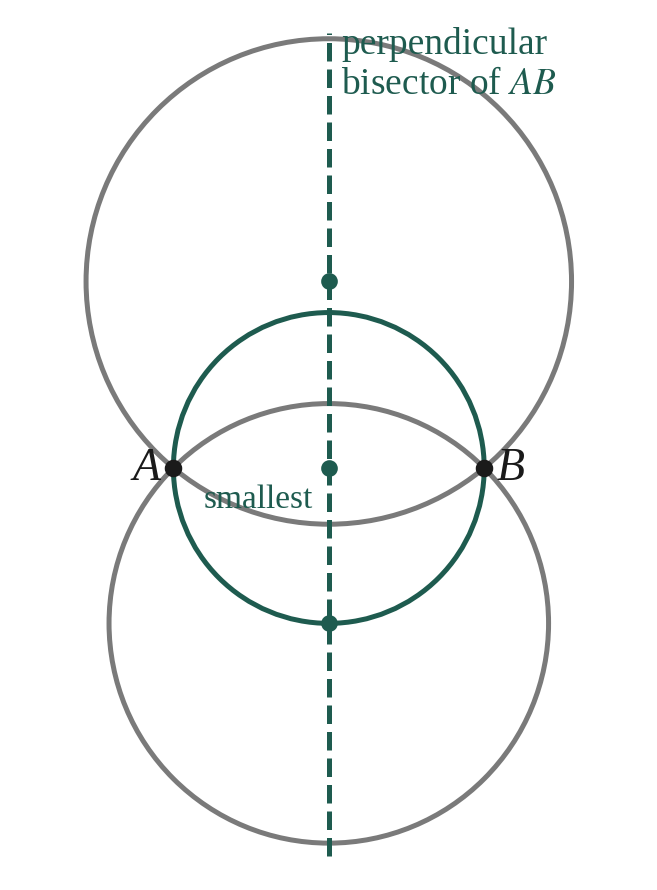
| Equidistant from A , B | The perpendicular bisector of A B . |
| Circles through points | 1 or 2 points: infinitely many. 3 collinear: none. 3 non-collinear: exactly one (circumcircle). |
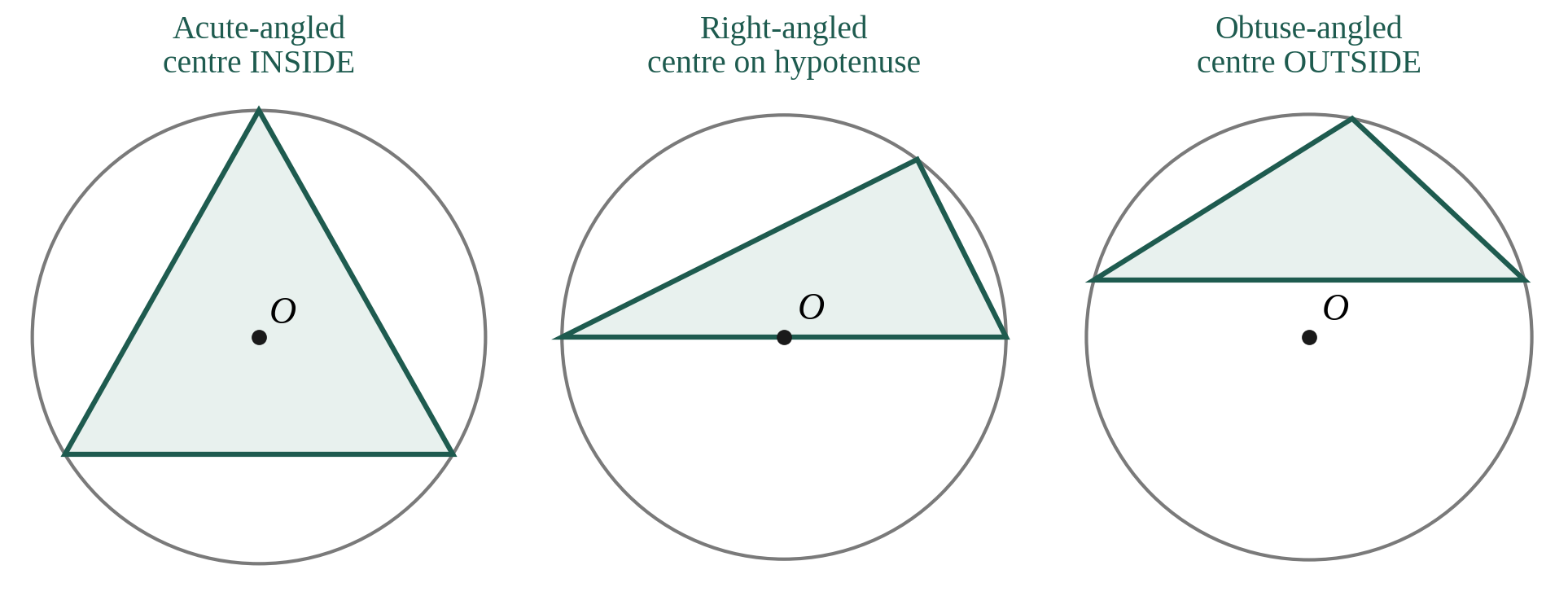
| Circumcentre | Meets the perpendicular bisectors. Acute: inside. Right: midpoint of hypotenuse. Obtuse: outside. |
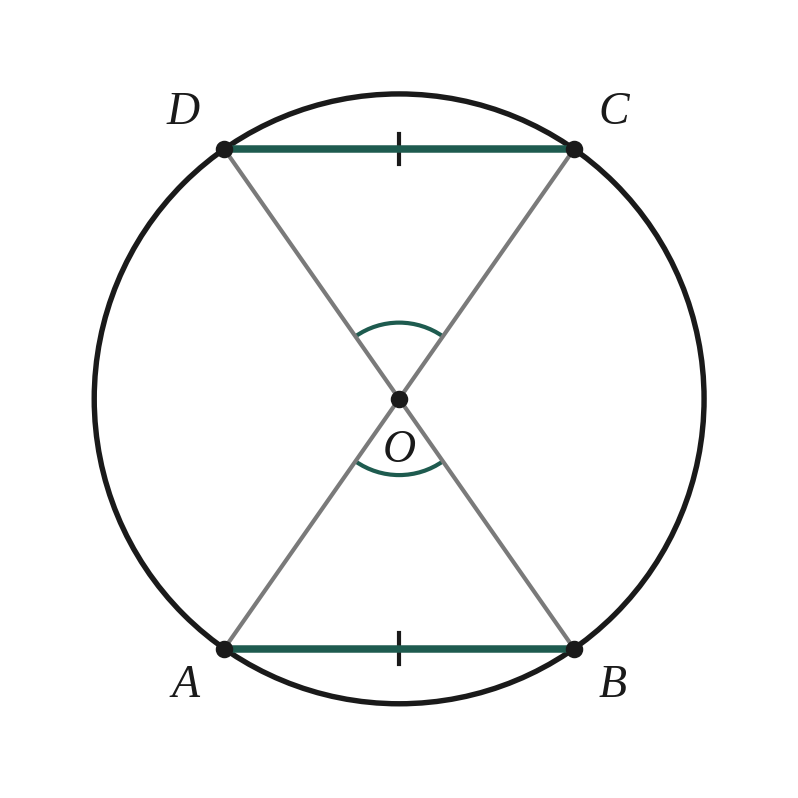
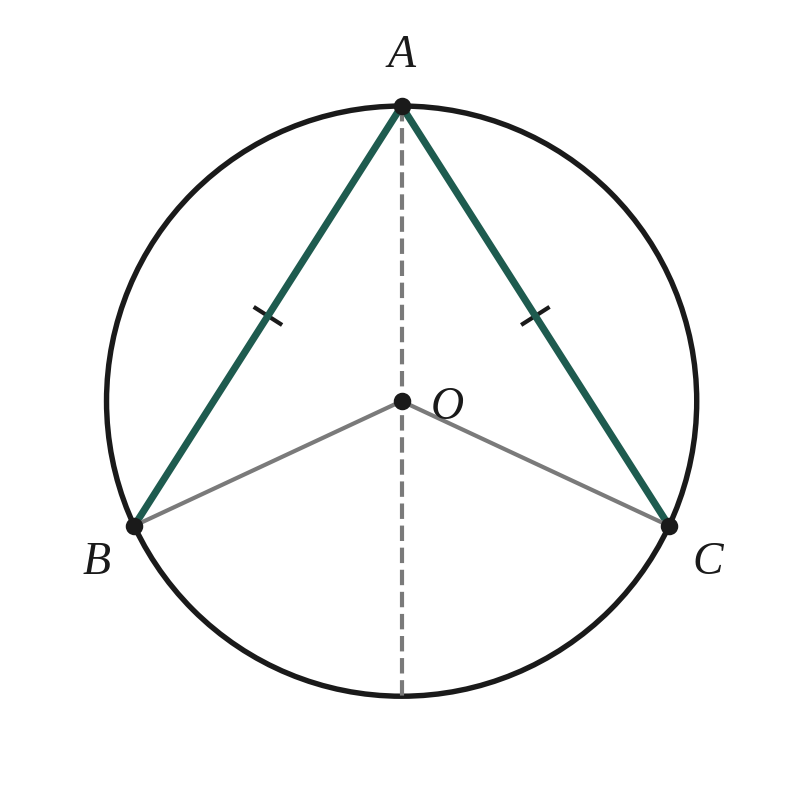
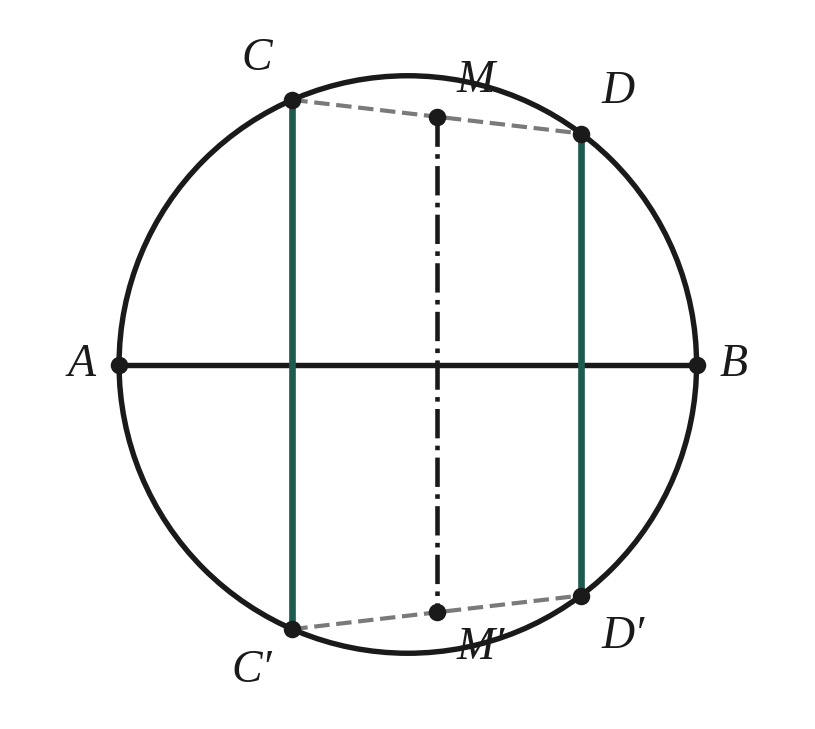
| Equal chords | Equal chords ⇔ equal angles at the centre ⇔ equal distances from the centre. |
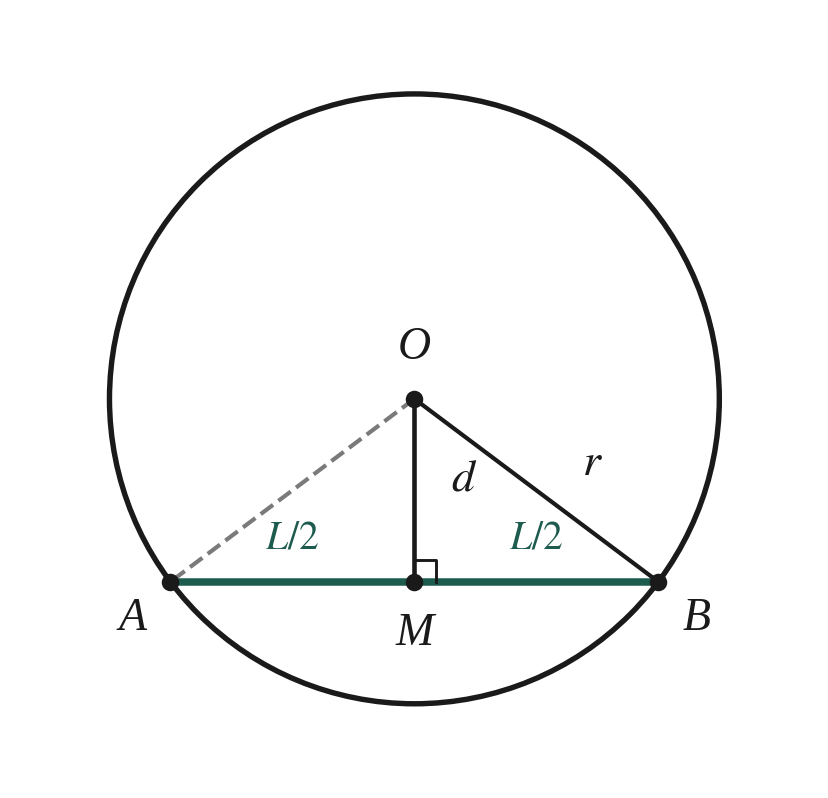
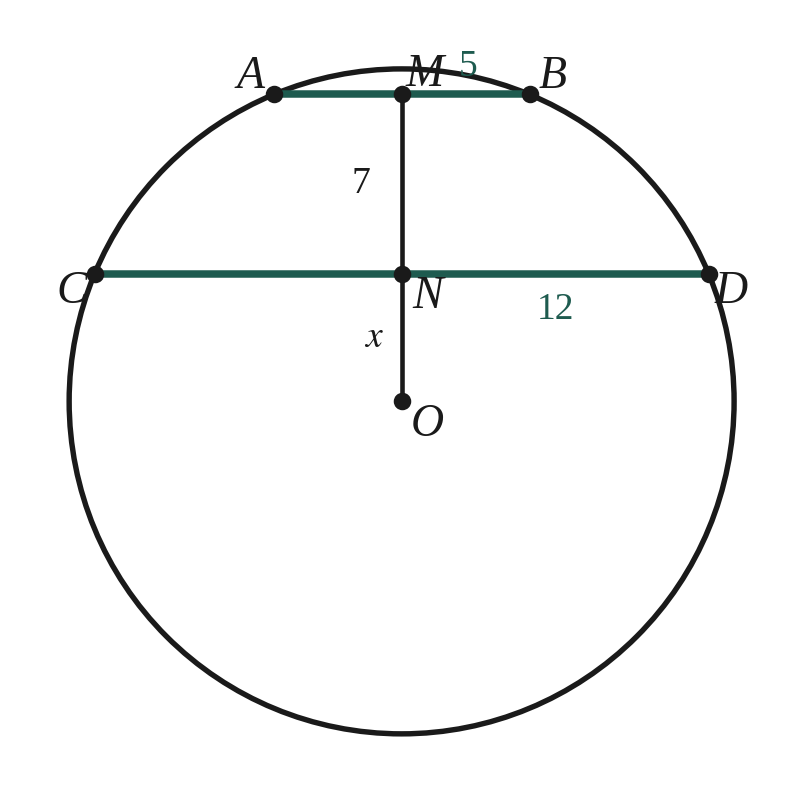
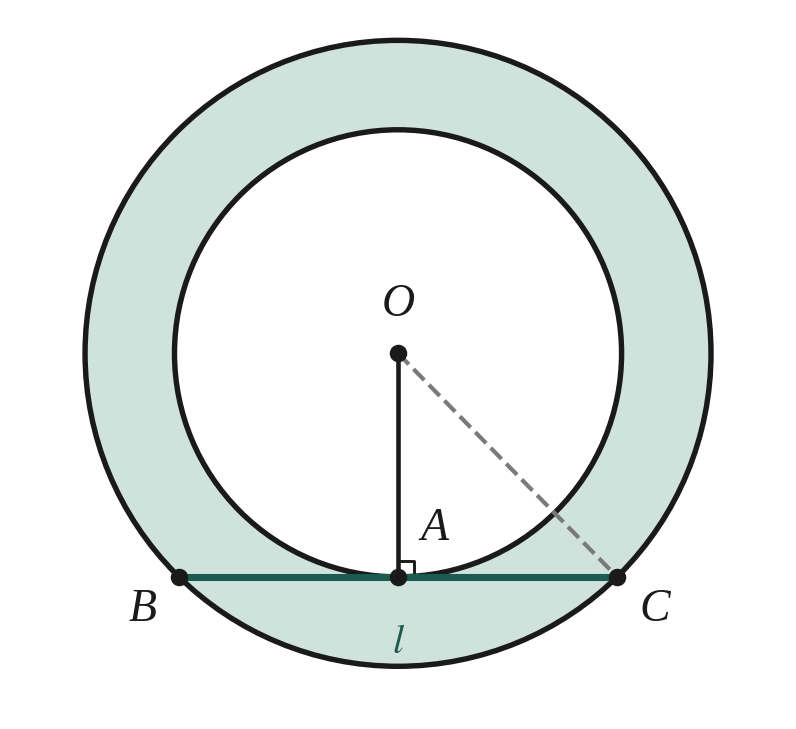
| Perpendicular to a chord | The perpendicular from the centre bisects the chord. L = 2√( r 2 − d 2 ) . |
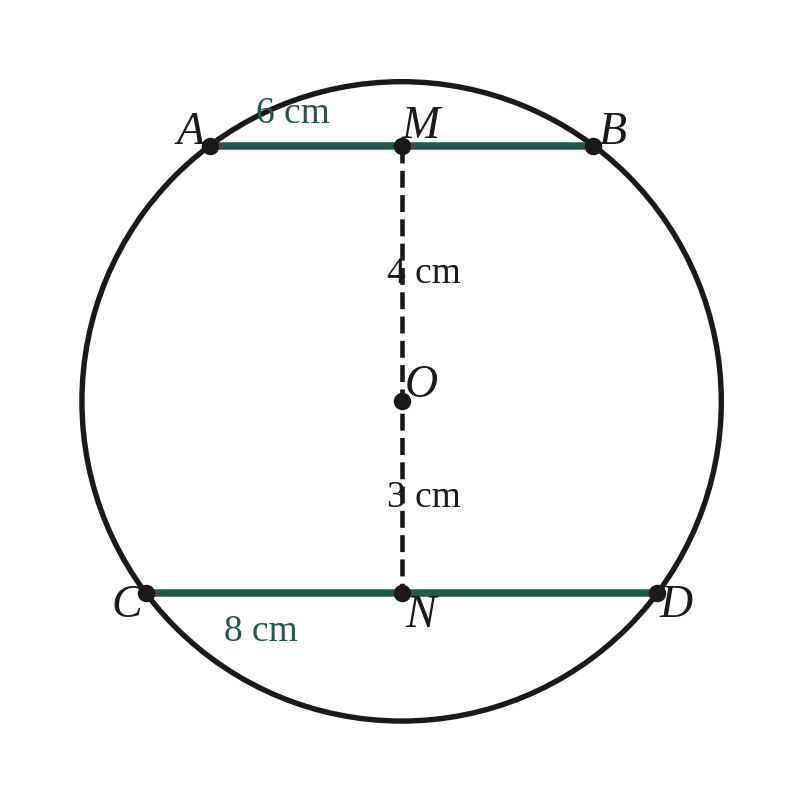
| Longer chord | Longer chord is closer to the centre. Diameter: d = 0 . |
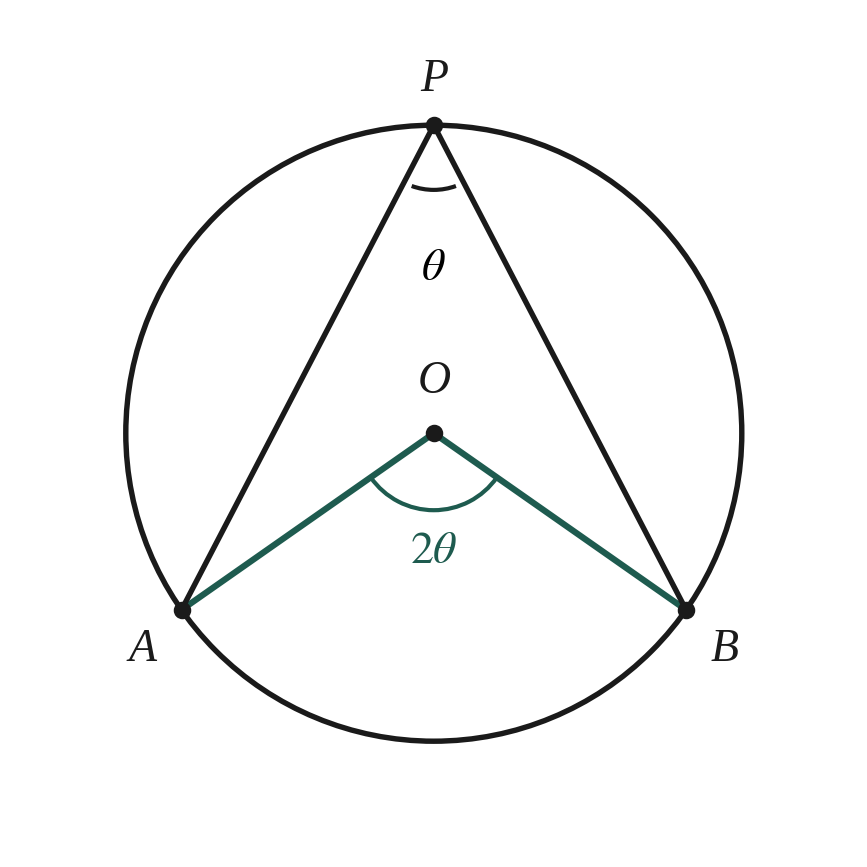
| Inscribed angle | Angle at the centre = 2 × angle at the circumference on the same arc. |
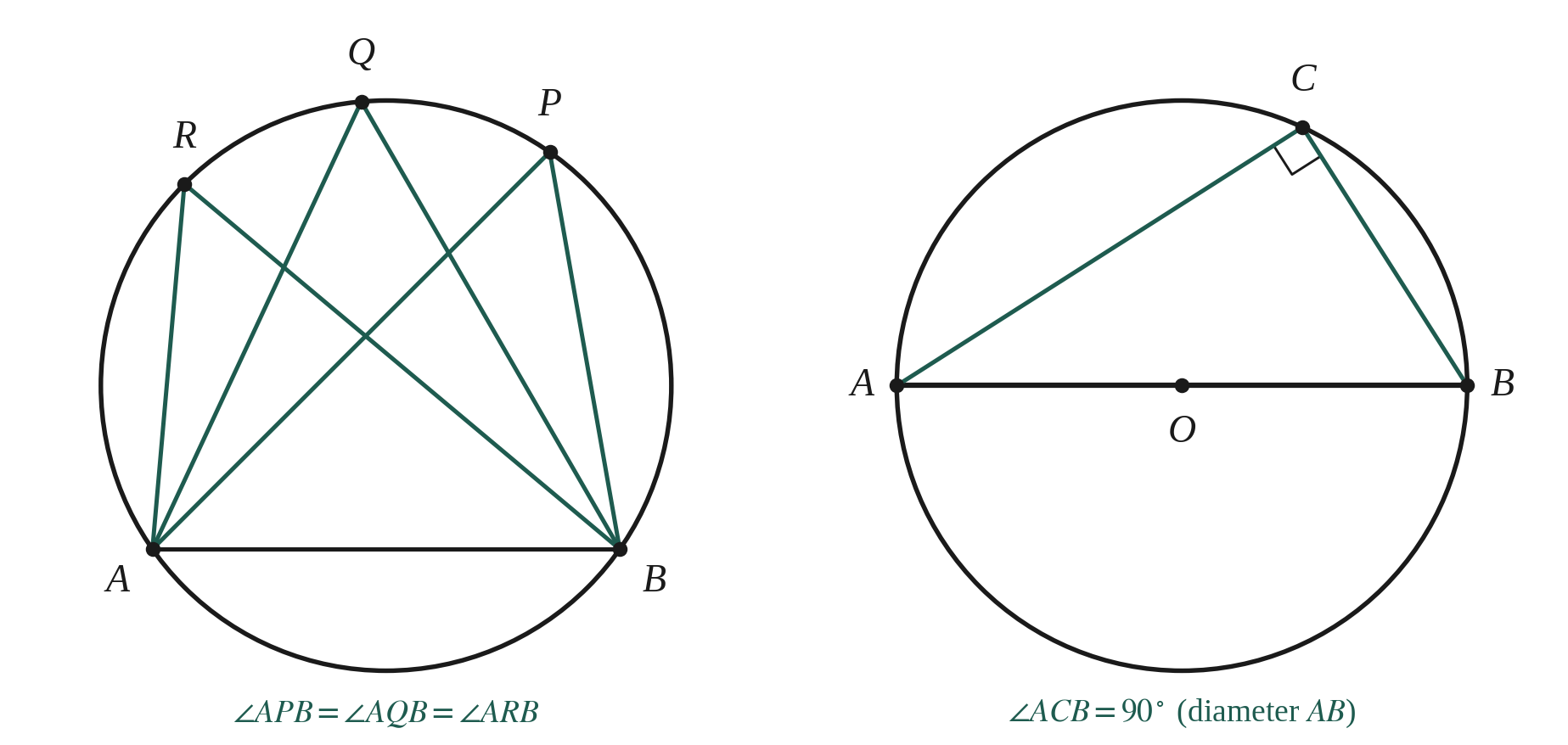
| Same segment, semicircle | Angles in the same segment are equal. Angle in a semicircle = 90° . |
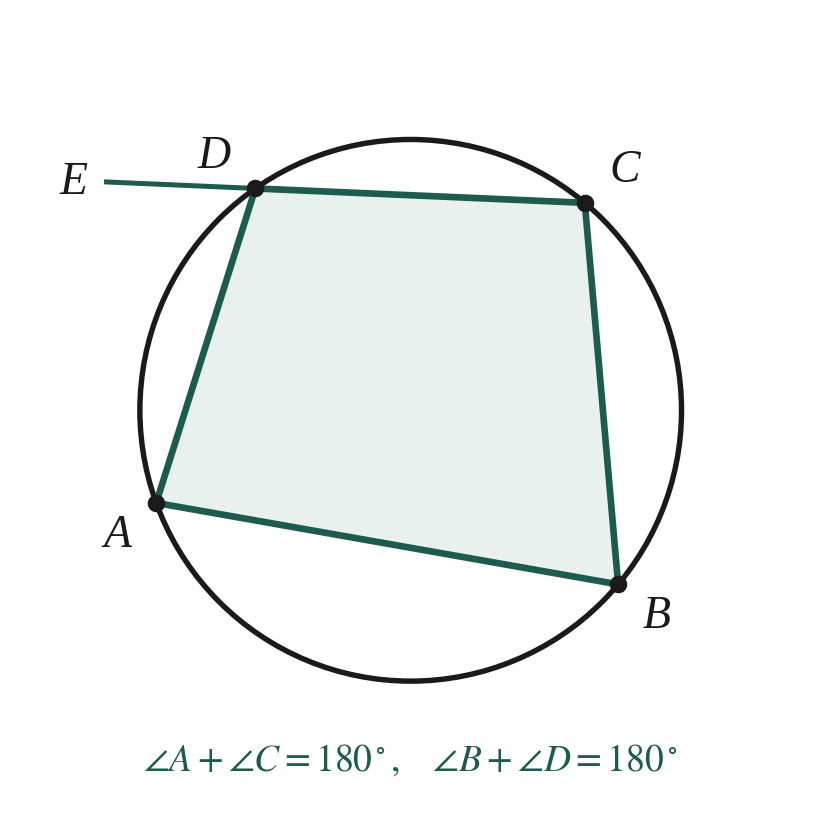
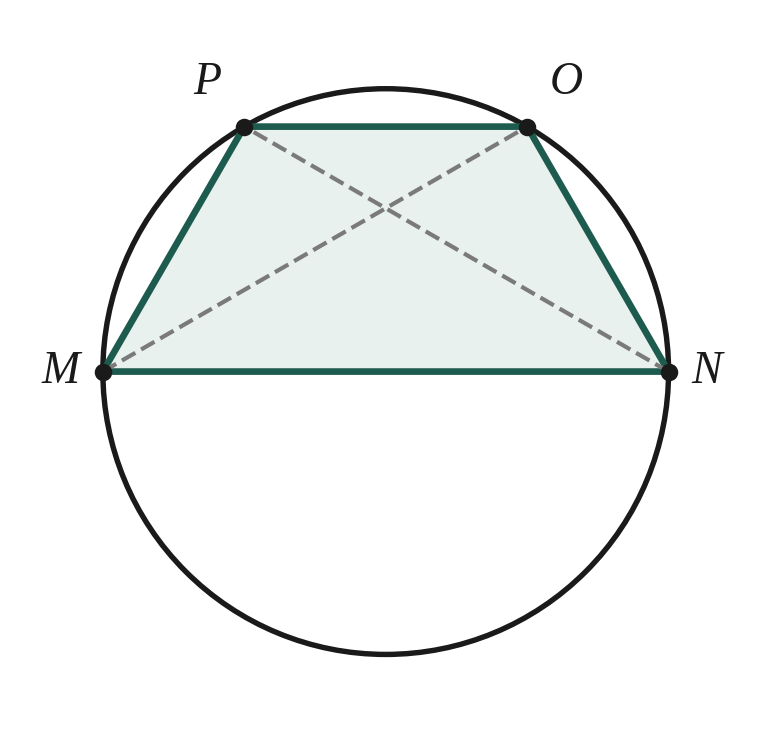
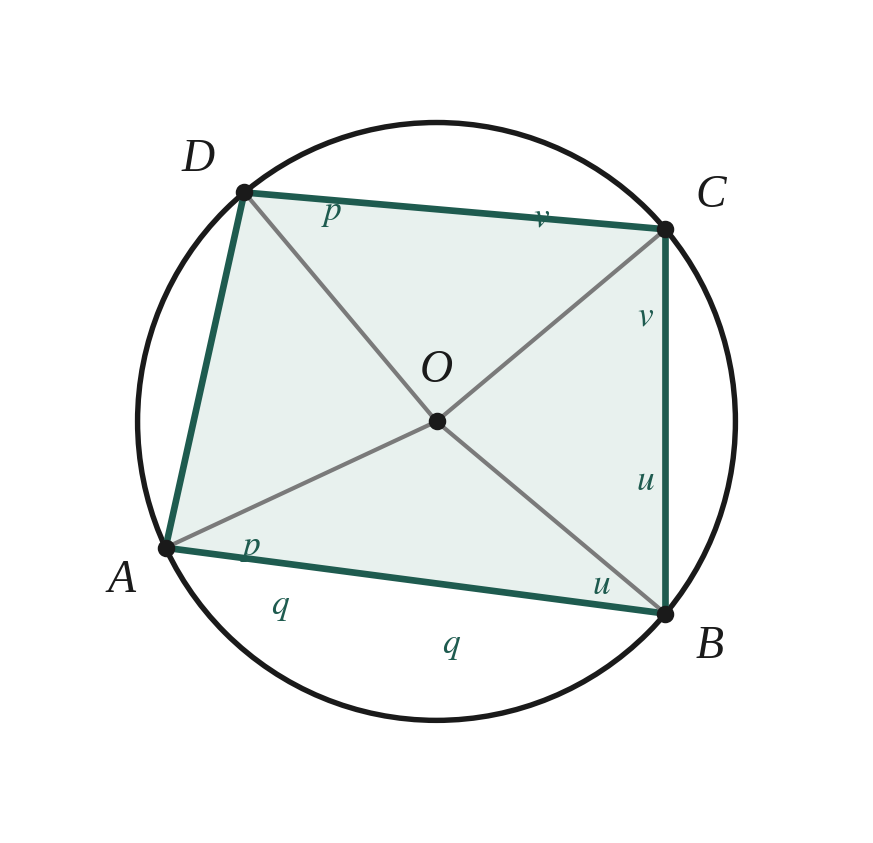
| Cyclic quadrilateral | Opposite angles sum to 180° (and the converse). Exterior angle = interior opposite angle. |
| Brahmagupta’s formula | Area of a cyclic quadrilateral = √(( s − a )( s − b )( s − c )( s − d )) , s = semi-perimeter. |
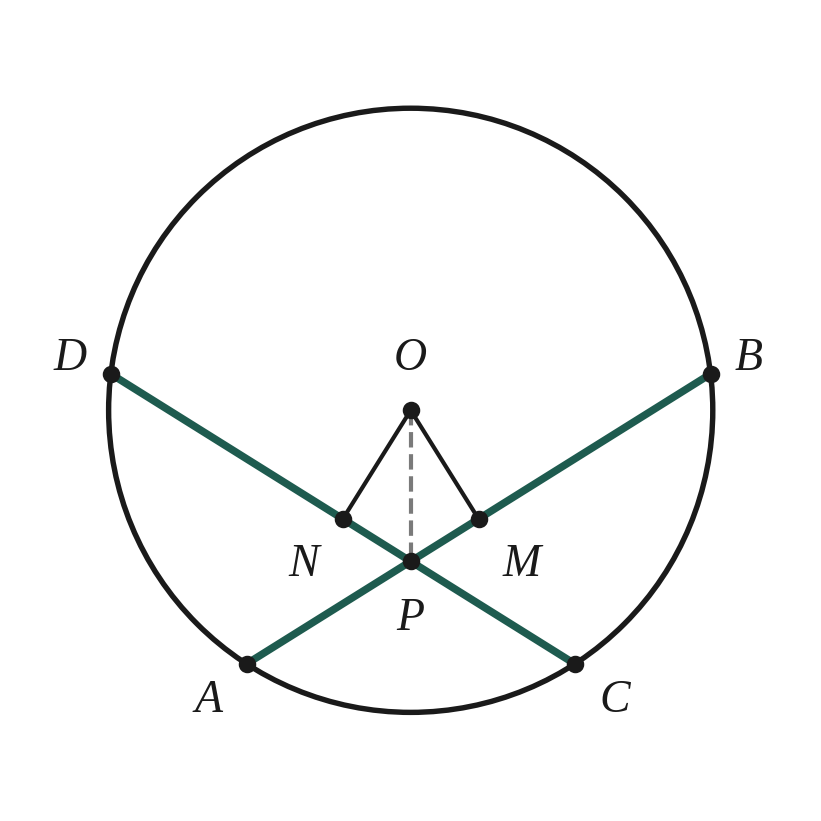
A chord joins two points of the circle. A chord through the centre is a diameter: d = 2r, the longest chord.
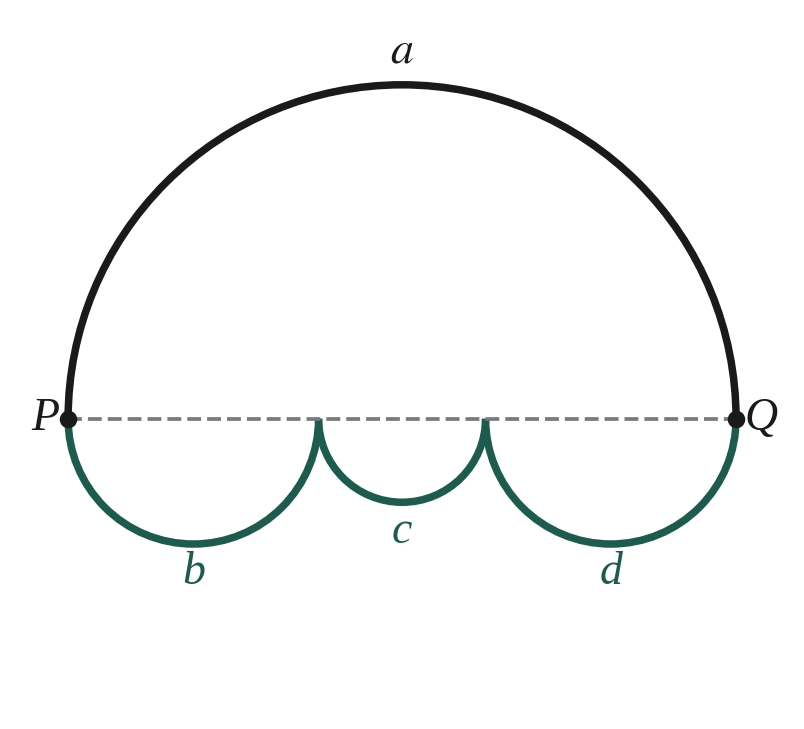
An arc is a connected part of the circle. A diameter cuts the circle into two semicircles.
All radii of a circle are equal. This is used in almost every proof.
So a circle has infinitely many lines of symmetry: every diameter.
A circle is determined by its centre and radius.
Through 1 point: infinitely many circles. Through 2 points A, B: infinitely many; their centres lie on the perpendicular bisector of AB.
The smallest circle through A and B has AB as diameter: radius = AB/2.
Through 3 collinear points: no circle, since the perpendicular bisectors are parallel and never meet.
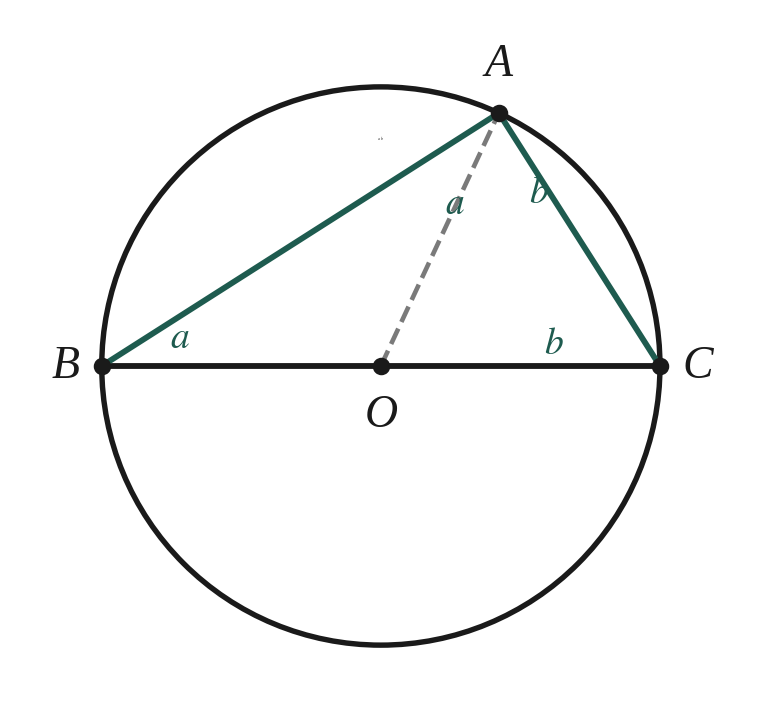
Right triangle: circumcentre is the midpoint of the hypotenuse, so circumradius = hypotenuse / 2.
Proof of Theorem 2 uses SSS congruence; proof of Theorem 3 uses SAS congruence.
A longer chord subtends a larger angle at the centre.
Angles at the circumference standing on the same arc are equal, wherever the point is on the major arc.
A diameter subtends 90° at every other point of the circle, because the central angle is 180°.
The angle on the minor arc side of the chord is 180° minus the angle on the major arc side.
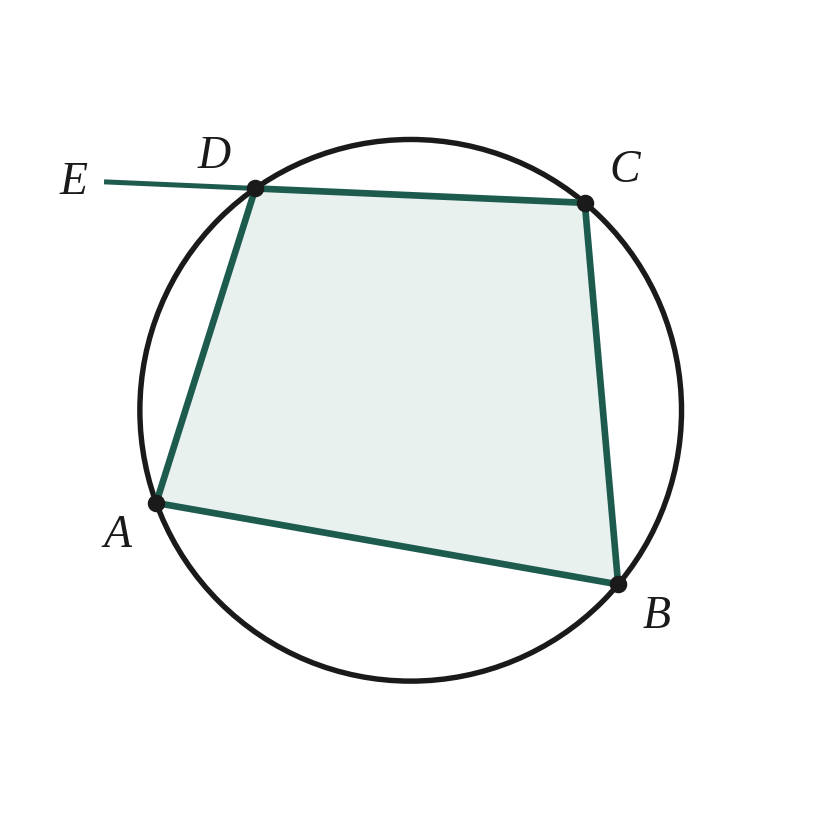
Exterior angle at D is ∠CDE: it equals the interior opposite angle ∠ABC.
The only parallelogram that can be cyclic is a rectangle.
Brahmagupta’s formula: for a cyclic quadrilateral with sides a, b, c, d and semi-perimeter s = (a + b + c + d)/2, area = √((s − a)(s − b)(s − c)(s − d)).
| Idea | Formula |
|---|---|
| Perimeter | Square 4 a . Rectangle 2( a + b ) . Equilateral triangle 3 a . |
| Circumference | C = π d = 2π r . Use π ≈ 22/7 or 3.14 . π is irrational. |
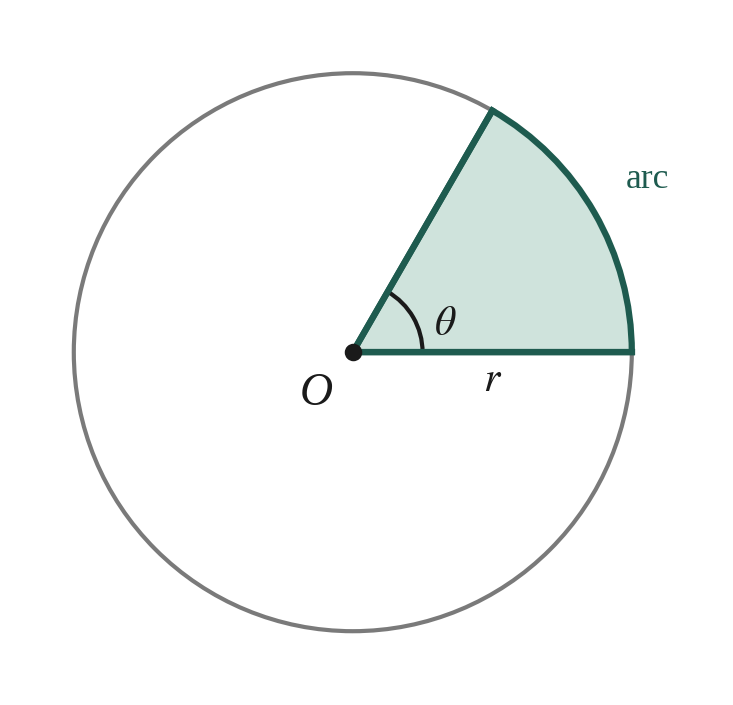
| Arc length | 2π r × θ/360° . |
| Lane stagger | 2π w for lane width w over one full lap. |
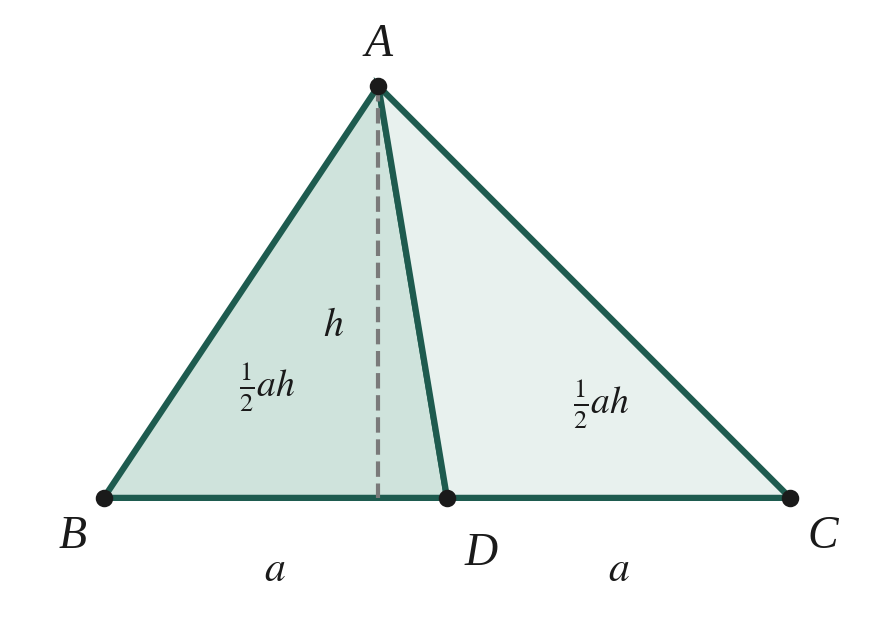
| Parallelogram, triangle | Parallelogram = b h . Triangle = ½ b h . A median halves the area. |
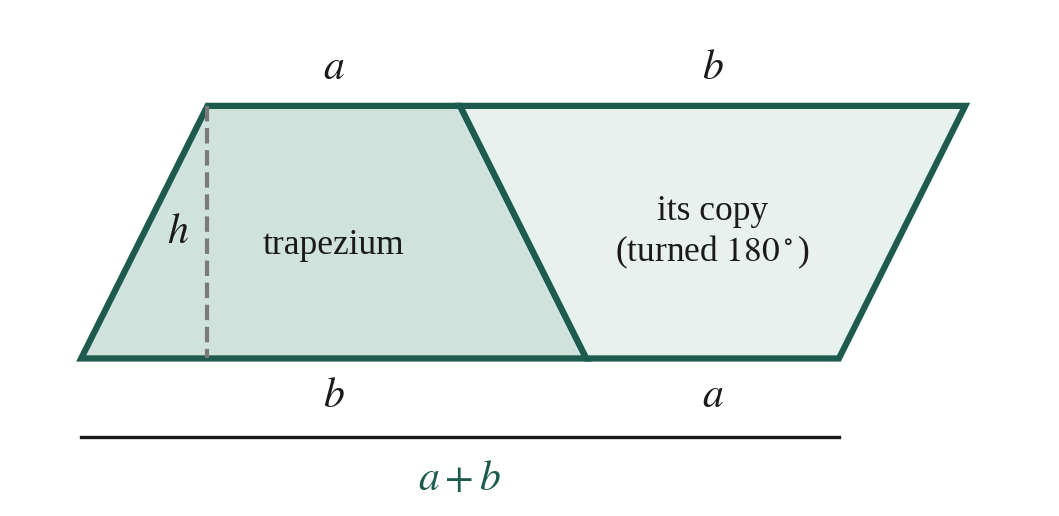
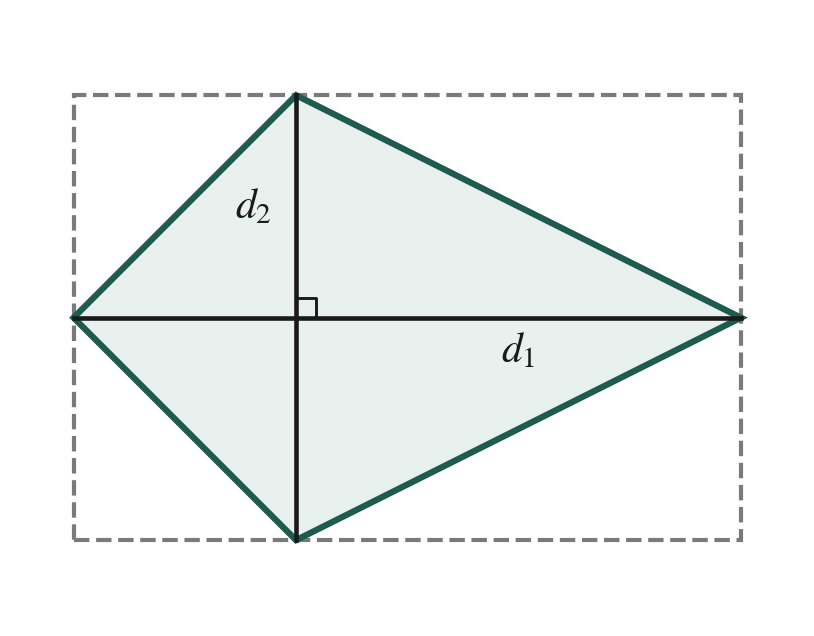
| Trapezium, kite, rhombus | Trapezium = ½( a + b ) h . Kite and rhombus = ½ d 1 d 2 . |
| Heron’s formula | √( s ( s − a )( s − b )( s − c )) , s = ( a + b + c )/2 . |
| Brahmagupta’s formula | Cyclic quadrilateral: √(( s − a )( s − b )( s − c )( s − d )) , s = semi-perimeter. |
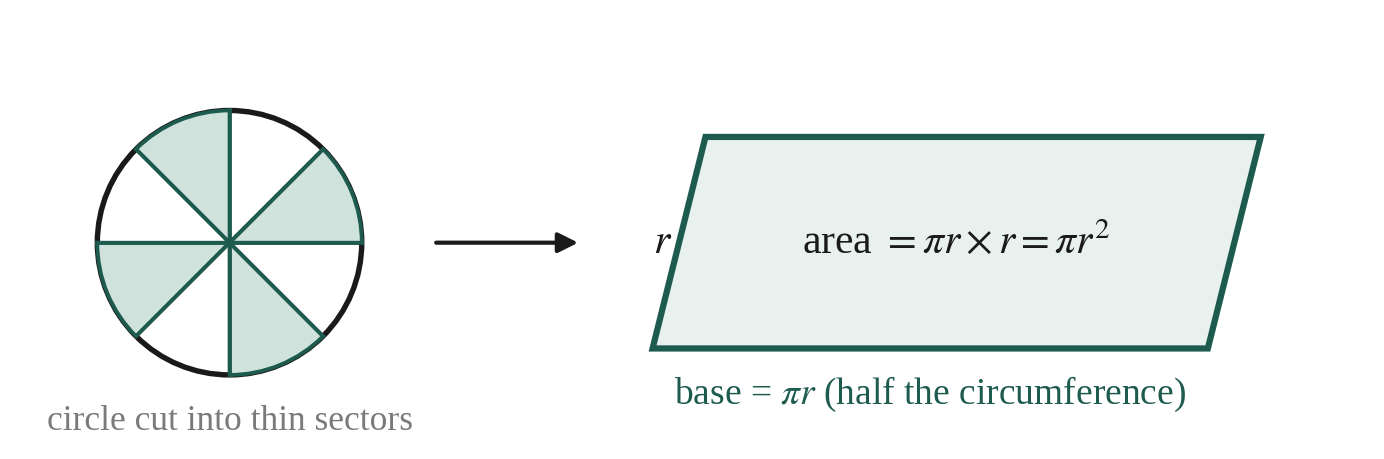
| Circle, sector | Circle π r 2 . Sector π r 2 × θ/360° . |
| Scaling | Lengths × k gives areas × k 2 . |
| Baudhāyana | a b = (( a + b )/2) 2 − (( a − b )/2) 2 . |
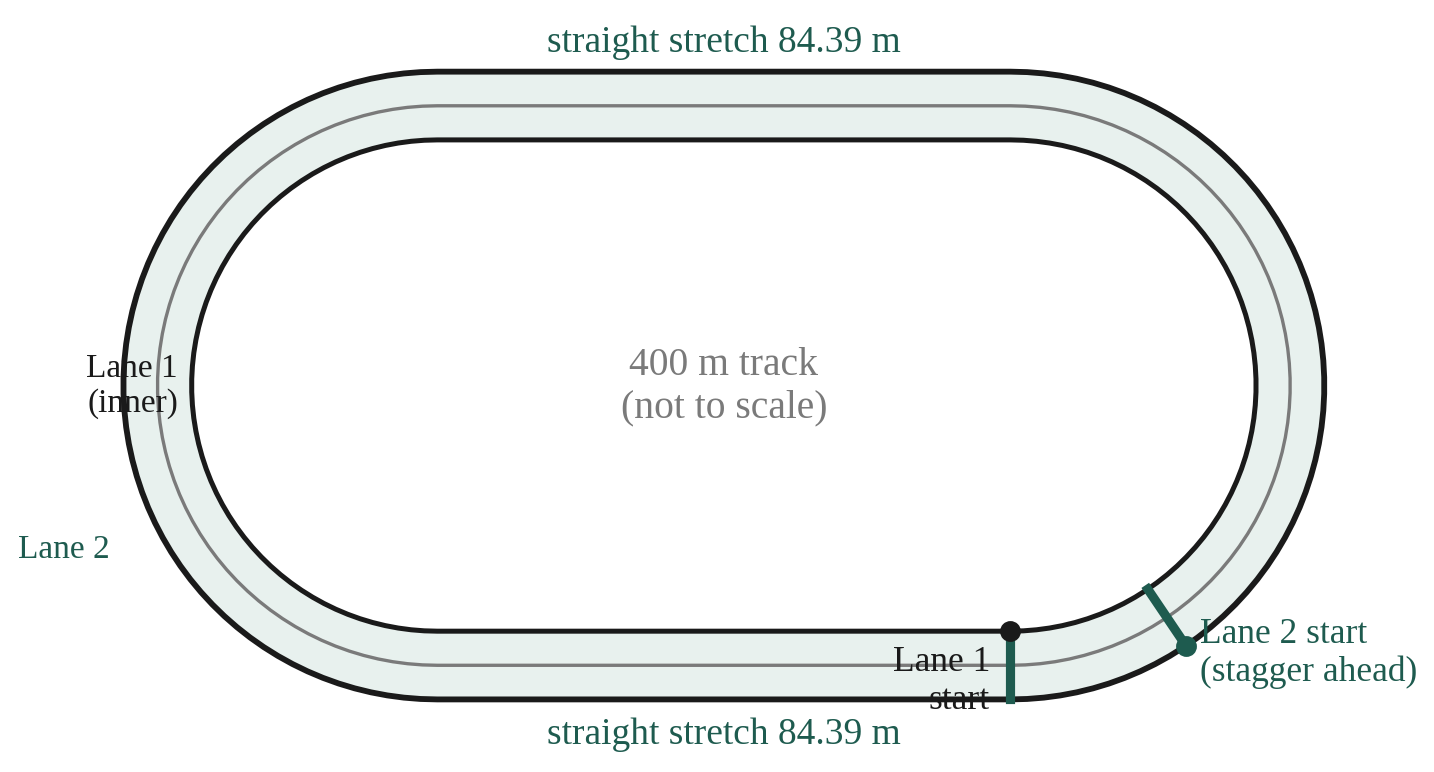
In a relay race the outer lanes start ahead of the inner lanes because the outer bends are longer. The gap between starting points is the stagger.
A 400 m track is two equal straight stretches and two semicircular bends that together make one full circle.
| Who and when | What they found |
|---|---|
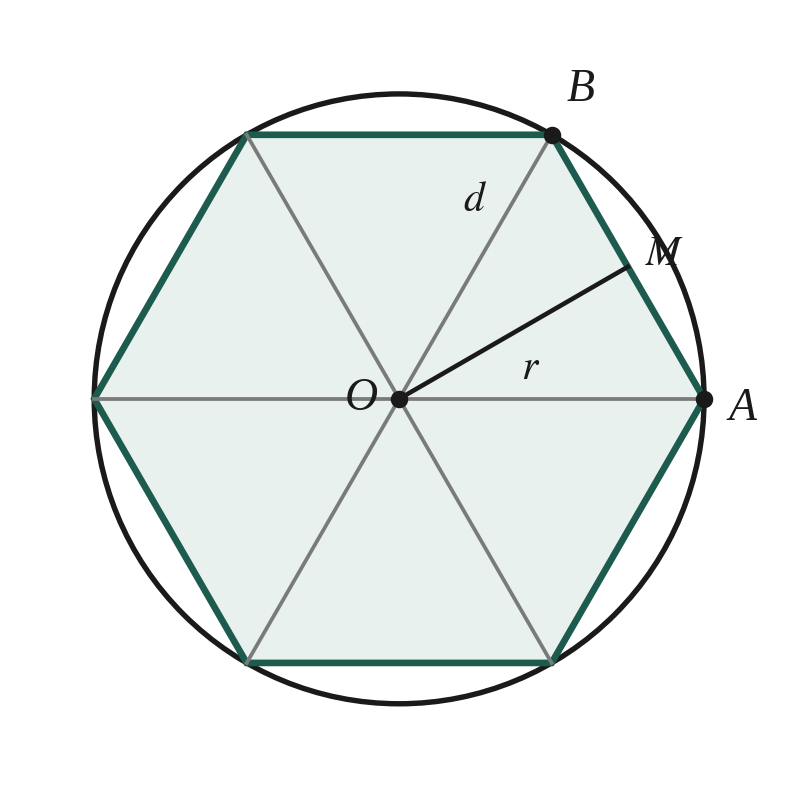
| Mesopotamia, c. 1900 BCE | Circle is longer than the inscribed hexagon; π ≈ 3 1/8 = 3.125 . |
| Archimedes, 250 BCE | Trapped π between 96-sided polygons: 3 10/71 < π < 3 1/7 (3.1408 to 3.1428). |
| Liu Hui (263 CE), Zu Chongzhi (480 CE) | Used polygons of 24,576 sides; π ≈ 355/113 = 3.1415929 , the best ratio known for about 800 years. |
| Āryabhaṭa, 499 CE | π ≈ 62832/20000 = 3.1416 , called āsanna (approximate). |
| Brahmagupta, 628 CE | π ≈ √10 ≈ 3.1623 . |
| Mādhava, c. 1400 CE | First exact infinite series for π , giving π correct to 11 decimal places. |
| Lambert, 1761 | Proved that π is irrational. |
22/7 is only a good approximation (3.142857…); π itself never terminates or repeats.
Use π = 22/7 when the radius is a multiple of 7, and 3.14 otherwise, unless the question says what to use.
Lane stagger. On a track with lane width w, the outer runner’s bends have radius r + w. Over one lap the extra distance is 2π(r + w) − 2πr = 2πw.
The stagger depends only on the lane width, not on the size of the track.
A trapezium is half of a parallelogram of base a + b and height h made from two copies of itself.
Diagonals of a kite or rhombus are perpendicular; the area is half the product of the diagonals.
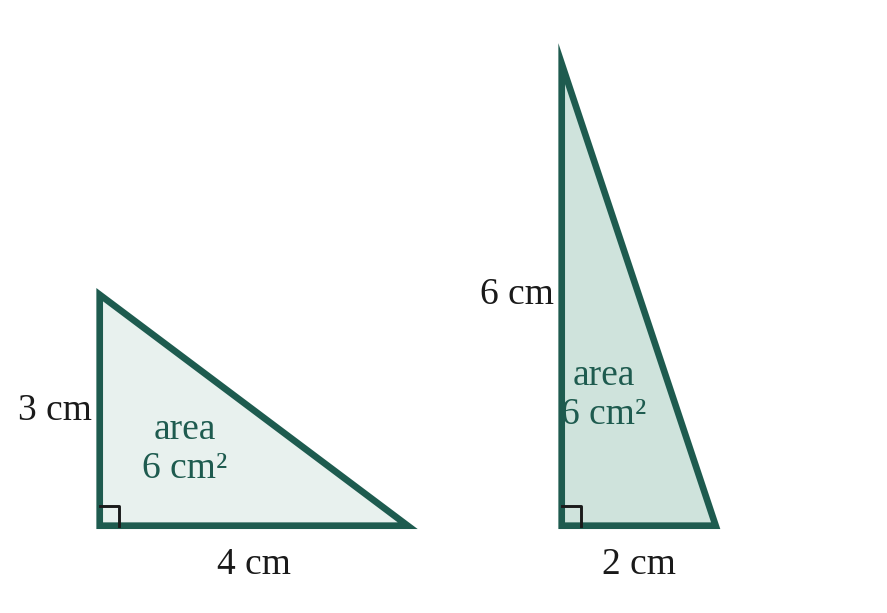
If every length is multiplied by k, the area is multiplied by k2.
Use Heron’s formula when the height is not given.
If the fourth side shrinks to d = 0, Brahmagupta’s formula becomes Heron’s formula, so Heron’s formula is a special case.
To find a height, equate Heron’s area with ½ × base × height.
Take a right triangle with hypotenuse (a + b)/2 and one leg (a − b)/2.
By the Baudhāyana–Pythagoras theorem its other leg is √(ab), the side of the required square.
| Idea | Statement |
|---|---|
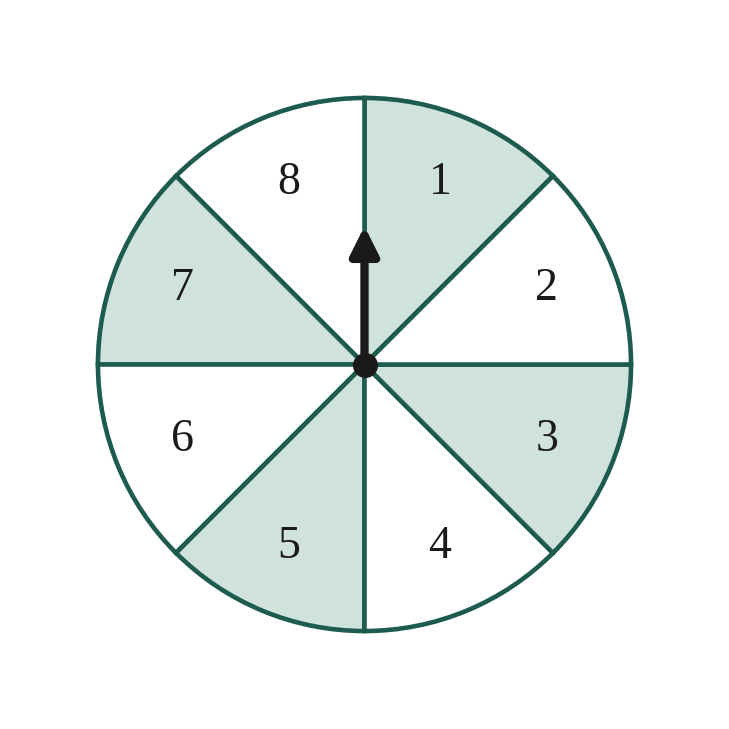
| Random experiment | Can be repeated under identical conditions; all outcomes are known; the result of one trial cannot be predicted. |
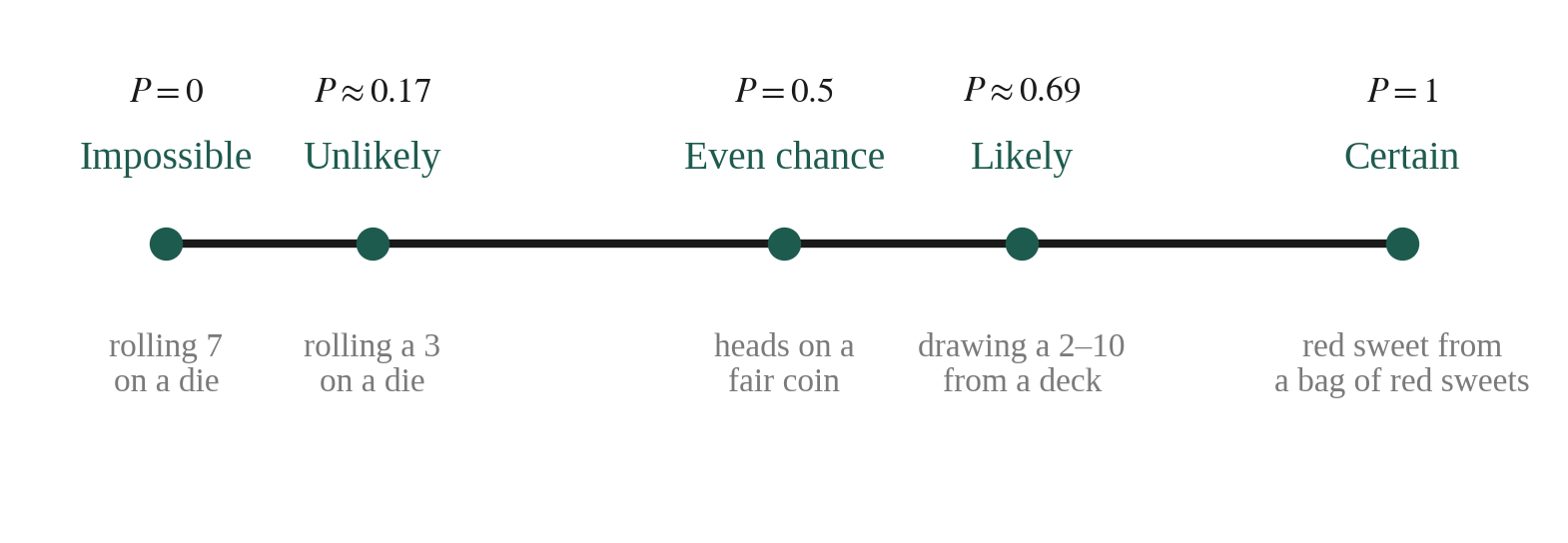
| Probability scale | 0 ≤ P ( E ) ≤ 1 . 0 impossible, 0.5 even chance, 1 certain. |
| Experimental probability | Times E occurred ÷ total trials (relative frequency). |
| Theoretical probability | n ( E )/ n ( S ) when all outcomes are equally likely. |
| Complement | P ( n o t E ) = 1 − P ( E ) . |
| Sample space, event | S is the set of all outcomes; an event E is a subset of S . |
| Counting rule | m ways followed by n ways give m × n combinations. |
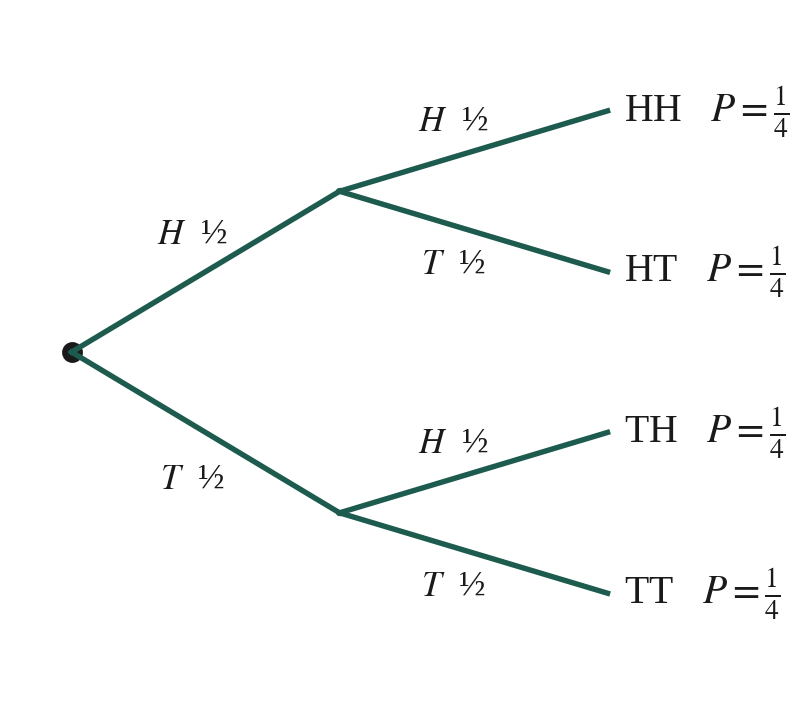
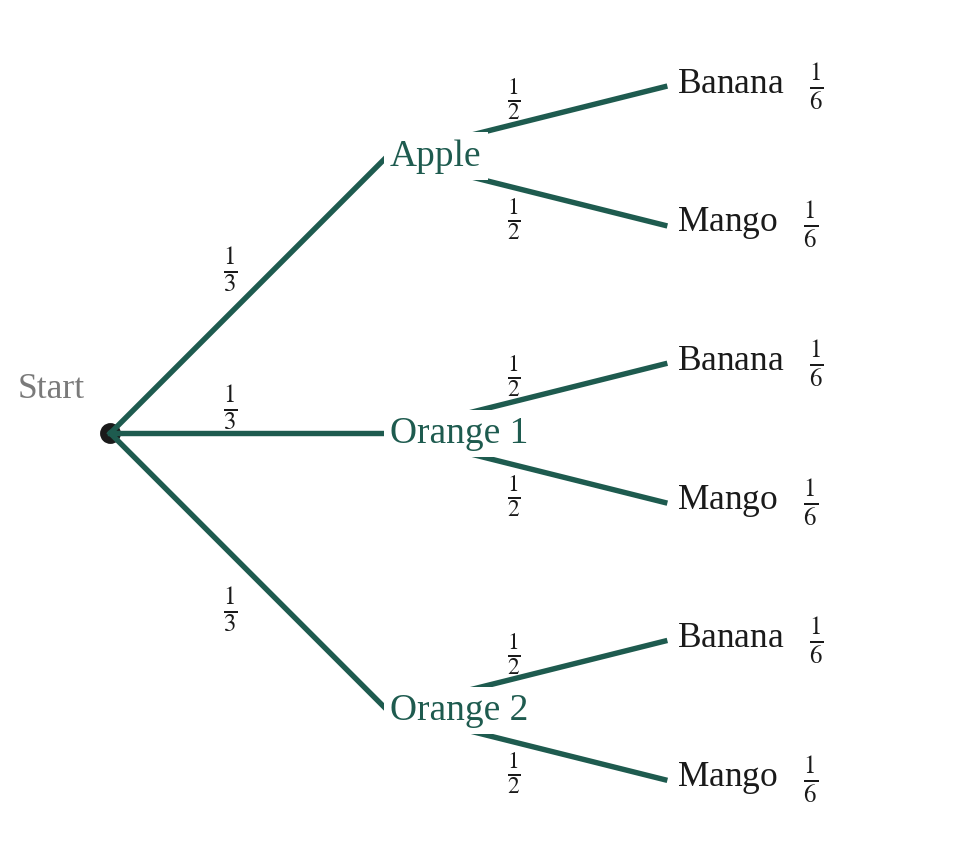
| Tree diagram | Multiply along a branch. Add the branches that make the event. |
| With, without replacement | With replacement the second stage is unchanged. Without replacement the counts, and so the probabilities, change. |
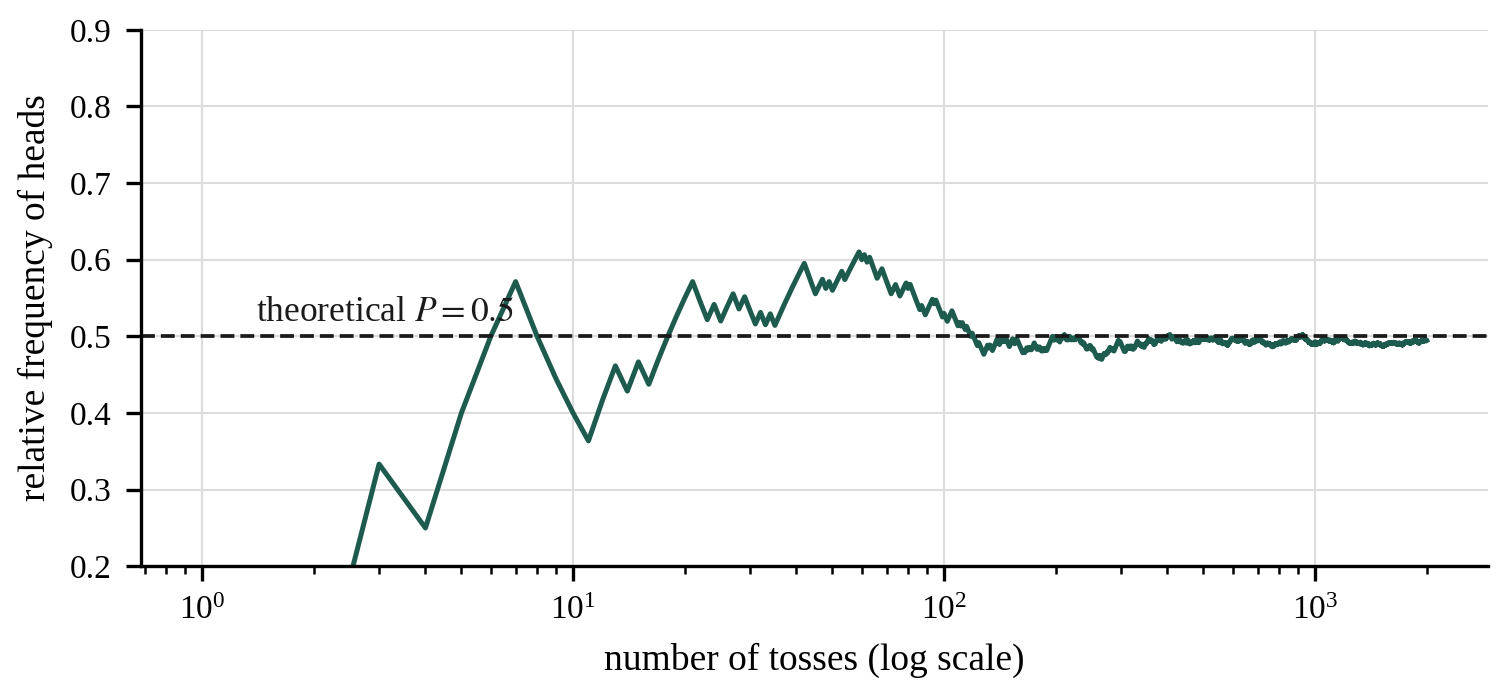
| Large numbers | More trials bring experimental probability close to theoretical probability. |
| Gambler’s fallacy | Past tosses do not change the next one: a fair coin has no memory. |
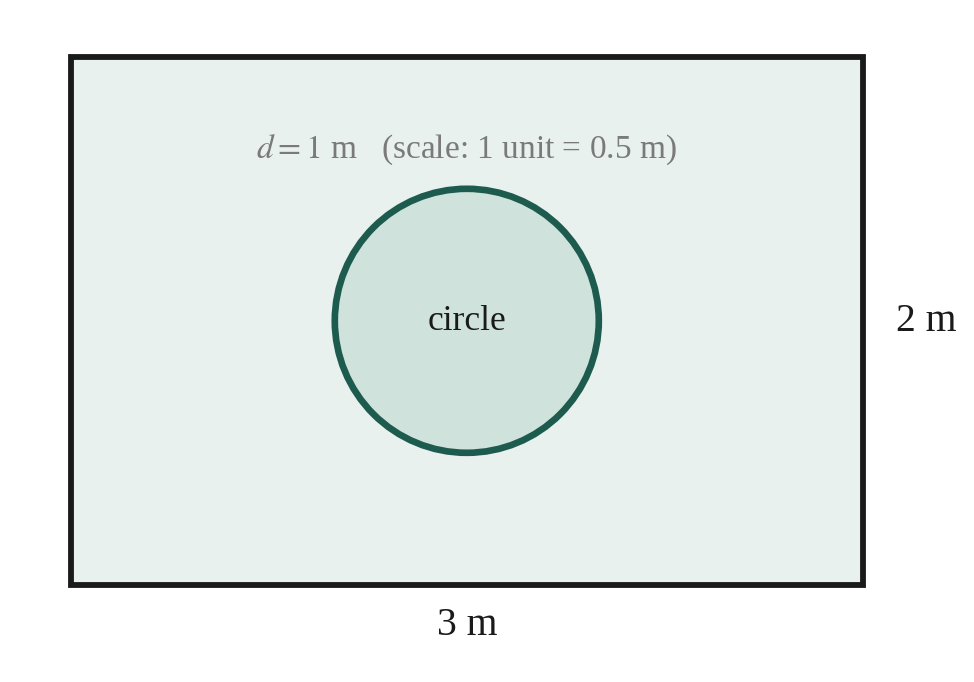
| Area probability | P = favourable area ÷ total area. |
Examples: tossing a coin, rolling a die, drawing a slip in a lucky draw.
Weather is random because thousands of small factors (humidity, wind, pressure, temperature) affect it, yet past records still let us assign useful probabilities.
It can change when the experiment is repeated.
A sample can be used to estimate for a larger population: expected number = P × total.
Outcomes are not equally likely when the chances differ: a bag with 3 red and 7 blue marbles gives P(red) = 3/10 and P(blue) = 7/10.
Snakes and Ladders began in ancient India as the teaching game Jñān Chaupaḍ: ladders stood for virtues and snakes for vices, with dice deciding the moves.
In 10 tosses the experimental probability may be far from 0.5; in 10,000 tosses it is very close.
Surveying a whole population is impractical, so a representative sample is used to estimate.
| Experiment | Sample space S | n ( S ) |
|---|---|---|
| One coin | {H, T} | 2 |
| One die | {1, 2, 3, 4, 5, 6} | 6 |
| Two coins | {HH, HT, TH, TT} | 4 |
| Three coins | {HHH, HHT, HTH, HTT, THH, THT, TTH, TTT} | 8 |
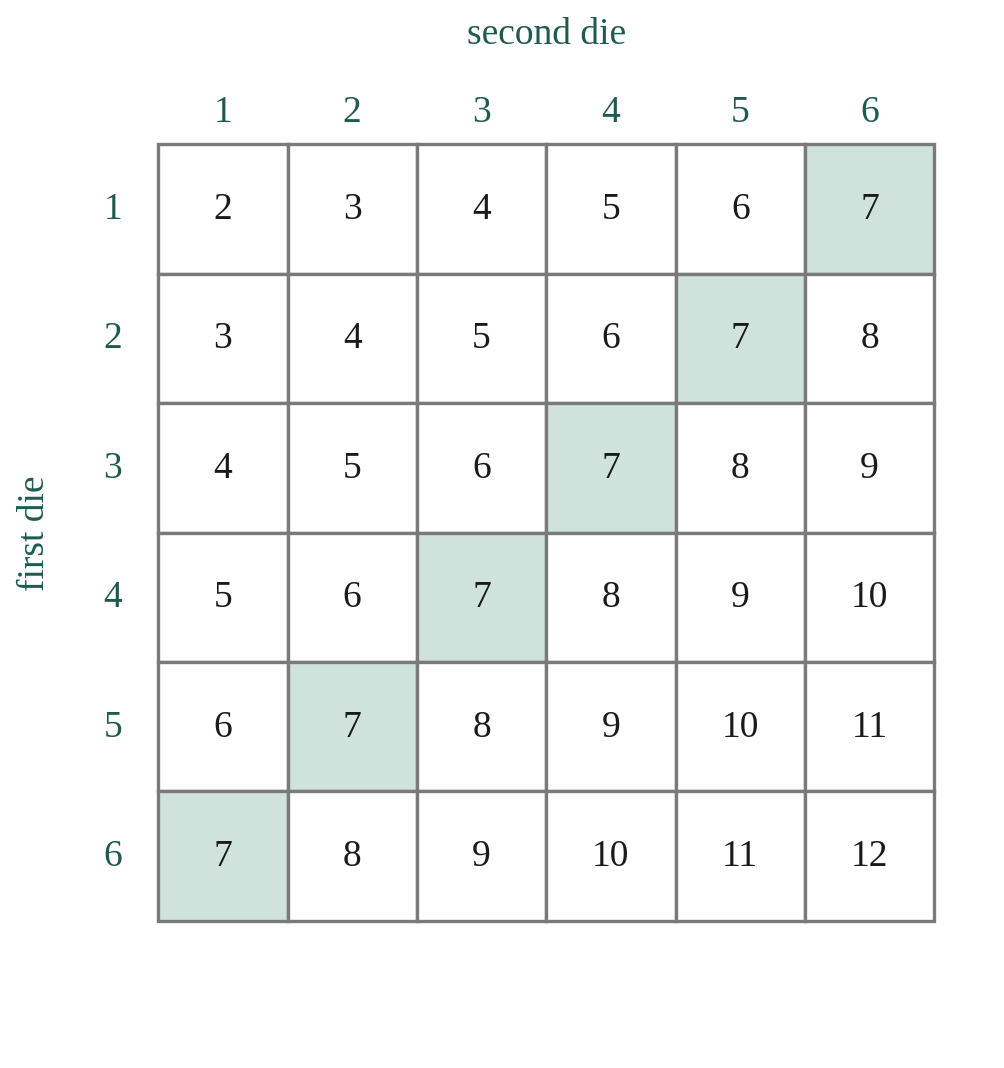
| Two dice | 36 ordered pairs | 36 |
With replacement: the second stage has the same probabilities as the first.
Without replacement: the item drawn first is not returned, so the totals and counts change for the second stage.
| Idea | Statement |
|---|---|
| Sequence | An ordered list of numbers t 1 , t 2 , t 3 , … . t n is the term at position n . |
| Explicit rule | Gives t n directly from n , for example t n = 2 n − 1 . |
| Recursive rule | Gives t n from earlier terms, for example t 1 = 1 , t n = t n−1 + 3 . |
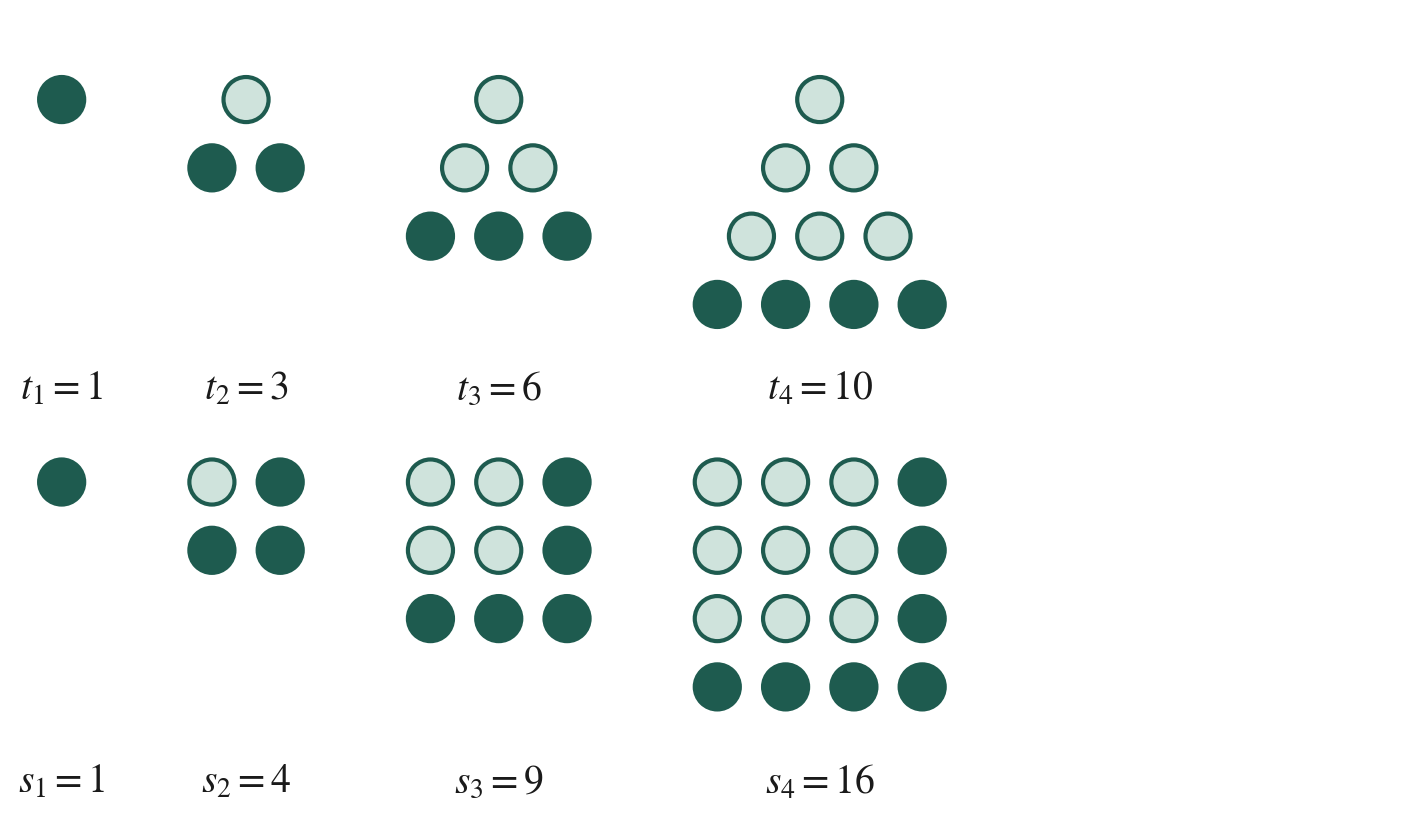
| Triangular, square numbers | t n = n ( n + 1)/2 and s n = n 2 = 1 + 3 + 5 + … + (2 n − 1) . |
| Virahānka–Fibonacci | V 1 = 1 , V 2 = 2 , V n = V n−1 + V n−2 : 1, 2, 3, 5, 8, 13, … |
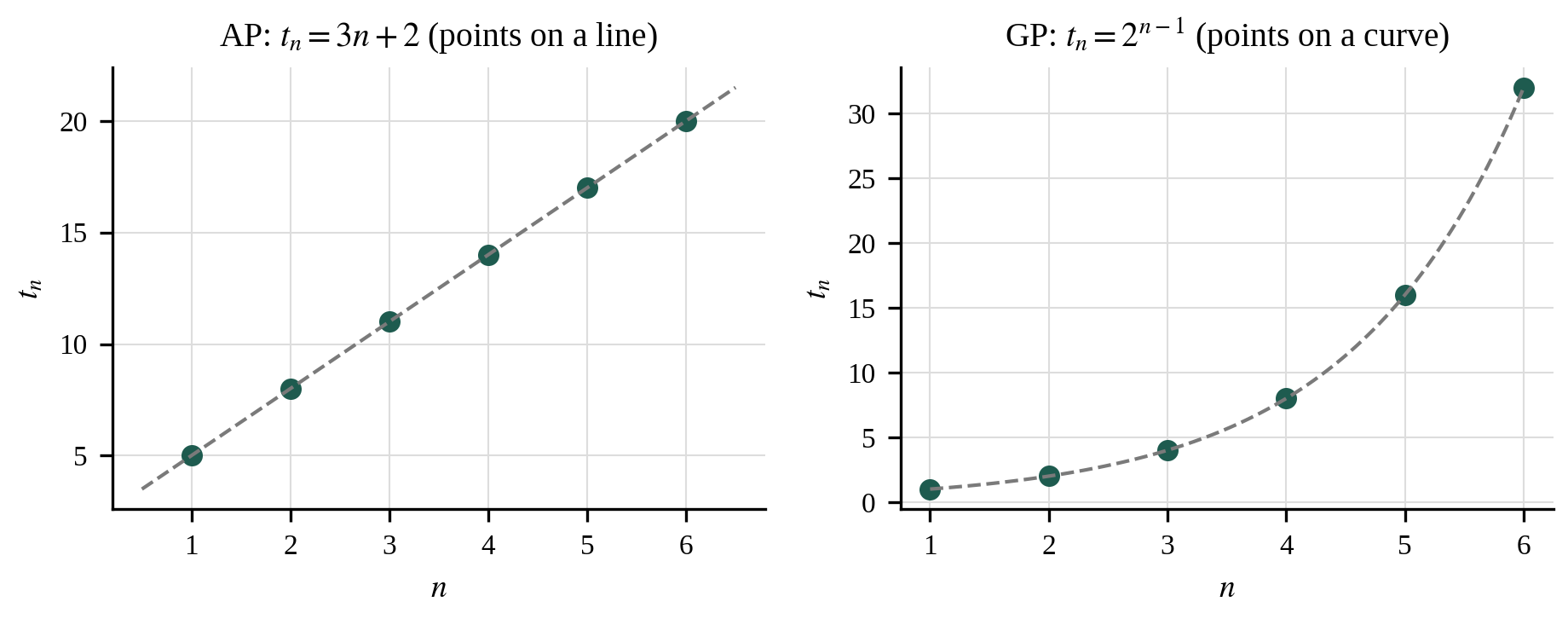
| AP | Constant difference d . t n = a + ( n − 1) d . Graph points lie on a straight line. |
| Sum of an AP | S n = n /2 [2 a + ( n − 1) d ] = n /2 ( a + l ) . |
| Sum of 1 to n | S n = n ( n + 1)/2 (Āryabhaṭa, 499 CE). |
| GP | Constant ratio r . t n = a r n−1 . Graph points lie on a curve. |
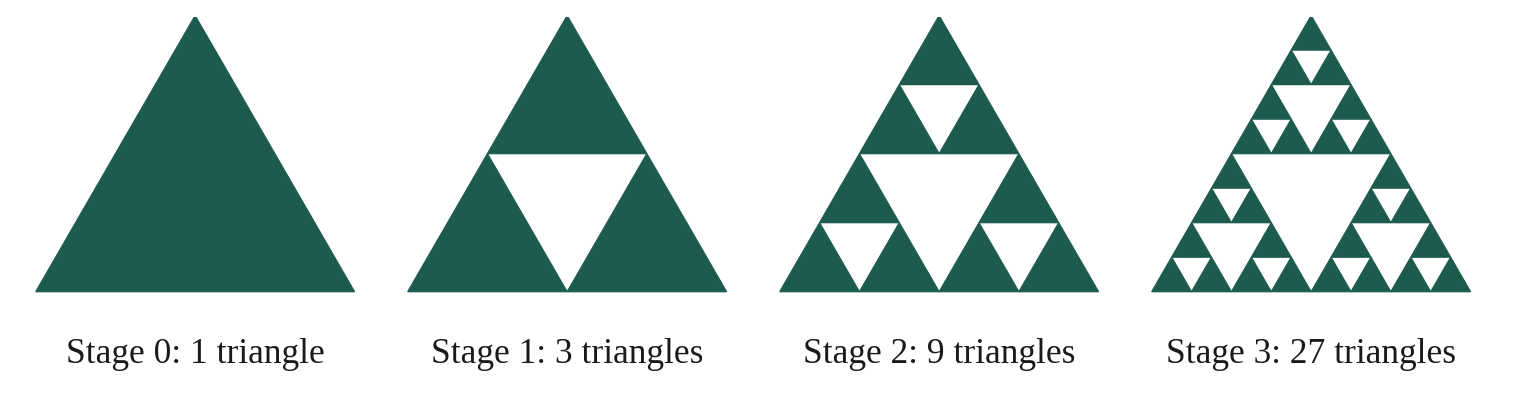
| Sierpiński triangle | Stage n : 3 n triangles; shaded area (3/4) n of the original. |
Triangular numbers 1, 3, 6, 10, … have tn = n(n + 1)/2.
Square numbers 1, 4, 9, 16, … have sn = n2.
Each square is the sum of consecutive odd numbers: 1 = 1, 4 = 1 + 3, 9 = 1 + 3 + 5, 16 = 1 + 3 + 5 + 7, so n2 = 1 + 3 + 5 + … + (2n − 1).
Adding the next row of dots to tn−1 gives tn = tn−1 + n.
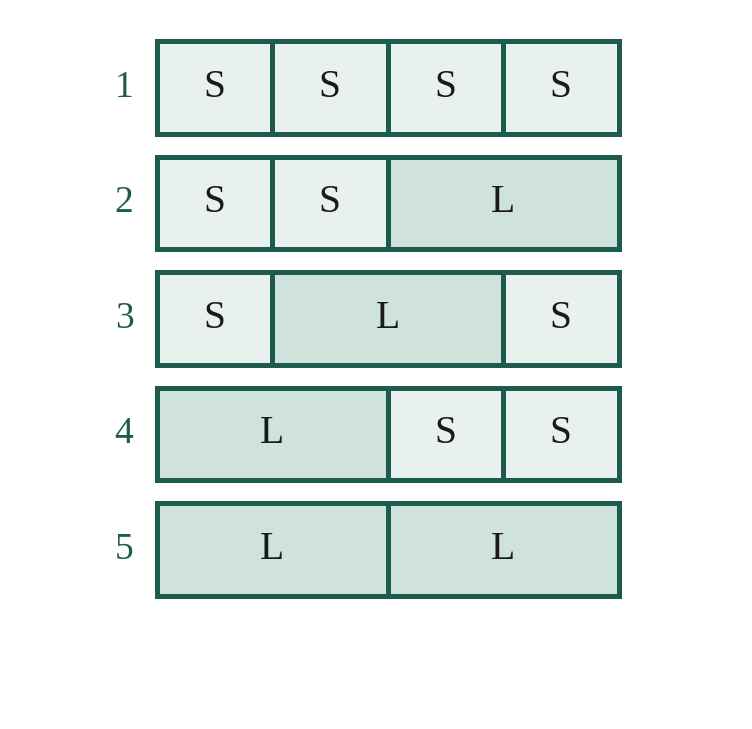
Virahānka (7th century CE) counted the poetic metres that fill n beats using short (1 beat) and long (2 beats) syllables. The counts 1, 2, 3, 5, 8, 13, … follow Vn = Vn−1 + Vn−2.
Gopāla (c. 1135) and Hemachandra (c. 1150) developed it before Fibonacci wrote of it in Europe (c. 1200).
A sequence can often be described by either kind of rule; the explicit rule is quicker for far-off terms.
Test for an AP: all consecutive differences are equal.
To find the number of terms: n = (l − a)/d + 1, where l is the last term.
An AP is a linear pattern: tn = dn + (a − d), so it connects with Chapter 2.
For an AP with first term a, last term l and n terms: Sn = n/2 (a + l).
A range sum is a difference: 25 + 26 + … + 58 = S58 − S24.
| AP | GP | |
|---|---|---|
| Rule | add the same d | multiply by the same r |
| n -th term | a + ( n − 1) d | a r n−1 |
| Growth | linear (straight line) | exponential (curve) |
| Test | equal differences | equal ratios |
If r > 1 the terms grow; if 0 < r < 1 they shrink towards 0; if r < 0 the signs alternate.
Any three consecutive terms x, y, z of a GP satisfy y2 = xz.
At each stage the middle triangle of every black triangle is removed: 3 triangles remain from each 1, and each has 1/4 of the area, so the total shaded area is multiplied by 3/4.
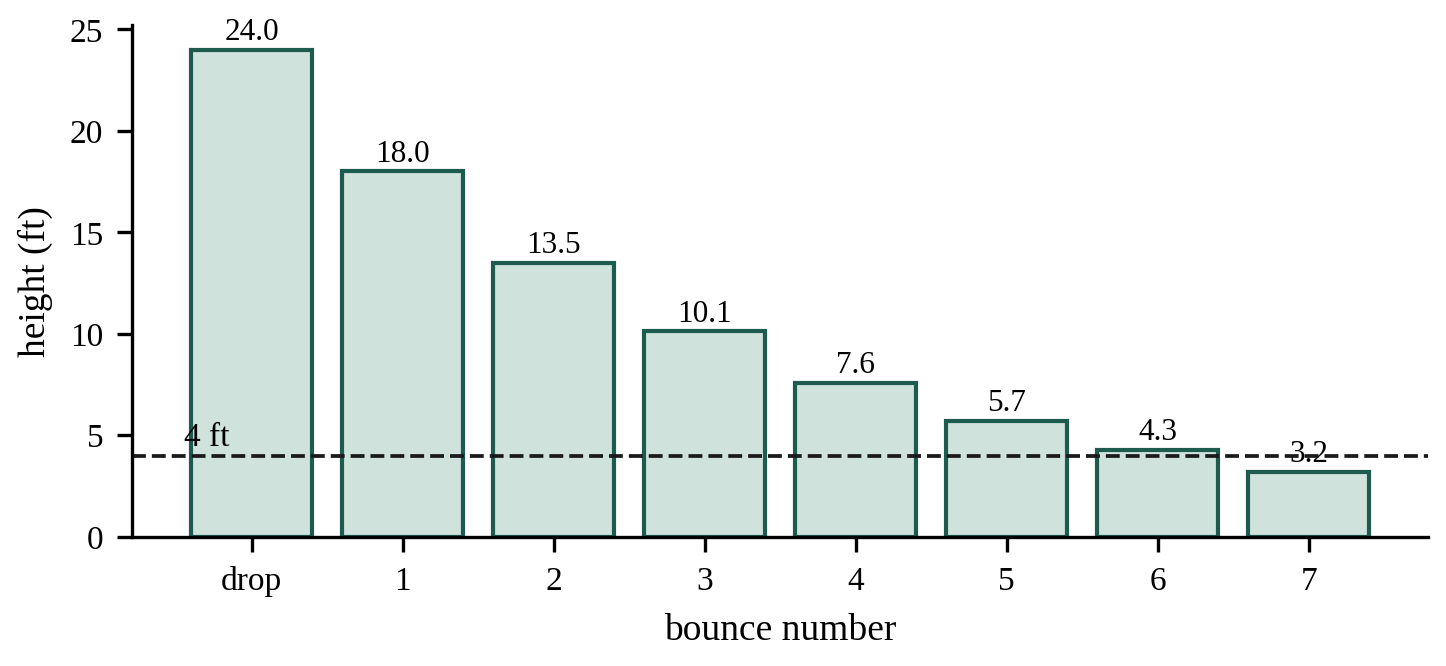
A bouncing ball rebounding to a fixed fraction r of its previous height has heights forming a GP with ratio r.
| Idea | Statement |
|---|---|
| Proposition | A statement that is definitely true or definitely false. Usually “If P , then Q ”: P is the hypothesis, Q the conclusion. |
| Converse | “If Q , then P ”: hypothesis and conclusion swapped. |
| Four cases | Proposition and converse can be both true, only one true, or both false. |
| Both true | Written “ P if and only if Q ”. |
| Justifying a true statement | Give a general argument valid for every case (use letters, not particular numbers). |
| Counterexample | One example satisfying the hypothesis but not the conclusion. One counterexample disproves a statement. |
| Examples do not prove | Checking a few cases never proves a general statement. |
| Divisibility | Divisible by a and by b is the same as divisible by lcm ( a , b ) ; equal to a b only when gcd is 1. |
| Perfect squares | Product of perfect squares is a perfect square; the converse is false. |
| Number of factors | p 2 has 3 factors; p q ( p ≠ q primes) has 4; the converses need care. |
| Contrapositive | “If P , then Q ” is equivalent to “If not Q , then not P ”. |
| Necessary, sufficient | P ⇒ Q : P is sufficient for Q ; Q is necessary for P . Both ways: iff. |
| Squares and factors | A positive integer is a perfect square if and only if it has an odd number of factors. |
| Geometry pairs | Isosceles triangle theorem and its converse; corresponding angles and parallel lines; Baudhāyana–Pythagoras theorem and its converse. |
“Is 7 prime?” is a question, not a proposition. “Close the door” is an instruction.
“If a number is a multiple of 6, then it is a multiple of 3” is a proposition, and it is true.
A statement with an unspecified variable, such as x + 2 = 5, is not yet a proposition; it becomes one for a given x.
Statements can often be rewritten in “if-then” form: “Equal angles in a triangle have equal opposite sides” is “If two angles of a triangle are equal, then the sides opposite them are equal”.
| Proposition | Converse | Example |
|---|---|---|
| true | true | If x = y then x + a = y + a ; and the converse (cancel a ). |
| true | false | If a number is a multiple of 6, it is a multiple of 3; but 9 is a multiple of 3 and not of 6. |
| false | true | If two triangles have equal area, then they are congruent (false); the converse “congruent ⇒ equal area” is true. |
| false | false | If a number is divisible by 4, then it is odd (false); the converse “odd ⇒ divisible by 4” is also false. |
Wording: “when”, “whenever” and “implies” can hide the direction. “A number has an odd number of factors when it is a perfect square” means “If a number is a perfect square, then it has an odd number of factors”; “when” does not turn it into the converse.
Real life: “If it rains on an uncovered road, the road gets wet” is true. “If the road is wet, then it has rained” is false: a water tanker may have spilled.
When both a proposition and its converse are true we write “P if and only if Q”.
Checking many examples never proves a general statement.
Contrapositive: “If P, then Q” is equivalent to “If not Q, then not P”. Proving the contrapositive is sometimes easier, as in divisibility questions.
Even a famous-looking rule can fail: n2 + n + 11 is prime for n = 0, 1, …, 9, but n = 10 gives 121 = 11 × 11.
Counterexamples for “if-then” statements must satisfy the if part.
Digit-sum rule for 3 (and 9): a number is divisible by 3 if and only if its digit sum is a multiple of 3 (same for 9).
Factors: p2 (p prime) has exactly 3 factors: 1, p, p2. pq (p ≠ q primes) has exactly 4: 1, p, q, pq. The number 8 also has 4 factors, so “4 factors ⇒ product of two primes” is false.
Factors come in pairs; the number of factors is odd exactly when the number is a perfect square.
Perfect squares: if a = m2 and b = n2, then ab = (mn)2. The converse is false: 2 × 8 = 16.
Sufficient means enough: P guarantees Q. Necessary means unavoidable: without Q, P cannot hold.
In “If a number is divisible by 6, then it is divisible by 3”, divisibility by 6 is sufficient for divisibility by 3, and divisibility by 3 is necessary for divisibility by 6, but not sufficient (9).
Step 1. Write the proposition in “if-then” form.
Step 2. Decide true or false. If true, give a general argument; if false, give a counterexample that satisfies the “if” part.
Step 3. Write the converse by swapping hypothesis and conclusion.
Step 4. Repeat Steps 2 for the converse. Never assume the converse is true (or false) because the proposition is.
Step 5. If both are true, state the result as “P if and only if Q”.
| Idea | Statement |
|---|---|
| Combined mean | Two groups with means a , b and sizes n , m : ( a × n + b × m )/( n + m ) . |
| Average of averages | The simple mean of group means is right only when the group sizes are equal . |
| Weighted mean | Σ w i x i / Σ w i . The weights can be sizes, volumes, marks ratios or frequencies. |
| Properties | Equal weights give the ordinary mean. Multiplying all weights by k > 0 changes nothing. The mean lies between the smallest and largest value. |
| Mixtures | Concentration = amount of active ingredient ÷ total quantity. Use volume as the weight. |
| Updating a mean | New mean = (old total ± change) ÷ new count. |
| Dilution | The solute stays the same; the total volume grows. |
| Rating schemes | Convert marks to percentages first, then apply the weights. |
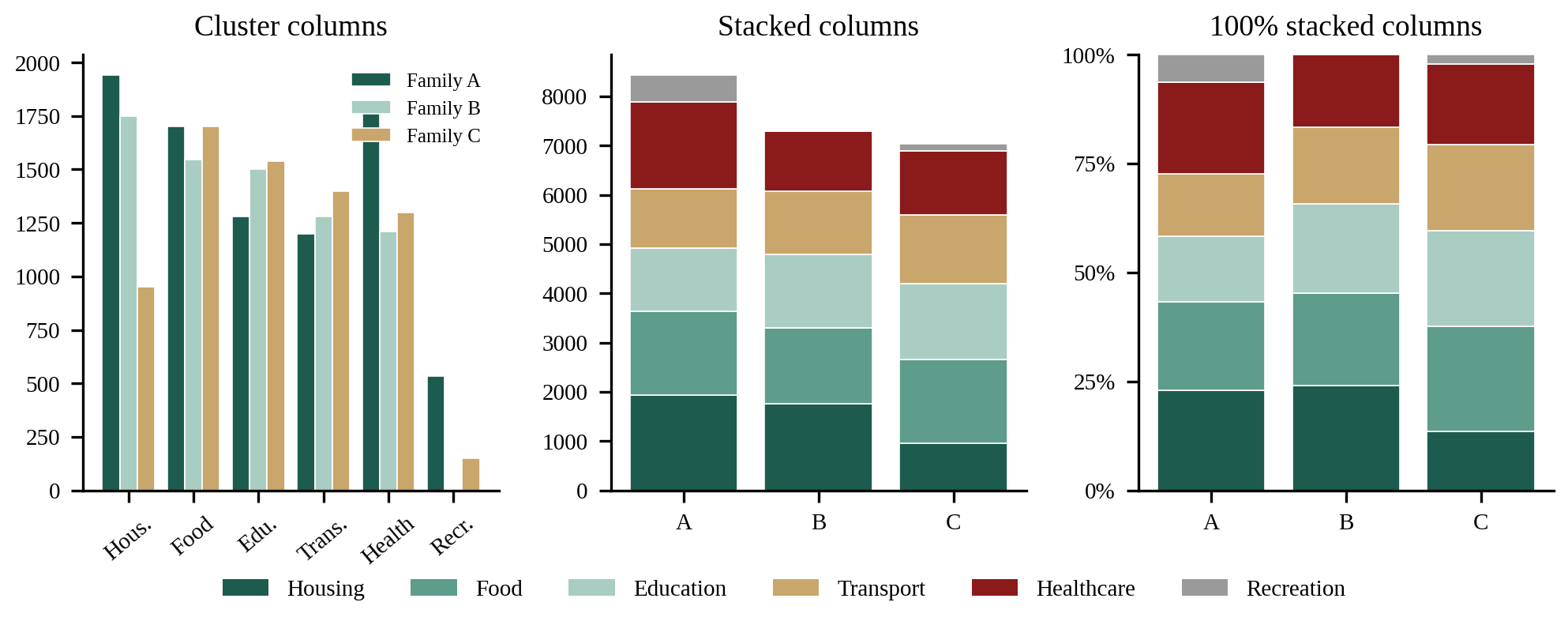
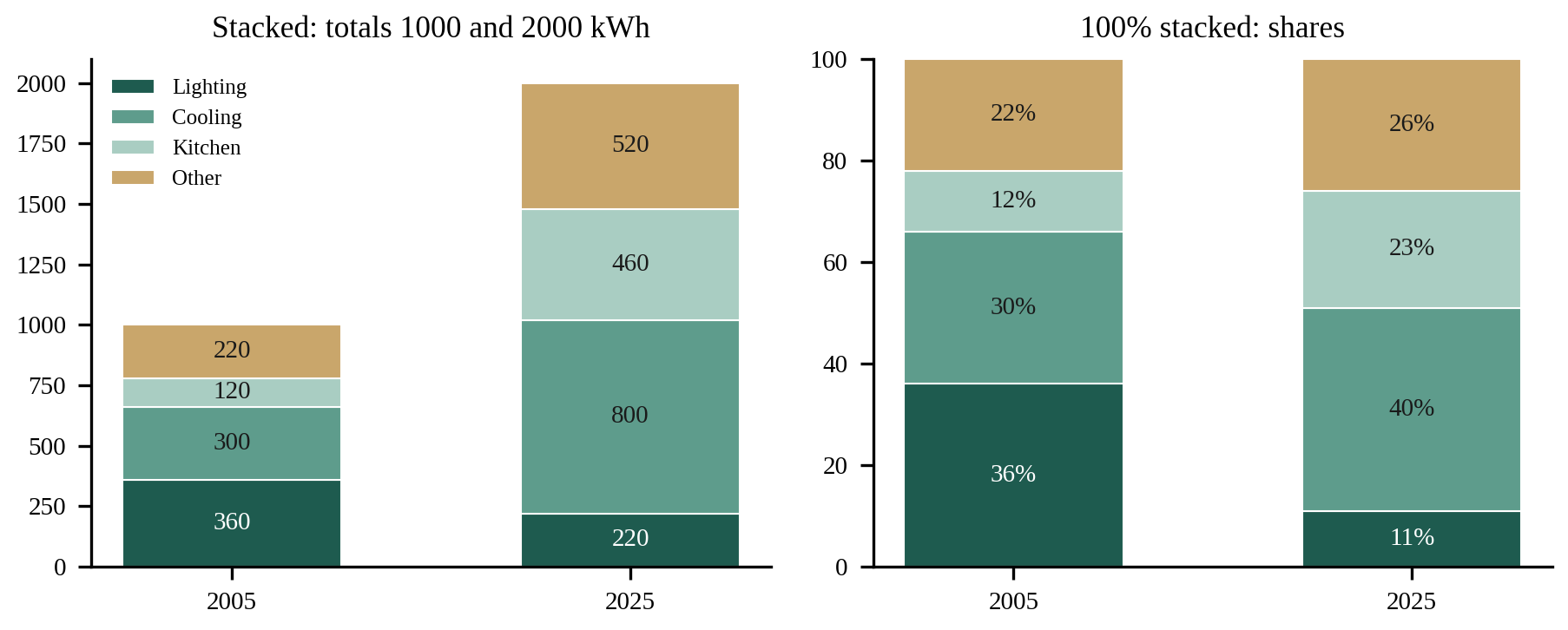
| Stacked bar chart | Shows totals and parts (absolute values). |
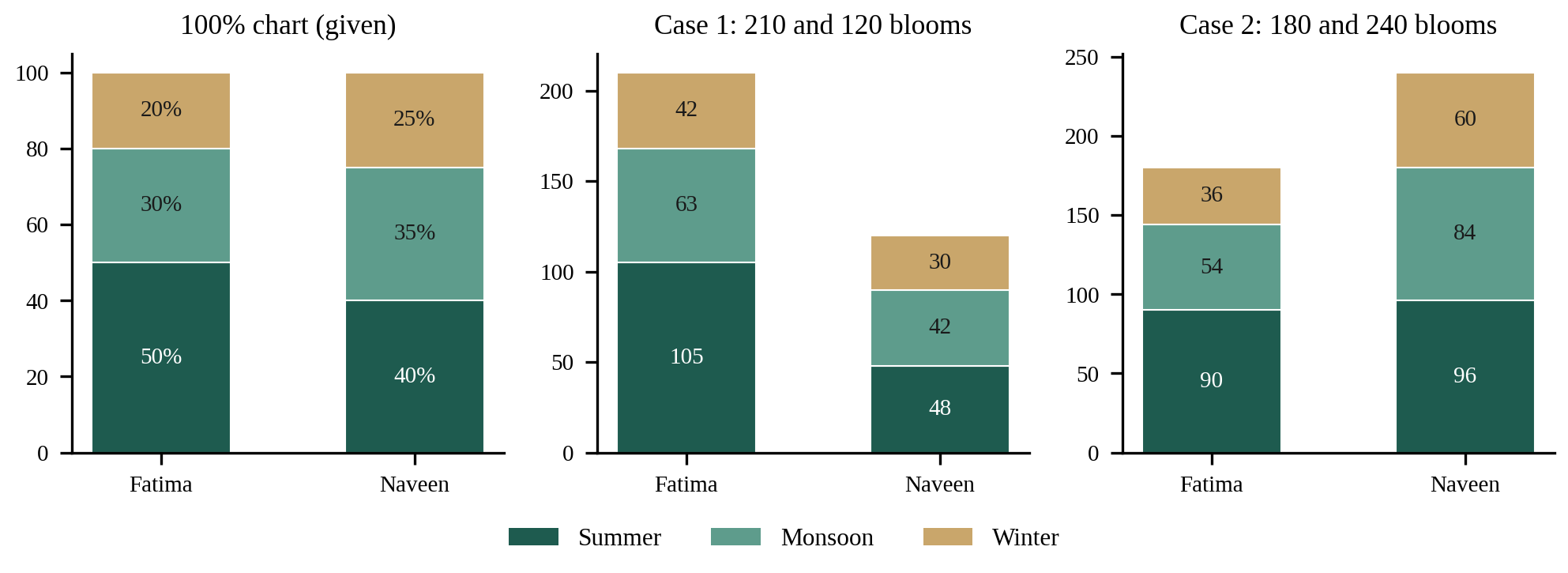
| 100% stacked bar chart | Shows shares only. It cannot compare absolute amounts across bars. |
| Conversions | Stacked to 100% stacked is always possible; the reverse is not. |
Averaging the two group means treats both groups as equally large, which is wrong if their sizes differ.
Equal sizes: if all groups have the same size p, then (a + b + c)p/3p = (a + b + c)/3, so the simple mean of the means works.
Recover a group’s total from its mean: total = mean × count.
Equal weights give the ordinary mean.
Multiplying all weights by the same k > 0 leaves the weighted average unchanged.
Bounding: the weighted mean lies between the smallest and largest value.
Brahmagupta (628 CE) used it for the mean depth of an uneven pit; Śrīdharācārya (750 CE) used it for the purity (varṇa) of mixed gold.
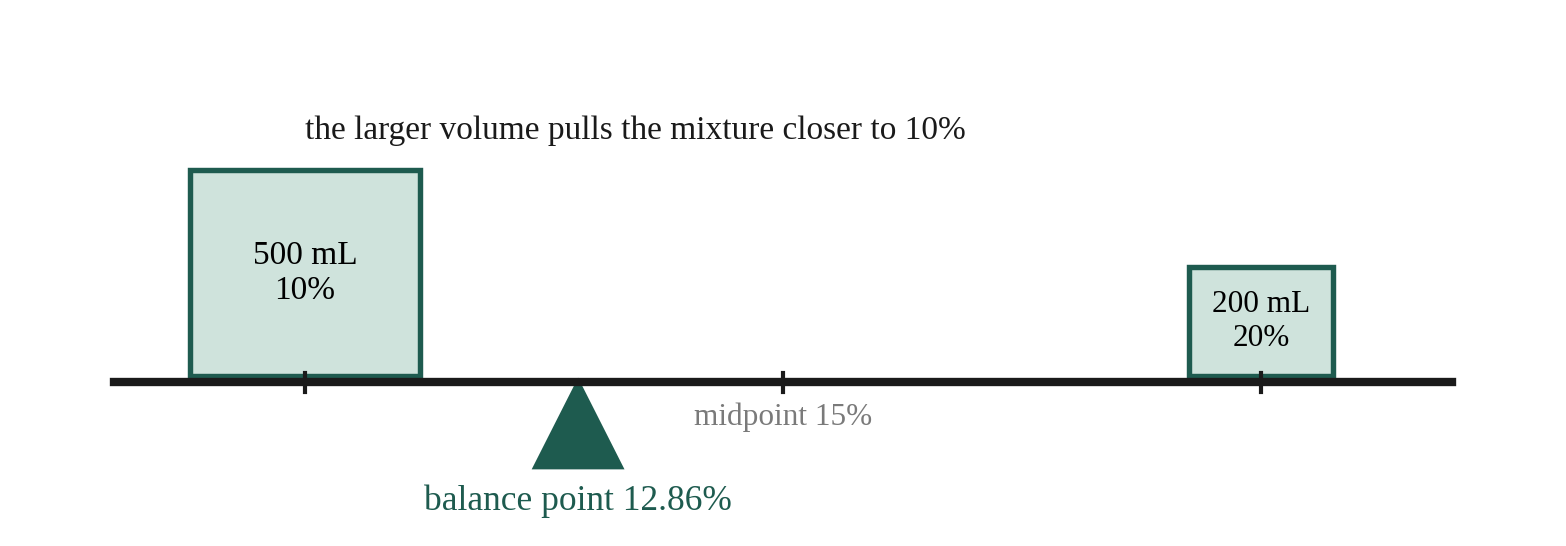
The concentration of a mixture of two sources always lies between the two source concentrations (endpoints included).
Never subtract percentages directly; add the amounts of solute.
0.55(320 + y) = 200 + 0.45y.
176 + 0.55y = 200 + 0.45y.
0.10y = 24.
y = 240 kg.
Hotel and restaurant ratings, exam scores and profit margins all use weights.
Weighting recent reviews more heavily is a deliberate choice of weights.
A new value above the old mean raises the mean; below lowers it; equal to the mean leaves it unchanged.
When values leave, subtract their total and their count.
A mixture of two concentrations cannot be stronger than both or weaker than both.
Write an equation for the amount of solute before and after mixing.
If a group’s mean is above the overall mean, that group pulls the combined mean up. The overall mean lies nearer the group with more members.
For ratings, multiply each rating by the number of customers who gave it before adding.
To read a middle segment of a stacked bar, subtract its lower end from its upper end.
To make a 100% stacked bar, divide each part by that bar’s total.
Stacked to 100% stacked: always possible. The reverse: not possible without the totals.
If every bar has the same total (such as 24 hours in a day), the chart is both stacked and 100% stacked.
| Idea | Statement |
|---|---|
| Algorithm | A precise, finite, correct step-by-step procedure. Its efficiency is judged by how the work grows with the size of the input. |
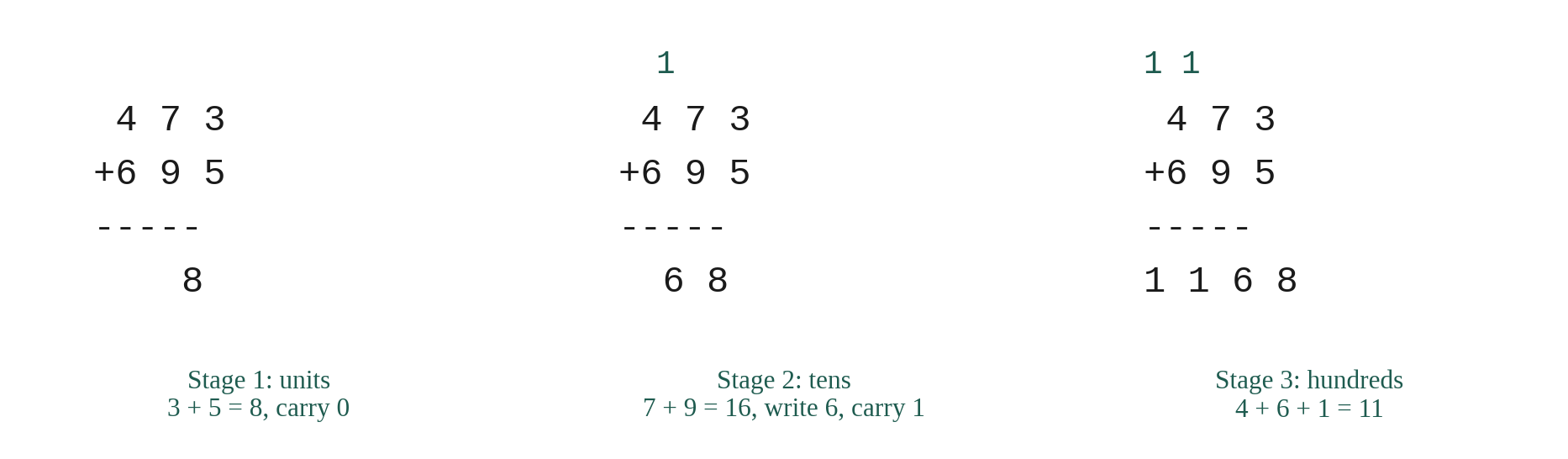
| Column addition | Align the digits from the right, add column by column with a carry. Effort grows with the number of digits , not the value. |
| Carry | In base 10 the carry is never more than 1, since 9 + 9 + 1 = 19 < 20 . |
| Divisors by scanning | Test every j from 1 to n : exactly n checks. |
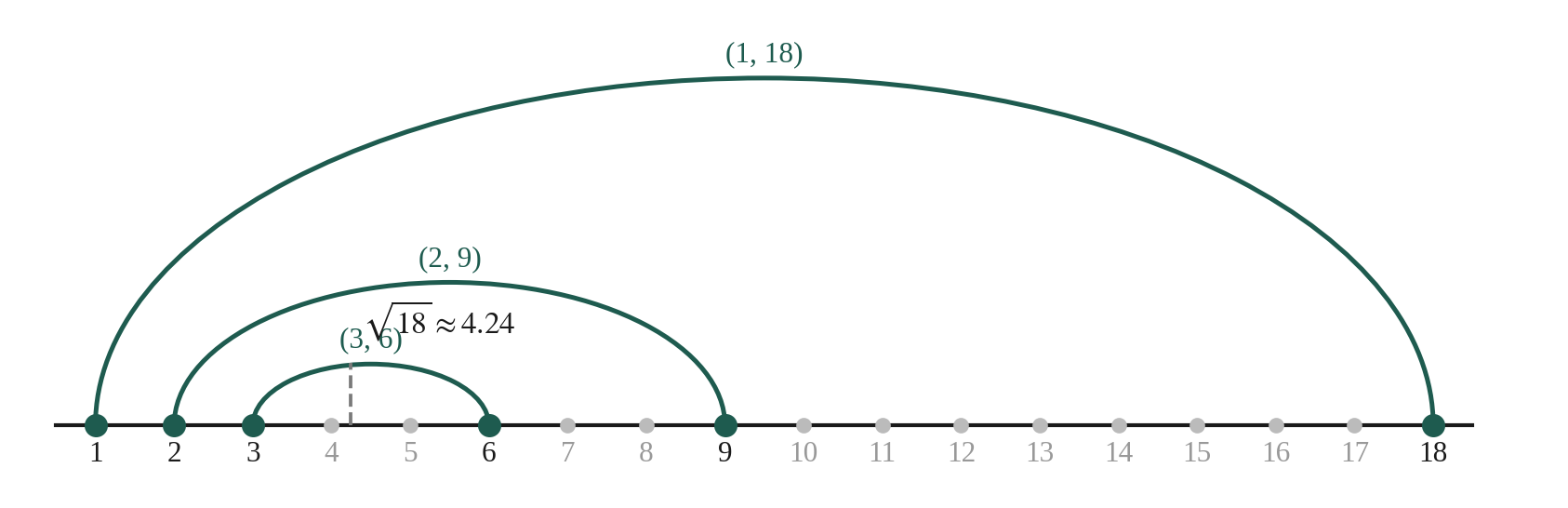
| Divisor pairs | If d | n then n / d | n . Testing j ≤ ⌊√ n ⌋ finds all divisors. |
| GCD, first algorithm | Common divisors of m and n ; report the largest. |
| Refinements | Scan once; stop at m i n ( m , n ) ; keep only the latest common divisor; scan backwards and stop at the first common divisor. |
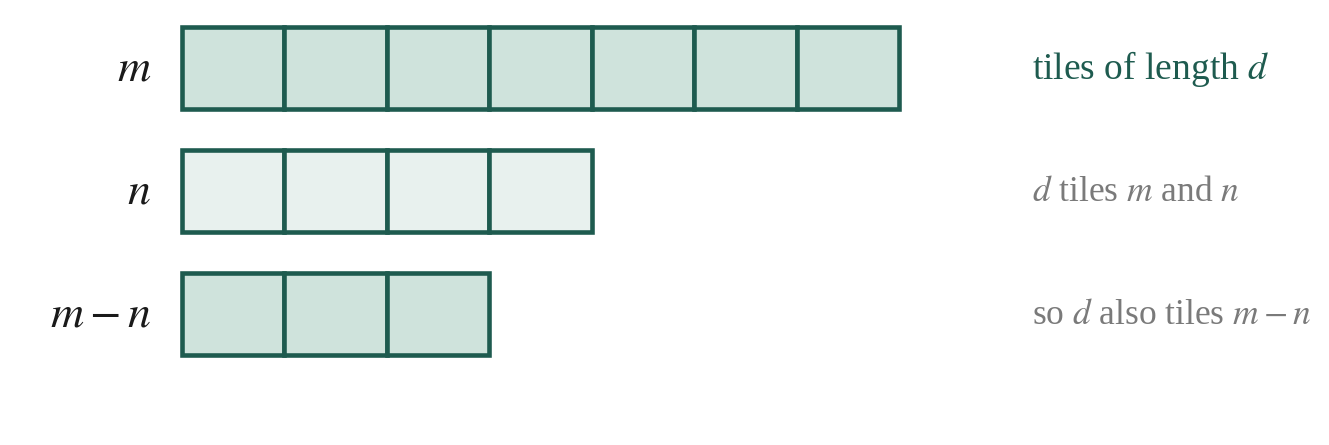
| Euclid (c. 300 BCE) | g c d ( m , n ) = g c d ( n , m − n ) for m ≥ n . |
| Āryabhaṭa (499 CE) | g c d ( m , n ) = g c d ( n , m m o d n ) . Steps grow with the number of digits. |
| LCM | l c m ( m , n ) = ( m × n )/ g c d ( m , n ) . |
| Prime factorisation | Prime exponents: gcd takes the minimum, lcm the maximum. |
| Word “algorithm” | From al-Khwārizmī (c. 820 CE), who wrote on Indian place-value arithmetic. |
To add 5 and 7 by counting dots we draw 5 dots, 7 more, and count 12. For 473 + 695 this would be hopeless.
The Indian base-ten place-value system lets us add column by column from the right with a carry.
If counting a dot takes 1 second and adding one column with carry takes 15 seconds, then adding 3,347 + 2,729 takes about 6,076 seconds by counting but only 4 × 15 = 60 seconds by columns: about 100 times faster.
Going from a 3-digit to a 4-digit number multiplies the dots by 10 but adds only one column: the effort grows with the number of digits.
Why it works (place value). A = ak10k + … + a110 + a0. When a0 + b0 ≥ 10 we write a0 + b0 = 10c1 + s0 and move the ten to the next place, so each group of ten at 10i becomes a one at 10i+1.
The carry is at most 1. Each digit is at most 9 and the incoming carry at most 1, so the column sum is at most 9 + 9 + 1 = 19 < 20.
Missing digits count as 0, so numbers of different lengths can be added.
Decimals: align the numbers by the decimal point and pad with zeros.
Running through the steps one by one is called executing the algorithm.
The algorithm needs exactly n checks: if n becomes 10 times larger, the work becomes 10 times larger.
Naming intermediate quantities (like list-of-divisors and j) and keeping ordered collections is the start of data structures.
For 54,000 and 81,000 this means 54000 + 81000 = 135000 divisibility checks and thousands of comparisons, though each has 80 divisors: we need much smarter algorithms.
The answer is the rightmost element only because the list is in increasing order.
Even Refinement 3 scans up to min(m, n), so the work grows with the value of the smaller number.
Backward scan: start k at min(m, n) and go down; the first k that divides both is the gcd, so we can stop at once.
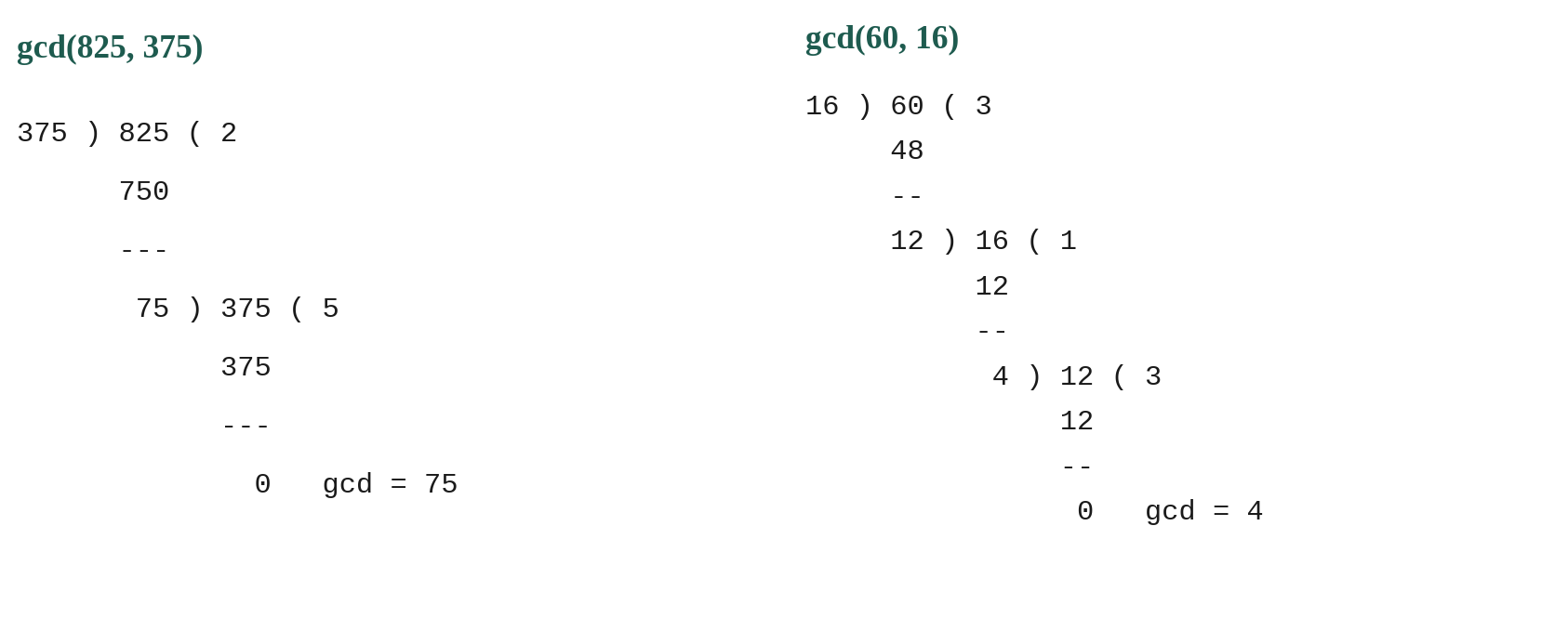
Each step replaces the pair by smaller numbers, so the process stops.
Flaw: gcd(99, 2) takes 49 subtractions; in general gcd(2k + 1, 2) takes k. The number of steps grows with the value, not the number of digits.
gcd(99, 2): 99 mod 2 = 1, then gcd(2, 1), then 2 mod 1 = 0: gcd(1, 0) = 1, only 2 reductions instead of 49.
The number of reductions grows with the number of digits, so very large numbers are handled quickly.
Described in the Āryabhaṭīya (499 CE) using Indian place-value numerals.
Muhammad ibn Mūsā al-Khwārizmī (780–850 CE) worked at the House of Wisdom in Baghdad and admired Indian mathematics.
Around 820 CE he wrote a treatise on the Indian place-value system and the four operations. The Arabic original is lost; its 12th-century Latin translation, Liber Algorismi de numero Indorum, spread Indian arithmetic across Europe.
The Latin form of his name, Algoritmi, gave the word algorismus for Indian methods of calculation, which became algorism and then algorithm.
Today “algorithm” means any well-defined, step-by-step procedure for a class of problems.
Proof. If d and d′ with dd′ = n were both greater than √n, then dd′ > √n × √n = n, a contradiction.
The list of divisors found in pairs is not in increasing order, so sort it (or keep a running maximum) when computing a gcd from it.
Prime test: n > 1 is prime exactly when it has no divisor from 2 to ⌊√n⌋.
lcm and gcd: lcm(m, n) × gcd(m, n) = m × n.
| Idea | Statement |
|---|---|
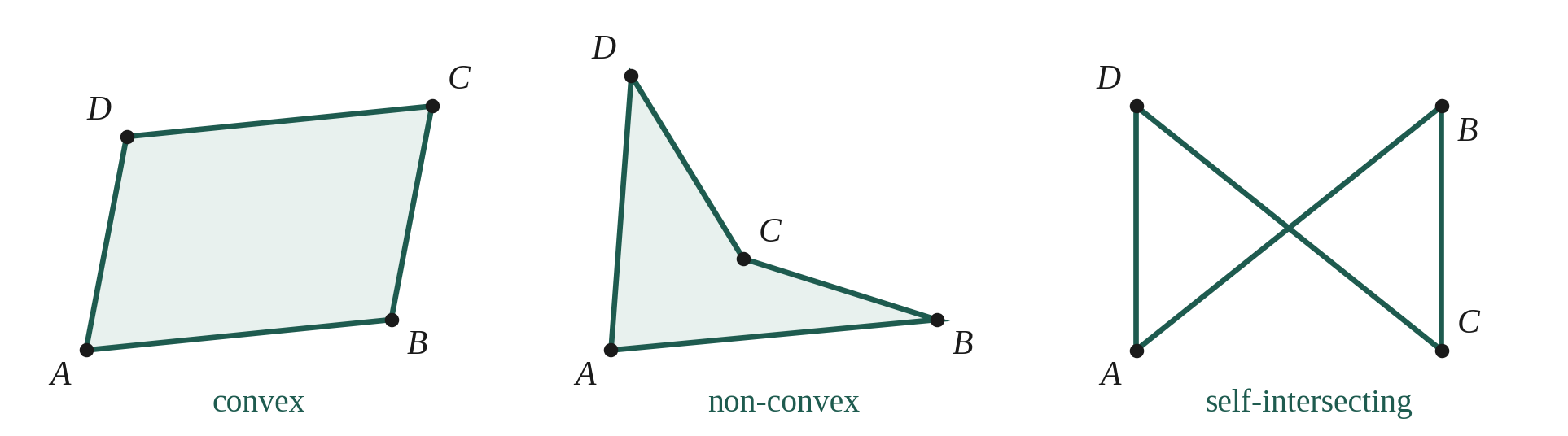
| Types | Convex, non-convex (a reflex angle), self-intersecting (opposite sides cross), non-planar. Angle sum of a plane simple quadrilateral is 360°. |
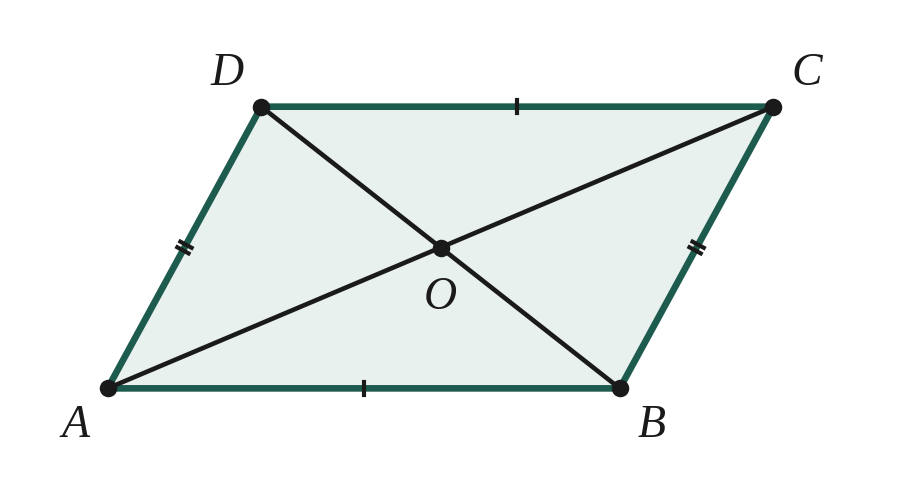
| Parallelogram | Opposite sides parallel. Then opposite sides and angles are equal, adjacent angles are supplementary and the diagonals bisect each other. |
| Tests for a parallelogram | Both pairs of opposite sides equal; or one pair equal and parallel; or diagonals bisect each other. |
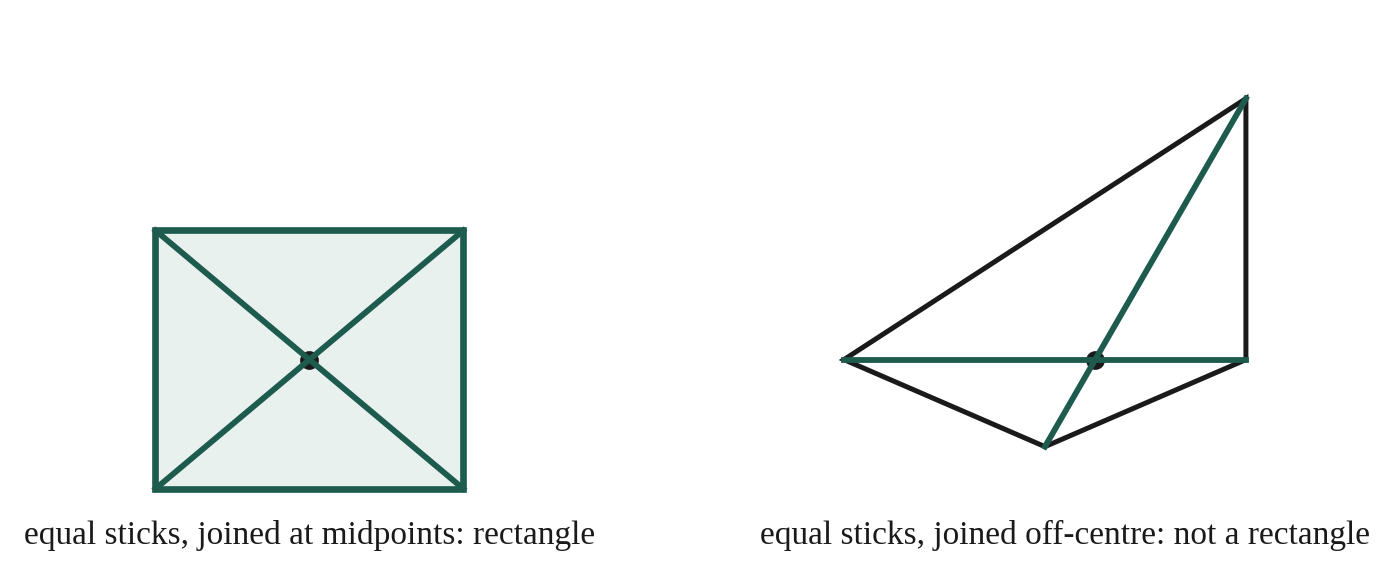
| Special parallelograms | Rectangle: one right angle (equal diagonals). Rhombus: four equal sides (perpendicular diagonals). Square: both. |
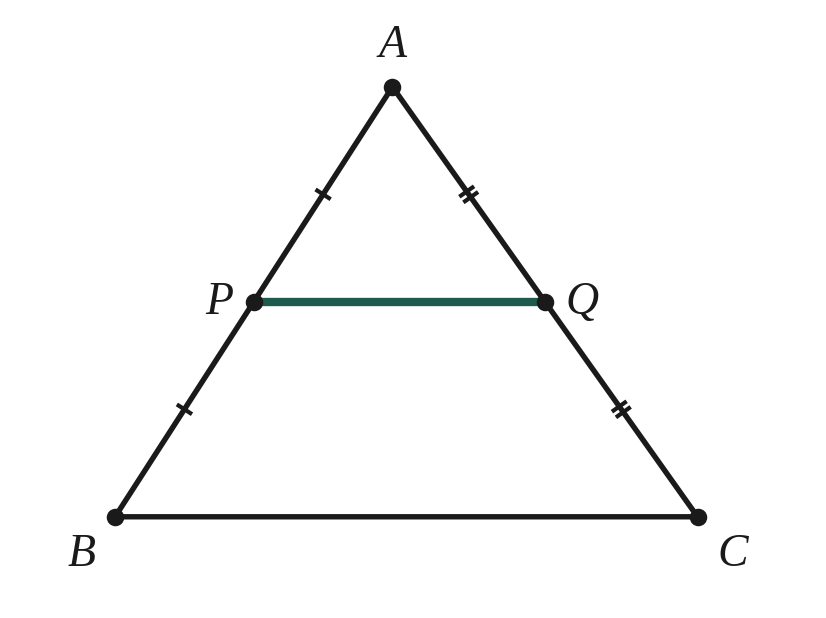
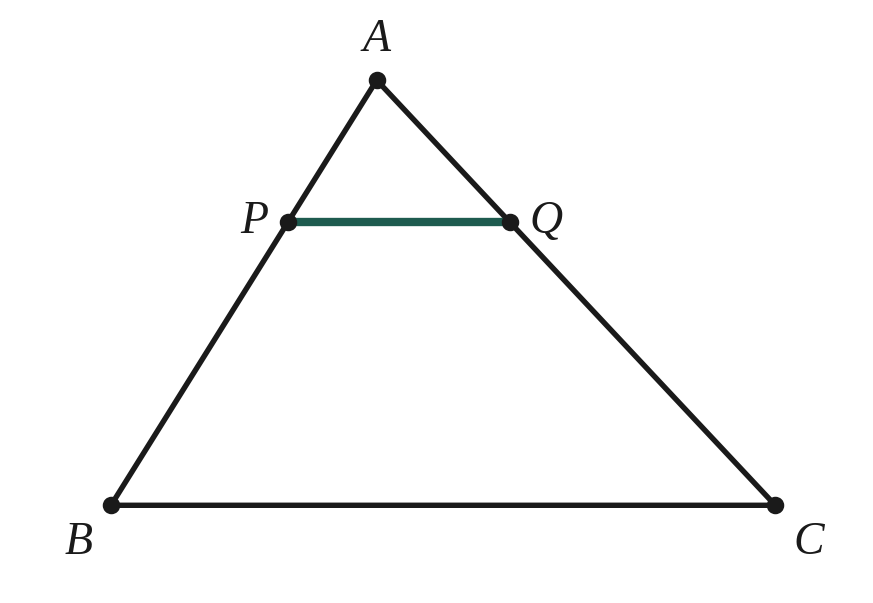
| Midpoint theorem | P , Q midpoints of A B , A C : P Q ∥ B C and P Q = ½ B C . Converse: a line through the midpoint of one side parallel to a second side bisects the third. |
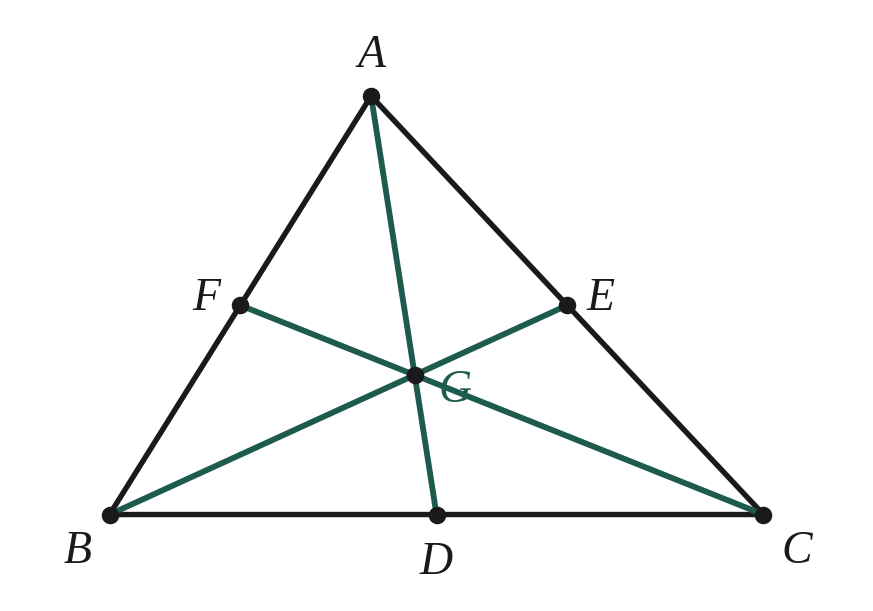
| Centroid | Medians meet at G , dividing each in the ratio 2 : 1 from the vertex. |
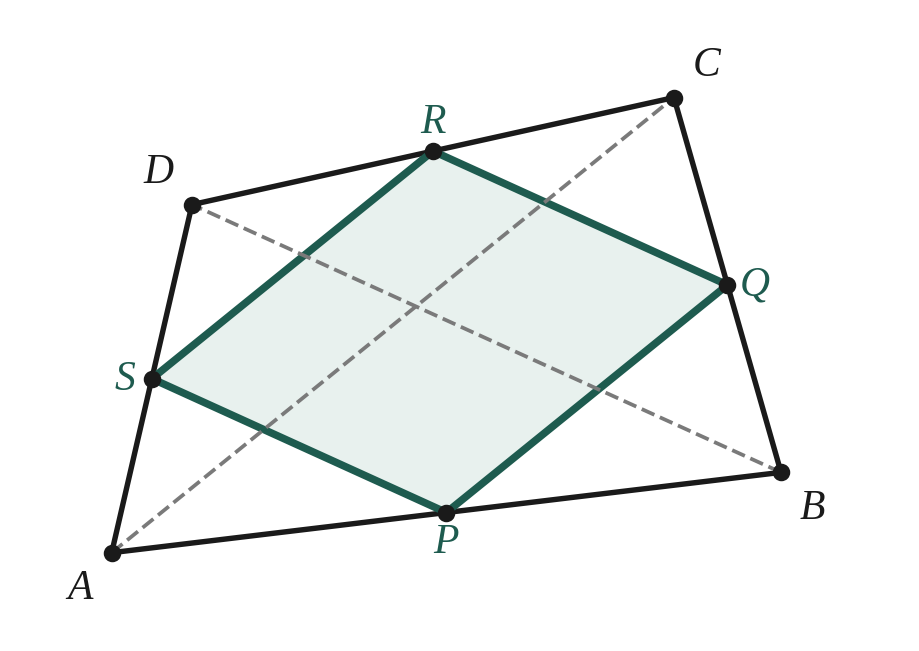
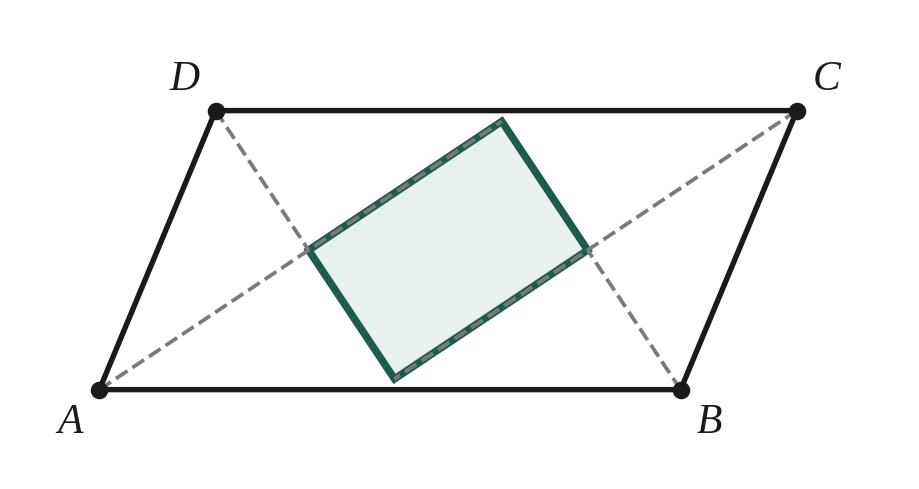
| Varignon parallelogram | The midpoints of the sides of any quadrilateral form a parallelogram with sides half the diagonals. |
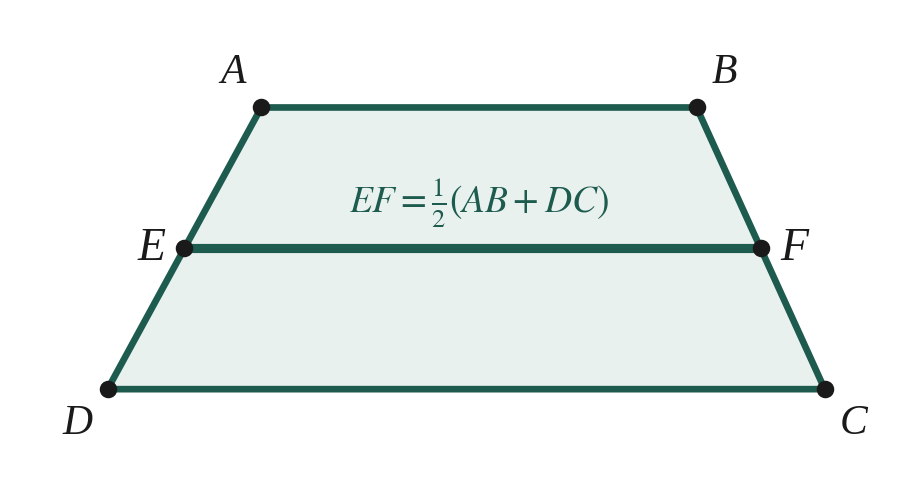
| Trapezium midline | E F ∥ A B ∥ D C and E F = ½( A B + D C ) . |
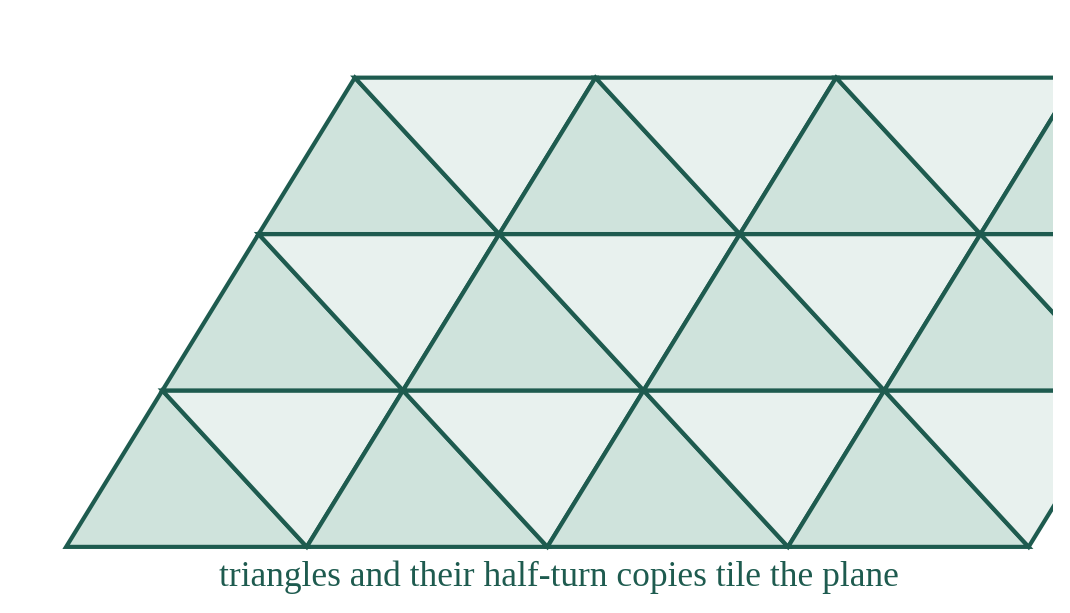
| Tiling | Copies meet around a point only if the angles add to 360°. Triangles, parallelograms and every quadrilateral tile; regular pentagons do not. |
| Polygons | Angle sum ( n − 2) × 180° . Diagonals n ( n − 3)/2 . Four lengths form a quadrilateral iff the largest is less than the sum of the other three. |
| Coordinates | Midpoint (( x 1 + x 2 )/2, ( y 1 + y 2 )/2) . For a parallelogram A B C D : D = A + C − B . |
Convex: every internal angle is less than 180° and both diagonals lie inside.
Non-convex: one internal angle is greater than 180° (a reflex angle); one diagonal lies outside.
Self-intersecting: two opposite sides cross, so the figure is not a simple polygon.
Non-planar: the four points do not lie in one plane; it is a spatial figure, not a flat polygon.
Opposite sides have no common endpoint; opposite angles have no common side.
| Figure | Sides | Angles | Diagonals |
|---|---|---|---|
| Parallelogram | opposite equal | opposite equal | bisect each other |
| Rectangle | opposite equal | all 90° | equal, bisect |
| Rhombus | all four equal | opposite equal | perpendicular, bisect angles |
| Square | all four equal | all 90° | equal, perpendicular |
Use each test exactly as stated: one equal pair, or one parallel pair, alone is not enough.
Converses: a parallelogram with equal diagonals is a rectangle; a parallelogram with perpendicular diagonals is a rhombus.
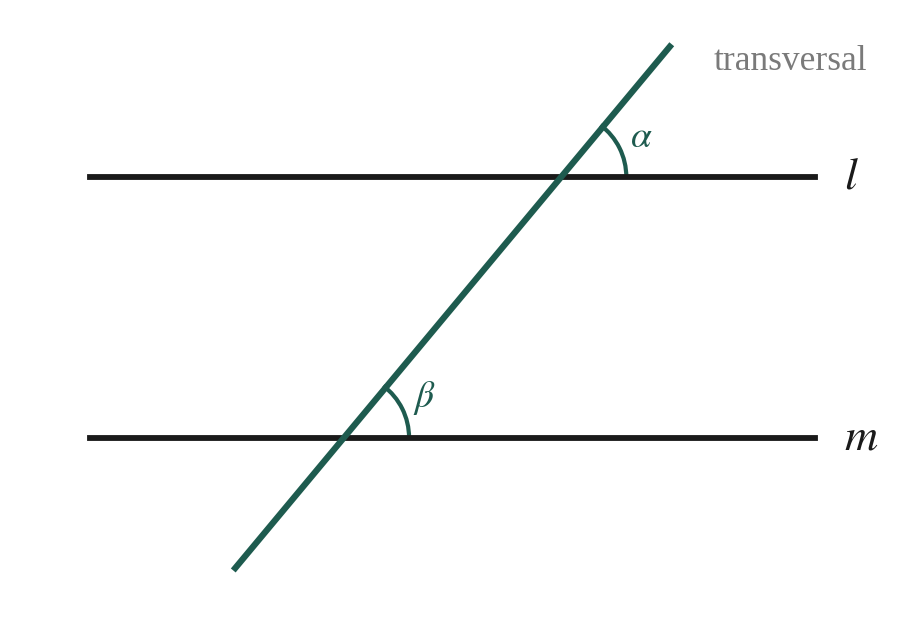
Useful angle facts: alternate angles, corresponding angles and vertically opposite angles between parallel lines.
Never use a converse unless its extra condition has been established.
It holds for convex, non-convex and self-intersecting quadrilaterals, and also in space.
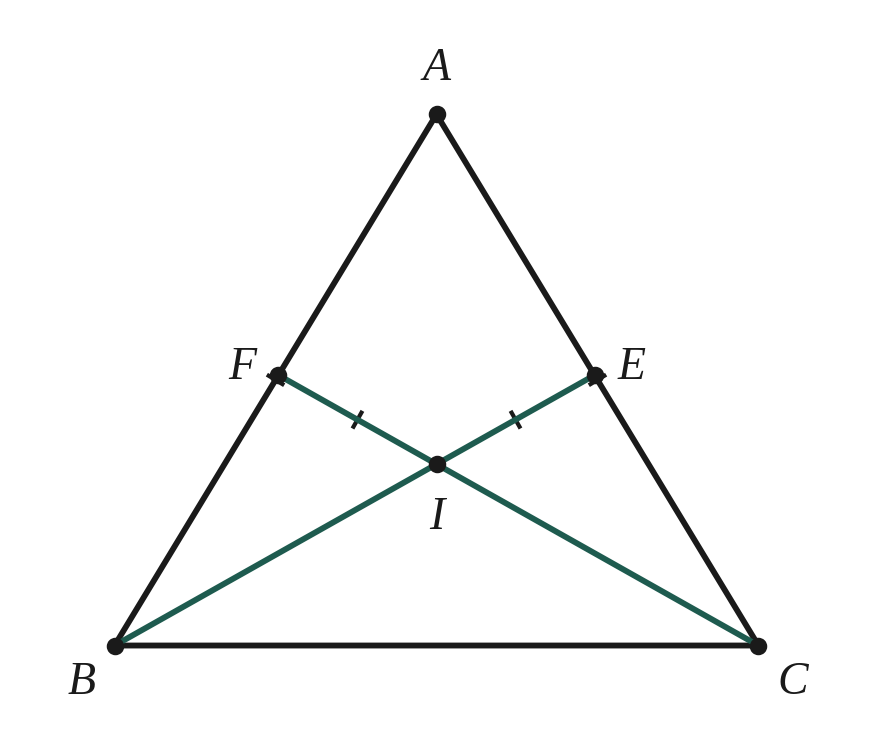
If AC = BD then PQRS is a rhombus; if AC ⊥ BD then it is a rectangle; if both, a square.
PQRS shrinks to a segment when the diagonals of ABCD are parallel.
Triangle: attach a half-turn copy along a side to get a parallelogram; translate it in two directions.
Quadrilateral: the four angles of a quadrilateral add to 360°, so four copies fit round a point.
Regular polygons alone: triangle (6 × 60°), square (4 × 90°) and hexagon (3 × 120°) tile. Pentagon (108°) and octagon (135°) do not, since 360° is not a whole-number multiple.
| Figure | Reflection axes | Rotational symmetry |
|---|---|---|
| General parallelogram | none | half-turn only |
| Rectangle | 2 (through midpoints of opposite sides) | half-turn |
| Rhombus | 2 (the diagonals) | half-turn |
| Square | 4 | 90°, 180°, 270° |
| General quadrilateral | usually none | usually none |
| Idea | Statement |
|---|---|
| Standard form | a x + b y + c = 0 , with a and b not both zero. Single-variable equations are special cases ( x + 0 y − 8 = 0 ). |
| Solution | An ordered pair ( u , v ) that satisfies the equation. There are infinitely many. |
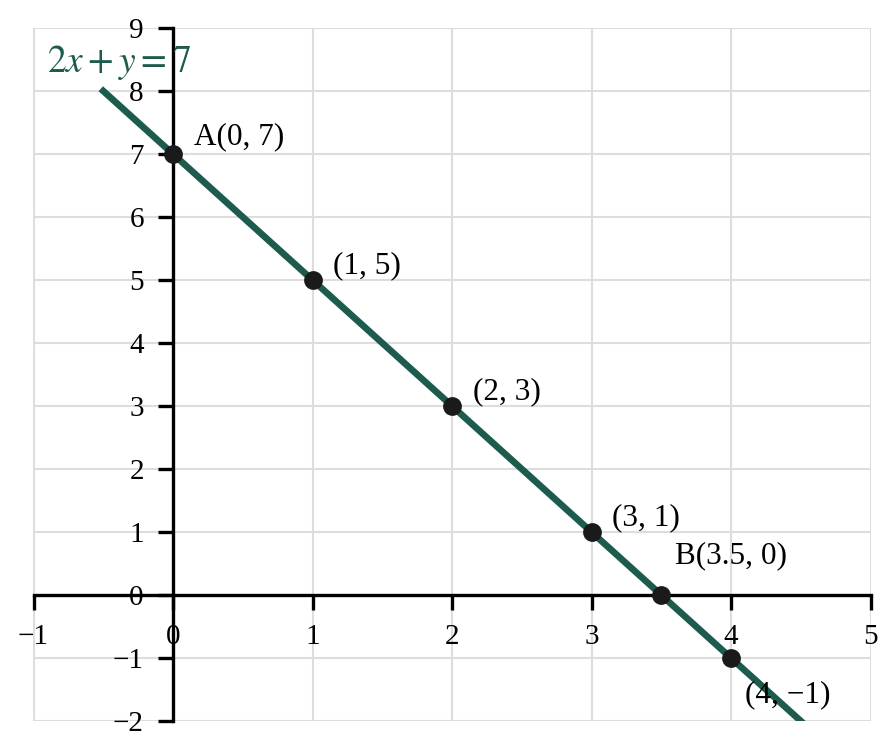
| Graph | A straight line; every point on it is a solution and every solution is a point on it. |
| Intercepts | y -intercept (0, − c / b ) ; x -intercept (− c / a , 0) . The line passes through the origin iff c = 0 . |
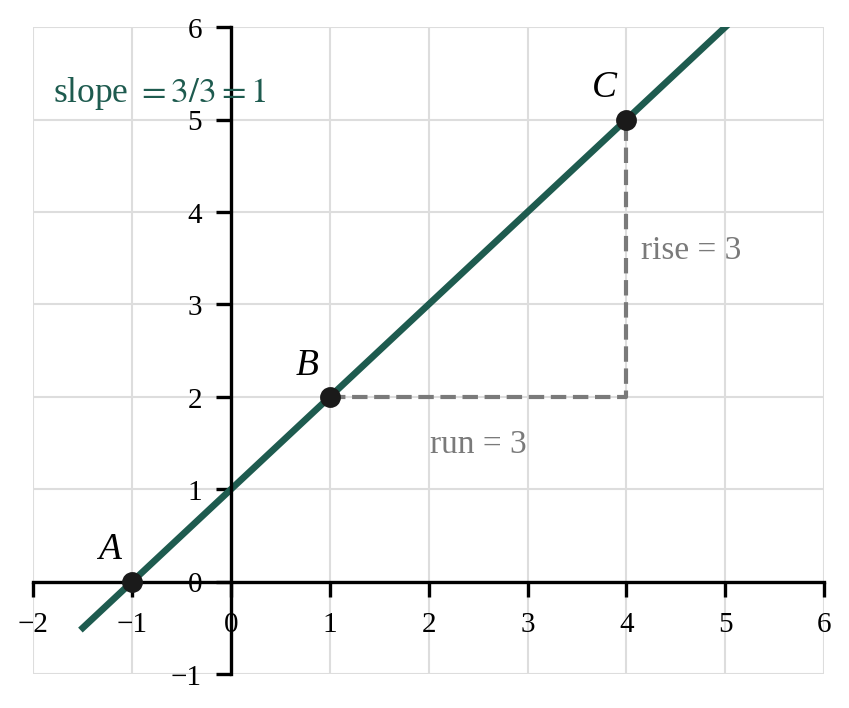
| Slope | m = rise ÷ run = ( y 2 − y 1 )/( x 2 − x 1 ) . For y = m x + d : slope m , y -intercept d . From a x + b y + c = 0 : m = − a / b . |
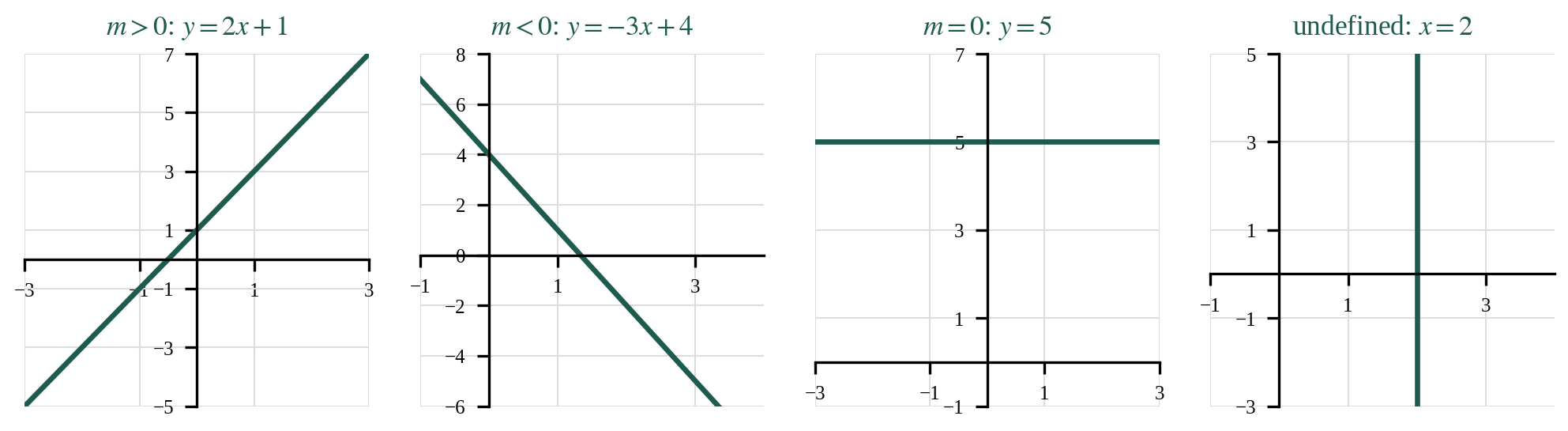
| Types of slope | Positive rises, negative falls, zero is horizontal, vertical lines have undefined slope. |
| Pair of equations | Two conditions on two unknowns: a 1 x + b 1 y + c 1 = 0 and a 2 x + b 2 y + c 2 = 0 . |
| Methods | Substitution (solve one equation for a variable) and elimination (equalise coefficients and add or subtract). |
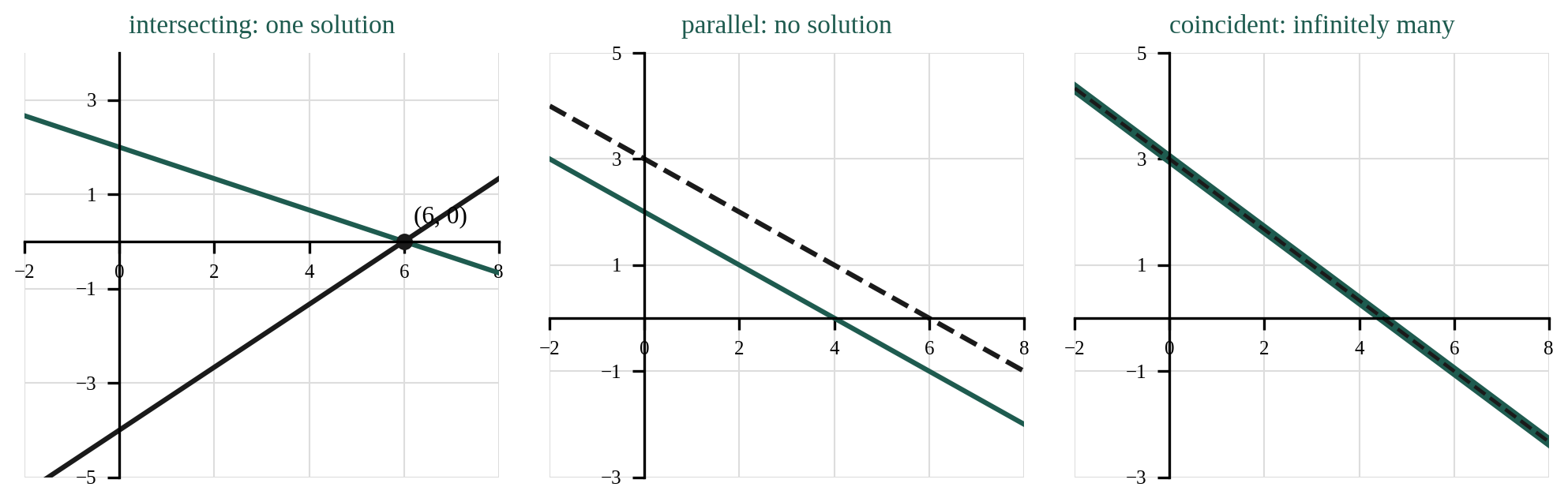
| Ratio test | a 1 / a 2 ≠ b 1 / b 2 : one solution. All three ratios equal: infinitely many. First two equal, third different: none. |
| Parallel lines | Equal slopes and different intercepts never meet. |
| Check | Always substitute the answer back into both original equations. |
Coefficients may be fractions: multiply by the LCM to clear them. ¼x + (3/5)y − ½ = 0 times 20 gives 5x + 12y − 10 = 0.
An equation in one variable is a special case: 4x + 7 = 0 is 4x + 0y + 7 = 0 and 3y = 5 is 0x + 3y − 5 = 0.
Move all terms to one side before reading a, b, c.
For 3x + 2y = 12: (2, 3) and (4, 0) are solutions; (1, 3) is not, since 3 + 6 = 9 ≠ 12.
Origin condition: the line passes through (0, 0) iff c = 0. Then x = 0 is the y-axis and y = 0 the x-axis.
Equivalent equations: multiplying every term by k ≠ 0 does not change the solutions.
If c = 0 the line passes through the origin: find a second point by choosing a convenient x.
Two points are enough to draw a line; a third is a useful check.
A point not on the line does not satisfy the equation.
Why m is the slope: points (x1, y1) and (x2, y2) on y = mx + d satisfy y1 = mx1 + d and y2 = mx2 + d. Subtracting, y2 − y1 = m(x2 − x1), so (y2 − y1)/(x2 − x1) = m.
Parallel lines: lines with equal slopes and different intercepts never meet. If they met at (x0, y0), then mx0 + d1 = mx0 + d2, so d1 = d2, a contradiction.
Rank steepness by comparing the ratios rise/run.
| Coefficient ratios | Lines | Solutions | Type |
|---|---|---|---|
| a 1 / a 2 ≠ b 1 / b 2 | intersecting | exactly one | consistent, independent |
| a 1 / a 2 = b 1 / b 2 = c 1 / c 2 | coincident | infinitely many | consistent, dependent |
| a 1 / a 2 = b 1 / b 2 ≠ c 1 / c 2 | parallel | none | inconsistent |
In elimination, an identity 0 = 0 means infinitely many solutions; a contradiction 0 = k (k ≠ 0) means none.
To get a pair of the wanted type from ax + by + c = 0: change the constant (parallel), multiply by a number (coincident), or alter the ratio of a to b (intersecting).
Babylonia (c. 2000 BCE): clay-tablet problems on areas and sums of two unknown lengths.
China (c. 200 BCE): the Jiuzhang Suanshu used counting rods in columns (fangcheng), a method equivalent to elimination.
India (c. 500 to 850 CE): Āryabhaṭa and Brahmagupta gave rules for linear problems in several unknowns; Mahāvīrāchārya (c. 850 CE) posed the citron problem below.
| Solid | Surface area | Volume |
|---|---|---|
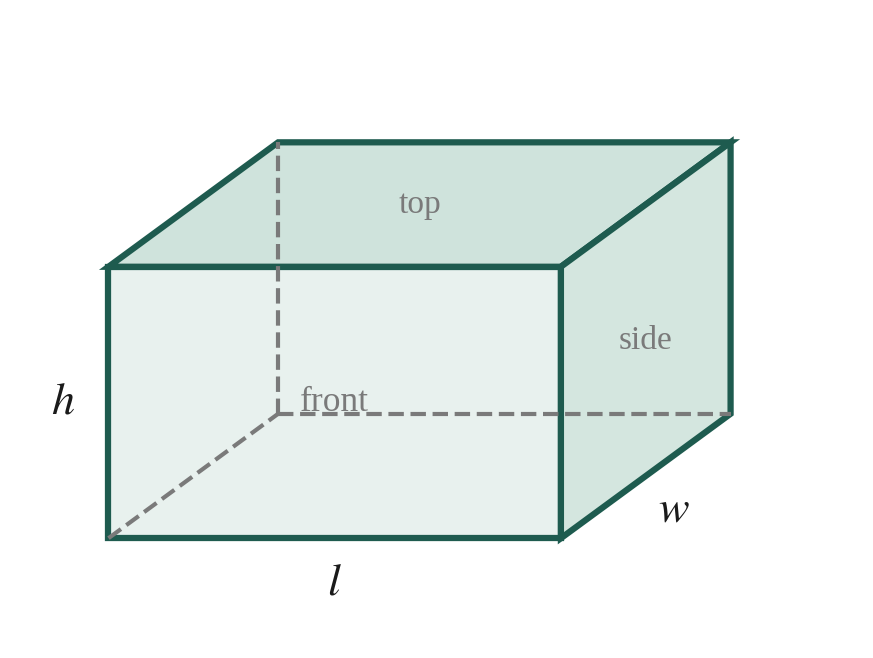
| Cuboid ( l , w , h ) | TSA = 2( l w + w h + h l ) ; lateral = 2 h ( l + w ) | l w h |
| Cube (edge a ) | 6 a 2 | a 3 |
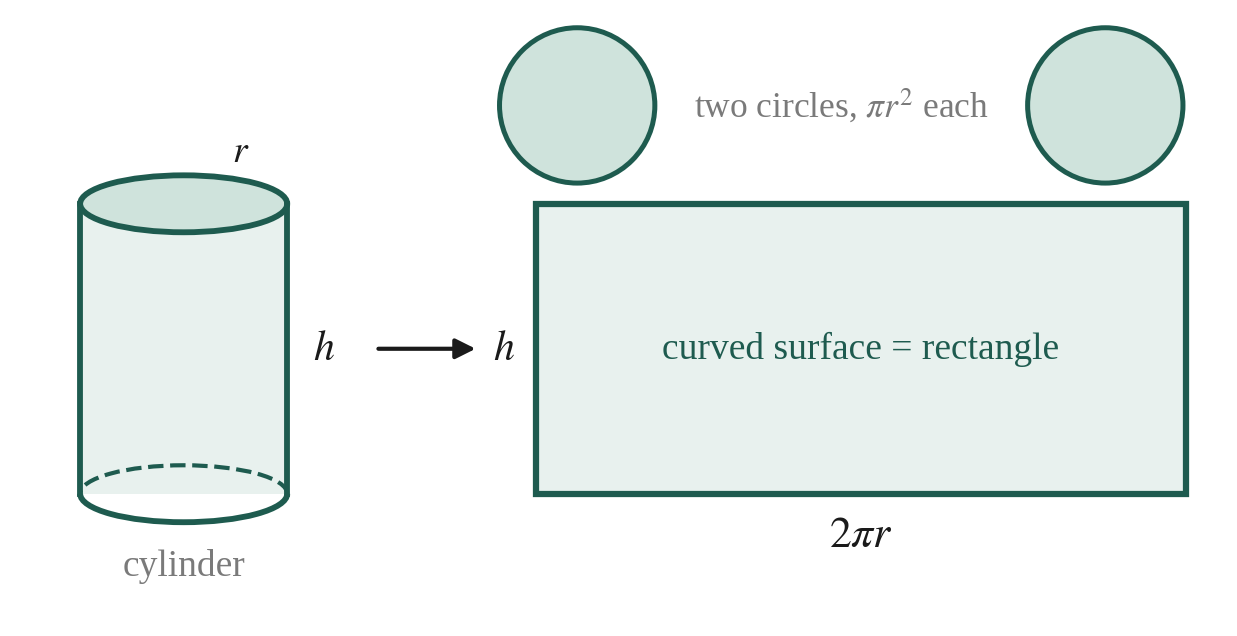
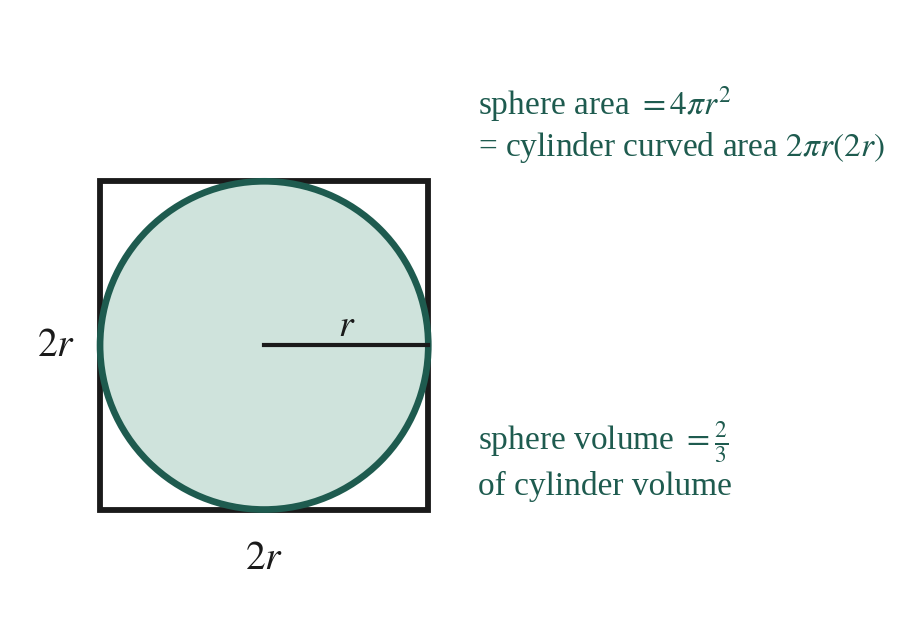
| Cylinder ( r , h ) | curved 2π r h ; total 2π r ( r + h ) | π r 2 h |
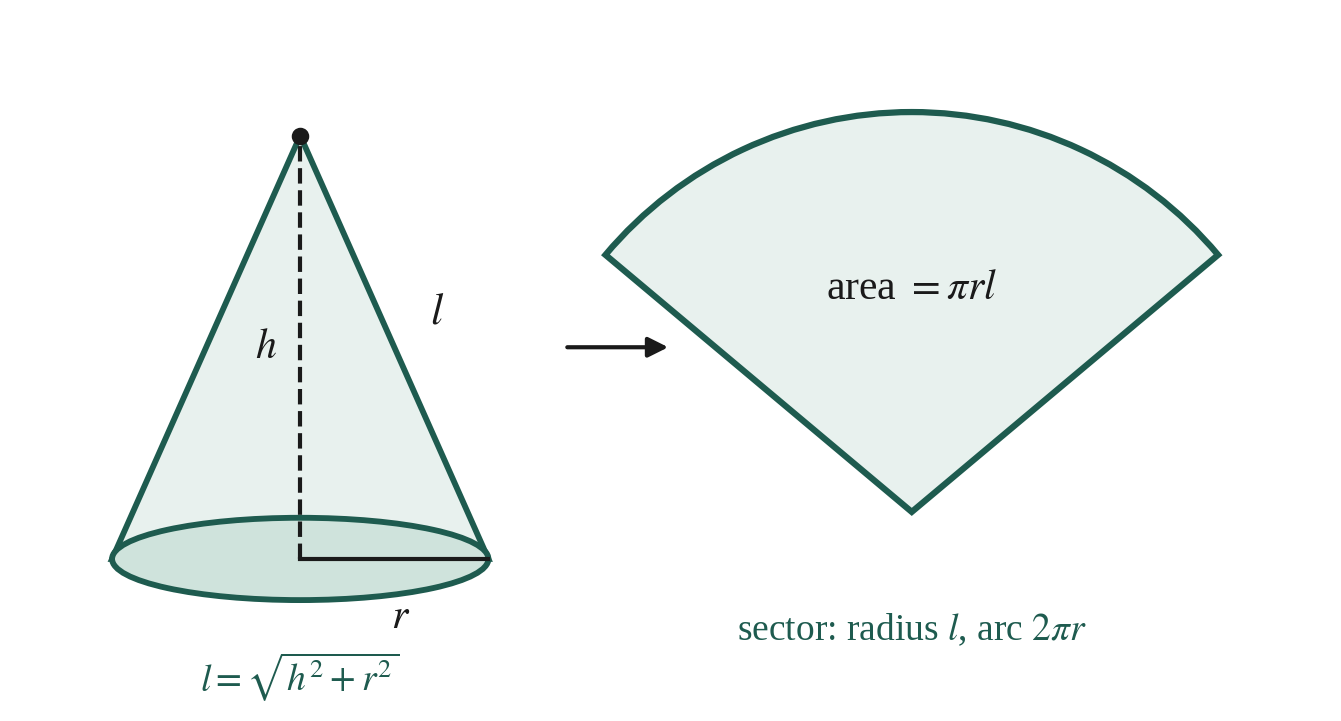
| Cone ( r , h , l ) | curved π r l ; total π r ( r + l ) ; l 2 = r 2 + h 2 | 1/3 π r 2 h |
| Pyramid | lateral = sum of triangular faces | 1/3 × b a s e a r e a × h |
| Sphere ( r ) | 4π r 2 | 4/3 π r 3 |
| Hemisphere ( r ) | curved 2π r 2 ; total 3π r 2 | 2/3 π r 3 |
Joining two solids hides the glued faces, so the total surface area decreases. Cutting a solid exposes two new faces, so the area increases.
Surface area is in square units, volume in cubic units; 1 m³ = 1000 litres.
If the top is open, subtract one circle: TSA = 2πrh + πr2.
A pipe or roller makes a cylinder whose curved surface is what touches the ground or wall.
Doubling r multiplies the volume by 4; doubling h multiplies it by 2.
To find r from a sector: arc length of sector = circumference of cone base.
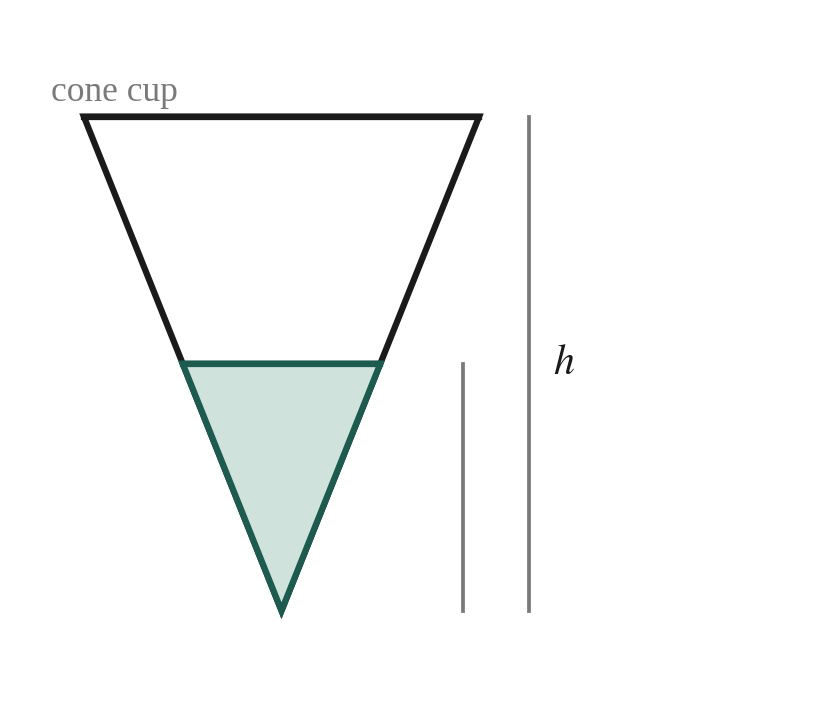
Similar cones: lengths in ratio k give volumes in ratio k3.
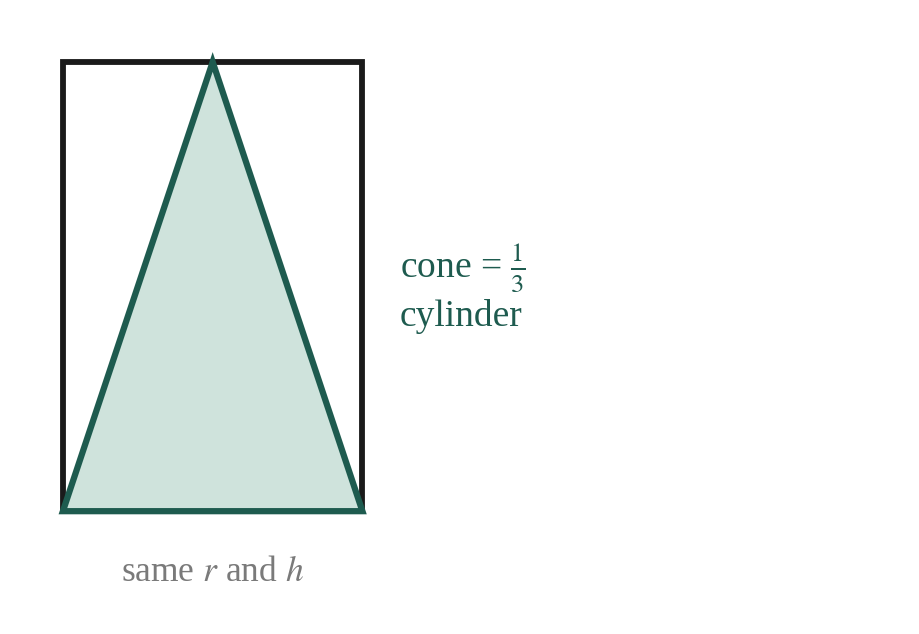
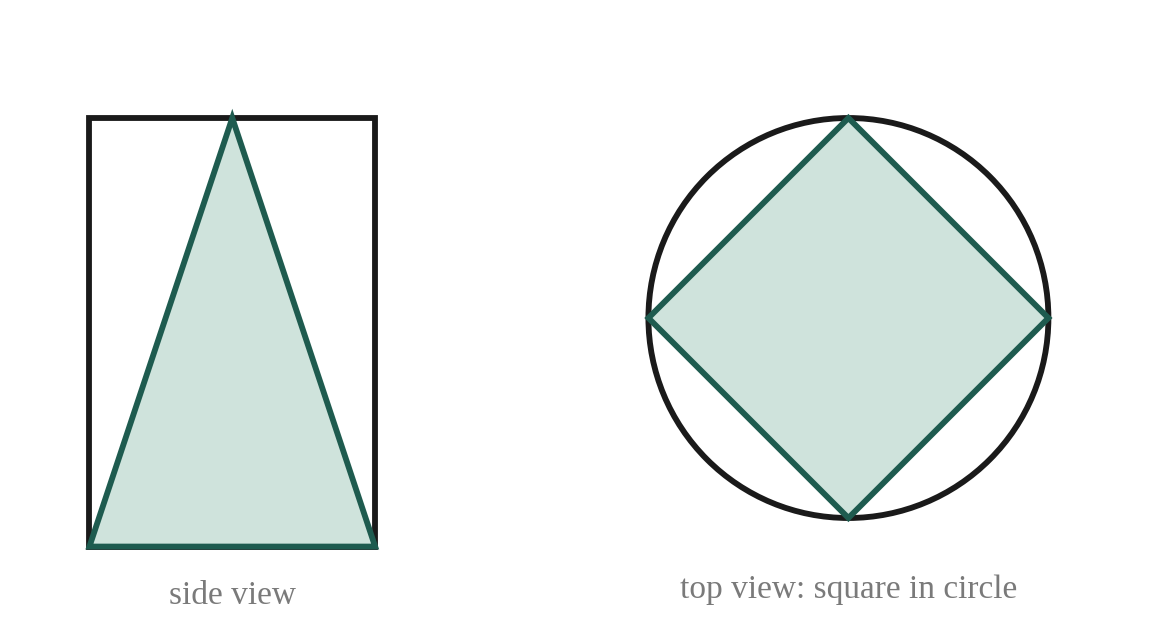
A pyramid is one-third of the prism with the same base and height, just as a cone is one-third of a cylinder.
The height is perpendicular to the base; the slant height lies along a lateral face.
Guesstimate: round to easy numbers, compute, and judge whether the answer is reasonable.
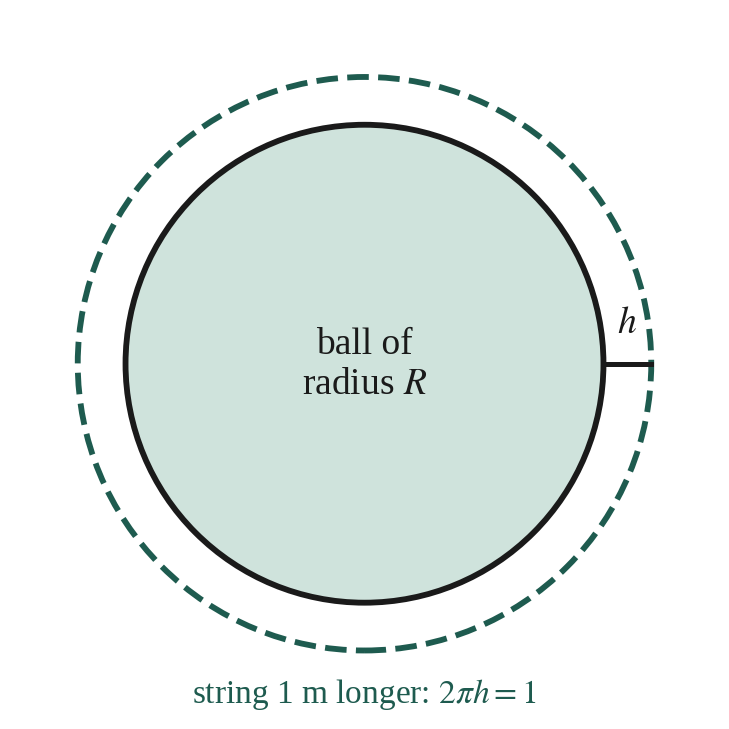
Circumference trick: adding length L to a circle’s circumference adds L/(2π) to its radius, whatever the radius.
The value of P(x) at x = k is P(k): replace x by k.
A linear polynomial has exactly one zero: ax + b = 0 gives x = −b/a.
Word problems: let a letter stand for the unknown, write an equation from the story, solve it, then check it against the story.