Types of Aircraft: Aerodynes, Aerostats and Rotorcraft
Learn how aircraft stay aloft, then classify fixed-wing aircraft, gliders, balloons, airships, helicopters, gyroplanes and newer powered-lift configurations. The key is to keep lift source, propulsion and operating capability as separate questions.
1. Start with the source of lift
Aircraft can first be grouped by the main physical mechanism that supports them in the air. An aerostat relies primarily on buoyancy; an aerodyne relies primarily on aerodynamic forces acting on a wing or other lifting surface.
| Group | How lift is produced | Examples |
|---|---|---|
| Aerostat | Buoyancy from a volume of heated air or lifting gas makes the vehicle's average density lower than the surrounding air. | Free balloon, hot-air balloon, gas balloon, airship |
| Aerodyne | Airflow around lifting surfaces produces aerodynamic force. Airflow may come from forward motion, a powered rotor, or both. | Airplane, glider, helicopter, gyroplane, tiltrotor |
How the main aircraft families generate support
“Lift” is used broadly in classification. Aerostats are supported by buoyancy; aerodynes generate aerodynamic force. For a conventional wing, a useful introductory relationship is L = ½ρV2SCL; a rotor blade is also an airfoil, but its local airspeed changes with radius and operating condition.
| Aircraft family | What supports it? | Where does propulsion fit? |
|---|---|---|
| Balloon or airship | Buoyancy: the surrounding air displaced by the envelope exerts an upward force. Net upward force is buoyancy minus the complete vehicle’s weight. | A balloon normally drifts with the wind; an airship has propulsion for steerable movement. Either remains an aerostat if buoyancy is its main support. |
| Airplane or glider | Airflow over the fixed wing creates aerodynamic lift. A glider can use rising air and does not need engine thrust to remain an aerodyne. | Engines provide thrust on powered airplanes; a pure glider trades altitude or uses atmospheric energy for forward flight. |
| Helicopter | Powered rotor blades act as rotating airfoils; the rotor’s thrust supports the aircraft and can be tilted to control its direction. | The engine normally drives the main rotor in powered flight. Collective changes total rotor thrust; cyclic tilts the rotor disc. |
| Gyroplane | Airflow through the rotor turns it in autorotation, and the rotor produces aerodynamic lift. | A separate propeller normally supplies forward thrust; the rotor is not normally engine-driven in forward flight. |
| Powered-lift / tiltrotor | Powered rotors or propulsors provide vertical support in vertical mode; a wing can support the aircraft in forward cruise. | Thrust direction or the active lifting system changes with flight mode; transition is a distinct operating phase. |
These are broad engineering groupings. In an actual certification or operating rule, use the definitions and classifications adopted by the relevant authority; a technical family name does not by itself settle a legal category.
Connect the aircraft families: Module 1.1 mind map
Start with the primary support mechanism, then follow the separate branches for aircraft family, rotor system, capability and safety.
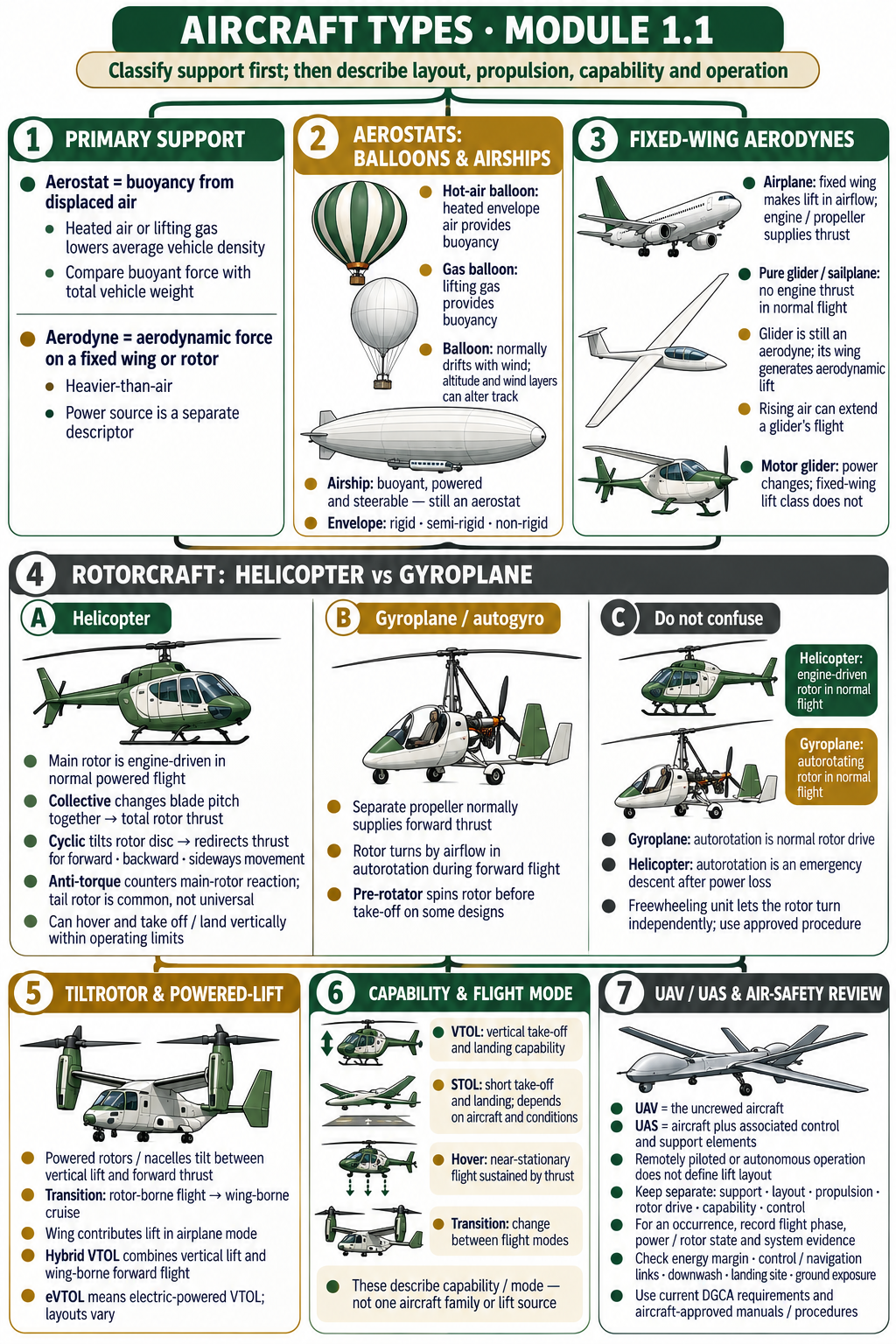
2. Aerostats: balloons and airships
An aerostat is supported mainly by buoyancy. Its envelope contains heated air or a gas with lower density than the surrounding air. Buoyancy acts upward; the vehicle's total weight acts downward. The difference between those forces determines whether it rises, descends or remains near an equilibrium altitude.
- Balloon: A buoyant aircraft that normally has no engine-driven means of forward propulsion. Wind carries it horizontally; the crew can influence altitude and may use winds at different heights to alter the track.
- Airship: A buoyant aircraft with propulsion and steering capability. It can make controlled horizontal progress relative to the surrounding air.
- Both are aerostats: The presence of an engine does not make an airship an aerodyne; its principal support still comes from buoyancy.


3. Aerodynes: fixed wings and rotorcraft
Aerodynes are heavier-than-air aircraft whose support comes mainly from aerodynamic forces on lifting surfaces. A wing does not have to be fixed to the fuselage: a rotor blade is a rotating wing. Nor does every aerodyne need an engine; an unpowered glider is still an aerodyne.
| Type | Lift and propulsion | Key distinction |
|---|---|---|
| Airplane | Lift mainly from fixed wings; propulsion may come from a piston engine, turboprop, jet or another system. | Forward motion creates airflow over the wing. Power source and engine count are separate descriptors. |
| Glider | Lift mainly from fixed wings; a pure glider has no engine providing thrust in normal flight. | It descends through the air while converting altitude and atmospheric energy into distance. Motor gliders are powered variants. |
| Helicopter | Lift and much of the control force come from one or more engine-driven rotors in flight. | Can take off and land vertically, hover, and move forward, backward or sideways within its operating limits. |
| Gyroplane (autogyro) | A propeller normally provides forward thrust; the rotor turns in autorotation because of airflow through the rotor disc. | The rotor is not normally engine-driven in flight. Some designs use a pre-rotator to spin it before take-off. |
| Tiltrotor | Tilting powered rotors provide lift in vertical flight and act as propellers in forward flight; the wing contributes in airplane mode. | Its lift system changes operating mode, combining rotor-borne and wing-borne flight. |


Helicopter movement and rotor thrust
In a hover, the main rotor's thrust is directed mostly upward and must balance the helicopter's weight, with additional margin available for climb. Changing collective pitch changes the total rotor thrust. Tilting the rotor disc with cyclic control redirects part of that thrust horizontally, allowing the helicopter to accelerate or move in a chosen direction. An anti-torque system counters the fuselage's reaction to main-rotor torque and provides directional control; its design varies across helicopter types.
Autorotation in a gyroplane
In forward flight, the gyroplane's rotor is driven by the airflow through the rotor disc rather than by the engine. The separate propeller supplies forward thrust. During a power loss, a suitable descent and airflow can keep the rotor turning and producing lift, giving the pilot a controlled landing option. This rotor behaviour is different from a helicopter's engine-driven rotor system in normal powered flight.
Autorotation in a helicopter
A helicopter can also autorotate after loss of engine power: the transmission's freewheeling unit allows the rotor to turn independently, and airflow through the rotor sustains rotation during a descent. The pilot uses the aircraft's approved procedure and operating limits; autorotation is a demanding emergency manoeuvre, not a guarantee of a damage-free landing.
4. Keep the classification axes separate
Aircraft descriptions often combine several independent facts. Use more than one label when needed rather than treating every label as an alternative aircraft class.
- Lift/support mechanism: buoyancy-supported aerostat or aerodynamically supported aerodyne.
- Wing/lifting arrangement: fixed wing, rotor, powered-lift arrangement, or a hybrid configuration.
- Propulsion and rotor drive: powered or unpowered; engine-driven rotor or rotor driven by airflow in autorotation.
- Operating capability: conventional take-off, short take-off and landing (STOL), vertical take-off and landing (VTOL), or hover.
- Control arrangement: crewed, remotely piloted or autonomous operation; applicable terminology depends on the system and governing rules.
UAV/UAS: “Uncrewed” or “unmanned” describes how the aircraft is operated; it does not tell you whether it is fixed-wing, a multirotor, a tiltrotor or an aerostat. A UAS includes the aircraft and the associated control and support elements. Size, operating category and permission requirements depend on the rules in force for the operation.
Electric and hybrid VTOL concepts
eVTOL describes electrically powered vertical take-off and landing aircraft, but does not specify one layout: examples include multicopters, tiltrotors and lift-plus-cruise designs. Hybrid VTOL describes a configuration or flight mode that combines vertical lift with wing-borne forward flight. Keep the energy source (electric, combustion or hybrid-electric) separate from the lift arrangement.
Classify uncrewed aircraft by layout and operation
Use these as engineering description axes, not as a substitute for the category or operating rules that apply to a particular aircraft.
| Layout | Support and flight pattern | Classification check |
|---|---|---|
| Fixed-wing | Wing produces lift in forward flight; may be launched or recovered in different ways. | Uncrewed operation does not make the aircraft a rotorcraft or mean it can hover. |
| Multirotor | Several powered rotors provide lift and control; many designs can hover. | Do not assume it has a wing-borne cruise mode. |
| Lift-plus-cruise | Separate propulsors provide vertical lift and forward cruise thrust; a wing can carry lift in cruise. | Identify the independent lift and cruise systems and the transition between them. |
| Vectored-thrust / tiltrotor | Some thrusters change direction or tilt between vertical lift and forward-flight thrust. | Transition and control response depend on the particular design. |
| Uncrewed aerostat | Buoyancy supplies primary support; propulsion and control may vary. | “Uncrewed” describes operation; “aerostat” describes support. |
| Operating risk | Question for the safety review |
|---|---|
| Command or navigation degradation | What is the approved lost-link or degraded-navigation response, and where will the aircraft go? |
| Energy or propulsion margin | Is usable energy sufficient for the planned flight, transition, diversion and recovery under the applicable procedure? |
| Vertical-flight transition | Which flight mode was active, and were speed, attitude, control authority and propulsion status within the approved envelope? |
| People and landing area | Could rotor wash, propellers, debris, the recovery path or a forced landing expose people or property? |
For safety review, consider the operating phase and the system involved: transition between hover and forward flight, battery or fuel energy margin, propulsion or control failure, communication and navigation links for remotely piloted aircraft, downwash, landing-site conditions and ground exposure. Apply the current Indian rules and the aircraft's approved procedures.
Quick classification examples
| Vehicle | Lift group and layout | Power or capability note |
|---|---|---|
| Hot-air balloon | Aerostat | Buoyancy supports it; burner heats the air in the envelope. |
| Gas airship | Aerostat | Buoyancy supports it; engine-driven propellers allow steering and forward travel. |
| Sailplane | Aerodyne, fixed wing | Unpowered in normal flight; lift comes from airflow over the wing. |
| Helicopter | Aerodyne, rotorcraft | Engine-driven rotor; VTOL and hover capability. |
| Gyroplane | Aerodyne, rotorcraft | Forward propeller thrust; rotor normally autorotates in flight. |
| Tiltrotor | Aerodyne, hybrid rotor/wing arrangement | Rotor-borne vertical mode and wing-supported forward-flight mode. |
5. Air Safety Officer application
Correct classification helps an investigator ask which physical system could have failed and what evidence should be checked. Begin with observable design and operation rather than relying on an informal label.
- Identify what supports the aircraft: buoyancy, a fixed wing, rotor blades, or a combination.
- Identify how forward thrust is produced and whether the rotor is powered in the flight condition being investigated.
- Record the aircraft's operating mode: hover, transition, forward flight, autorotation, launch or recovery.
- Match the classification to the evidence: flight/engine data, rotor and transmission condition, propeller evidence, envelope integrity, control inputs, operating records and applicable approved documents.
- Use current DGCA requirements and the aircraft's approved documentation for Indian legal or airworthiness decisions. Technical terminology alone does not establish compliance.
6. High-yield distinctions and exam traps
- A rotorcraft is heavier-than-air; its rotor blades act as rotating lifting surfaces.
- Aerodyne does not mean “engine-powered”: a glider is an unpowered aerodyne.
- An airship is powered but remains an aerostat when buoyancy supplies its primary support.
- A helicopter's rotor is engine-driven in flight; a gyroplane's rotor normally turns by autorotation.
- VTOL, STOL and hover describe operating capability; they do not by themselves identify the lift mechanism.
- UAV/UAS operation is independent of whether lift comes from a fixed wing, rotor or buoyancy.
L1 — Core terms
Aerodynes, aerostats, heavier-than-air aircraft, rotorcraft, lift generation and helicopter flight capabilities.
L2 — Primary distinctions
Fixed-wing versus rotary-wing aircraft; lighter-than-air principles; powered versus unpowered aircraft and rotor systems.
L3 — Recognise the configurations
Gliders, balloons, airships, helicopters, gyroplanes (gyrocopters/autogyros) and tiltrotors.
L4 — Flight modes and rotor principles
VTOL, STOL, hovering, autorotation and rotor thrust, including the difference between powered and unpowered rotor flight.
L5 — Modern and uncrewed aircraft
UAV classifications, hybrid VTOL aircraft, electric VTOL systems and the operational safety factors that accompany their design and use.
7. Related UPSC ASO previous-year questions
The 2023 Set-B paper tests both major distinctions in this lesson:
- Q54 — Rotorcraft: Identify rotorcraft as heavier-than-air and verify the helicopter's vertical, hovering and directional flight capabilities.
- Q59 — Aerodynes and aerostats: Distinguish aerodynamic lift from buoyant support and identify the broad aircraft families within each group.
8. Quick self-check
1. Is a helicopter an aerostat or an aerodyne, and what produces its lift?
Answer: An aerodyne and a rotorcraft. Its rotor blades generate aerodynamic lift; the engine drives the rotor in normal powered flight.
2. An airship has engines and can steer. Why is it still an aerostat?
Answer: Because buoyancy from its envelope remains the principal source of support. Propulsion controls its horizontal motion, not its primary lift mechanism.
3. What normally turns a gyroplane's rotor during forward flight?
Answer: Airflow through the rotor disc produces autorotation. A separate propeller normally supplies forward thrust.
4. Does “UAV” tell you whether an aircraft is fixed-wing or rotary-wing?
Answer: No. UAV describes uncrewed operation. The aircraft may use fixed wings, rotors, a hybrid arrangement or another lift system.
5. Is VTOL a lift-source category?
Answer: No. VTOL describes the ability to take off and land vertically. Different aircraft configurations can achieve it through different lift systems.
6. Which distinction separates a helicopter from a gyroplane in normal flight?
Answer: A helicopter normally uses an engine-driven rotor for lift. A gyroplane's rotor normally autorotates in the airflow while a separate propeller supplies forward thrust.
Continue Module 1
After aircraft classification, study the major airframe parts and their functions.
Further reading
For a fuller treatment of introductory aircraft types, construction, flight principles and controls, consult the FAA's official aeronautical knowledge handbook. Its regulatory terminology is U.S.-specific; use current DGCA requirements for Indian regulatory decisions.
- Federal Aviation Administration, Pilot’s Handbook of Aeronautical Knowledge — Chapters 1, 3, 4 and 6.
- Federal Aviation Administration, Helicopter Flying Handbook — helicopter controls, rotor aerodynamics and emergency procedures.
- Federal Aviation Administration, Balloon Flying Handbook — balloon systems and buoyant flight.
- Federal Aviation Administration, Aviation Handbooks & Manuals — official handbook index, including glider and rotorcraft references.
- Federal Aviation Administration — What is an unmanned aircraft system (UAS)? — distinguishes the aircraft from the equipment needed to operate it.
- Federal Aviation Administration — Powered Lift FAQ — explains powered-lift operation and the vertical-to-cruise flight transition. Its regulatory terminology is U.S.-specific.
UPSC-style self assessment
36 questions on Topic 1.1
Select one option for each question, then open its answer when you are ready. The set mixes statement combinations, classification, assertion–reason and applied safety across L1–L5.
A. Core classification and lift
Q01.Consider these statements:
- An aerostat is supported primarily by buoyancy.
- An aerodyne is supported primarily by aerodynamic forces.
- Every powered aircraft is an aerodyne.
Which are correct?
Reveal answer and explanation
Correct answer: C. Statements 1 and 2 describe the main support mechanisms. Power is a separate axis: a powered airship remains an aerostat, while an unpowered glider is an aerodyne.
Q02.For a balloon, which best describes buoyant support?
Reveal answer and explanation
Correct answer: B. Net buoyant support depends on displaced air and total system weight. Heated air or lifting gas makes the balloon's average density lower than surrounding air.
Q03.Which is the useful distinction between a typical balloon and a typical airship?
Reveal answer and explanation
Correct answer: B. Both are aerostats. Propulsion and steering distinguish an airship's horizontal control; buoyancy remains the main support for both.
Q04.An engine-powered gas airship is best classified as:
Reveal answer and explanation
Correct answer: B. Power provides controlled horizontal thrust, while buoyancy supplies primary support. These labels describe different axes.
Q05.A sailplane gains height in rising air without engine thrust. Which conclusion is correct?
Reveal answer and explanation
Correct answer: B. A pure glider remains a heavier-than-air fixed-wing aerodyne. It may use atmospheric energy, but its wing relies on airflow to generate lift.
Q06.Which statement about a motor glider is correct?
Reveal answer and explanation
Correct answer: B. A motor glider remains a fixed-wing aerodyne. The engine changes propulsion options, not its primary lift classification.
B. Aircraft families and rotor systems
Q07.A rotorcraft is generally:
Reveal answer and explanation
Correct answer: B. Rotorcraft are heavier-than-air aircraft. Their rotor blades produce aerodynamic force; helicopters and gyroplanes are rotorcraft.
Q08.Which combination best describes a helicopter in normal powered flight?
Reveal answer and explanation
Correct answer: B. A helicopter's powered rotor supports vertical flight and hover. Capability depends on design, conditions, weight and operating limits.
Q09.A conventional gyroplane in forward flight is most accurately described as:
Reveal answer and explanation
Correct answer: B. A gyroplane (autogyro or gyrocopter) is an aerodyne rotorcraft. Its rotor normally autorotates in flight while a separate propeller supplies forward thrust.
Q10.What is the usual purpose of a gyroplane pre-rotator?
Reveal answer and explanation
Correct answer: B. Some gyroplanes use a pre-rotator before take-off. This does not mean the rotor is normally engine-driven in forward flight.
Q11.Consider statements about autorotation:
- It is the normal rotor-drive mode of a typical gyroplane in forward flight.
- It can also be used in a helicopter descent after engine power loss.
- It means the engine normally drives the rotor.
Which are correct?
Reveal answer and explanation
Correct answer: B. A gyroplane rotor normally turns through airflow. A helicopter can autorotate after loss of engine power when airflow turns the rotor.
Q12.Which statement about aircraft names and families is correct?
Reveal answer and explanation
Correct answer: B. Helicopters and gyroplanes are distinct rotorcraft types. Gyrocopter and autogyro are commonly used for gyroplane designs.
C. Lift, controls and operating capability
Q13.Why can a rotor blade generate lift?
Reveal answer and explanation
Correct answer: A. Rotor blades function as rotating wings. Their motion through air produces aerodynamic force and rotor thrust.
Q14.In a conventional helicopter, what does collective control primarily change?
Reveal answer and explanation
Correct answer: A. Collective pitch changes blade pitch together and therefore changes total rotor thrust.
Q15.In a conventional helicopter, what is the primary effect of cyclic control?
Reveal answer and explanation
Correct answer: B. Cyclic inputs vary blade pitch around the rotation and tilt the rotor disc, redirecting thrust and controlling attitude and horizontal movement.
Q16.Which statement about anti-torque and directional control is best?
Reveal answer and explanation
Correct answer: B. A tail rotor is common, but coaxial, tandem and other configurations manage torque differently.
Q17.In a steady hover with no vertical acceleration, upward rotor thrust is approximately:
Reveal answer and explanation
Correct answer: B. In steady hover, vertical forces balance. More upward thrust is needed to climb; performance remains subject to aircraft limits.
Q18.A helicopter loses engine power in flight. Which best describes a properly conducted autorotation?
Reveal answer and explanation
Correct answer: B. Airflow through the rotor can sustain rotor speed after engine drive is lost. Height, airspeed, conditions, limits and pilot action affect the outcome.
D. VTOL, STOL, UAV and hybrid systems
Q19.VTOL most directly describes:
Reveal answer and explanation
Correct answer: B. VTOL describes capability. Helicopters, tiltrotors and other powered-lift aircraft can achieve it through different designs.
Q20.Which statement about STOL is correct?
Reveal answer and explanation
Correct answer: B. STOL is distinct from vertical operation. There is no single runway-distance value for every aircraft and condition.
Q21.During transition, a tiltrotor typically:
Reveal answer and explanation
Correct answer: B. Tiltrotors transition between rotor-borne vertical flight and wing-borne forward flight. The sequence is design-specific.
Q22.What does eVTOL tell you most directly?
Reveal answer and explanation
Correct answer: A. Electric power and VTOL are descriptors. Layouts include multicopter, tiltrotor, lift-plus-cruise and others.
Q23.Which statement correctly distinguishes UAV and UAS?
Reveal answer and explanation
Correct answer: B. UAS is the broader system. Uncrewed operation may be remotely piloted or autonomous, depending on the system.
Q24.A small uncrewed aircraft has fixed wings and no vertical-lift rotors. Which inference is sound?
Reveal answer and explanation
Correct answer: A. Uncrewed operation describes how the aircraft is operated, not its lift layout. UAVs can be fixed-wing, rotary-wing or hybrid.
E. Applied classification and safety
Q25.An electric aircraft uses vertical lift rotors plus a wing and cruise propeller. What is the best classification approach?
Reveal answer and explanation
Correct answer: B. State independent axes together: electric power source, lift arrangement, operating capability and flight mode. Authority-specific certification labels still depend on applicable rules.
Q26.A remotely piloted multirotor loses its command link near people. What is the best safety assessment?
Reveal answer and explanation
Correct answer: B. Lost-link behaviour varies by aircraft and setup. Establish the configured response and exposure instead of assuming a universal behaviour.
Q27.A helicopter operates close to ground staff. Which hazard deserves specific attention?
Reveal answer and explanation
Correct answer: A. Rotor wash can affect people and loose objects near the aircraft. Ground coordination, exclusion areas and procedures matter.
Q28.Read the assertion and reason.
Assertion (A):An engine-powered airship remains an aerostat when buoyancy supplies primary support.
Reason (R):Propulsion and primary support are different classification axes.
Reveal answer and explanation
Correct answer: A. Engine power provides horizontal thrust while buoyancy supplies main support, so both descriptors can apply to different aspects of one aircraft.
Q29.Match the aircraft to its usual description:
Aircraft
- 1Sailplane
- 2Airship
- 3Helicopter
- 4Gyroplane
Usual descriptions
- aBuoyant and steerable by propulsion
- bFixed-wing glider
- cPowered rotor in normal flight
- dForward propeller and rotor normally in autorotation
Reveal answer and explanation
Correct answer: A. A sailplane is a fixed-wing glider; an airship is a powered aerostat; a helicopter uses a powered rotor in normal flight; a gyroplane normally has propeller thrust and an autorotating rotor.
Q30.A heavier-than-air vehicle has a separate forward propeller and an overhead rotor turned by airflow in normal forward flight. Which best fits?
Reveal answer and explanation
Correct answer: B. The propeller supplies forward thrust while airflow normally turns the gyroplane rotor. This distinguishes it from a conventional helicopter's powered rotor in normal flight.
Q31.Which statement correctly distinguishes buoyant support from aerodynamic lift?
Reveal answer and explanation
Correct answer: B. Buoyancy supports an aerostat, while aerodynamic forces support an aerodyne. Engine power is a separate classification axis: a powered airship remains an aerostat.
Q32.A powered multirotor is holding a steady hover in still air. Which statement best describes its support?
Reveal answer and explanation
Correct answer: B. The rotor discs accelerate air to produce thrust. In a steady hover, the upward component of total rotor thrust balances weight; extra upward thrust is needed to climb.
Q33.An electric uncrewed aircraft uses dedicated vertical-lift rotors and a separate cruise propeller with a wing. Which description keeps its classification axes separate?
Reveal answer and explanation
Correct answer: C. “Electric” is its energy source, “uncrewed” describes operation, and “lift-plus-cruise” describes the physical layout. Those labels can apply together; the UAS is broader than the aircraft itself.
Q34.Which statement about a UAV and its UAS is most accurate for a safety investigation?
Reveal answer and explanation
Correct answer: A. The aircraft and the complete system are different scopes of analysis. A safety review may need evidence from the vehicle, control station, link, software, procedures and operating team; exact definitions depend on the applicable rule set.
Q35.A lift-plus-cruise aircraft loses stable control during conversion from vertical lift to wing-borne flight. What should the first technical review establish?
Reveal answer and explanation
Correct answer: C. Transition changes which surfaces or propulsors provide support and control. Establish the aircraft state and evidence against its approved envelope and procedure before drawing a cause or compliance conclusion.
Q36.Consider these statements:
- 1.An airship can have propulsion and still be an aerostat.
- 2.“eVTOL” identifies one mandatory rotor layout.
- 3.“Uncrewed” alone does not reveal whether the aircraft is fixed-wing or rotor-borne.
Which statements are correct?
Reveal answer and explanation
Correct answer: B. An airship remains buoyancy-supported, and uncrewed operation is independent of the lift layout. eVTOL describes electric power and vertical take-off/landing capability; it does not prescribe one physical arrangement.
One-page recall
Revision tables: all Topic 1.1 concepts
Use these tables to compare the lift source, aircraft layout, power system, operating capability and safety meaning without mixing separate classification axes.
1. Primary support and lift source
| Group | Primary support | How to recognise it | Examples |
|---|---|---|---|
| Aerostat | Buoyancy: upward force from displaced surrounding air | Heated air or lifting gas lowers the complete vehicle's average density; compare buoyant force with envelope, structure, fuel and payload weight. | Hot-air balloon, gas balloon, airship |
| Aerodyne | Aerodynamic forces on wings or lifting surfaces | Airflow over a fixed wing or through a rotor produces lift; airflow may come from forward motion, powered rotation or both. | Airplane, glider, helicopter, gyroplane, tiltrotor |
2. Lighter-than-air aircraft
| Type | Support | Propulsion and control | Recall point |
|---|---|---|---|
| Hot-air balloon | Buoyancy from heated envelope air | Normally no engine-driven horizontal propulsion; wind carries it, while altitude and wind layers can influence track. | Heated air is less dense than surrounding air. |
| Gas balloon | Buoyancy from lifting gas | Normally drifts with the wind horizontally; altitude can be managed within design limits. | Still an aerostat when unpowered. |
| Airship | Buoyant envelope | Propulsion and steering allow controlled horizontal progress relative to the air. | Engine power does not change its primary lift group. |
| Envelope forms | Airships may be rigid, semi-rigid or non-rigid. | Construction describes structure, not a change from aerostat to aerodyne. | Do not confuse structural subtype with lift source. |
3. Heavier-than-air configurations
| Aircraft | Lift layout | Propulsion / rotor drive | Key distinction |
|---|---|---|---|
| Airplane | Fixed wing | Propulsion supplies forward thrust; wing supplies lift in airflow. | Engine type and count are separate labels. |
| Glider / sailplane | Fixed wing | Pure glider has no engine thrust in normal flight; motor gliders may have an engine. | Remains an aerodyne; can use rising air. |
| Helicopter | One or more powered rotors | Main rotor is engine-driven in normal powered flight. | Can hover and operate vertically within limits. |
| Gyroplane / autogyro / gyrocopter | Autorotating rotor | A separate propeller normally supplies forward thrust; a pre-rotator may spin the rotor before take-off. | Rotor normally is not engine-driven in forward flight. |
| Tiltrotor | Powered rotors plus wing | Rotors tilt between vertical lift and forward-thrust modes. | Transitions between rotor-borne and wing-borne flight. |
| Multirotor | Several powered rotors | Thrust and control are distributed across multiple motors. | Common UAV layout; not the only UAV layout. |
4. Rotor thrust, controls and autorotation
| Concept | Core idea | Exam distinction |
|---|---|---|
| Lift generation | Rotor blades act as rotating airfoils and generate aerodynamic force through the air. | Rotorcraft are heavier-than-air; the rotor is a lifting surface. |
| Hover | In steady hover, upward rotor thrust approximately balances aircraft weight. | More thrust is needed to climb; hover is a capability/flight condition. |
| Collective | Changes blade pitch together to vary total rotor thrust. | Primarily changes lift magnitude. |
| Cyclic | Changes rotor-disc orientation and redirects the thrust vector. | Enables attitude and horizontal movement control. |
| Anti-torque | Counters main-rotor torque and manages yaw; designs vary. | A tail rotor is common, not universal. |
| Gyroplane autorotation | Airflow normally drives the rotor in forward flight; a separate propeller supplies thrust. | Normal rotor-drive mode for a typical gyroplane. |
| Helicopter autorotation | After power loss, approved procedure and descent airflow can keep the rotor turning; a freewheeling unit permits rotor/engine separation. | Emergency manoeuvre with aircraft-specific limits; outcome is not guaranteed. |
5. Capability and flight-mode terms
| Term | Meaning | What it does not mean |
|---|---|---|
| VTOL | Vertical take-off and landing capability. | Not one lift source or aircraft family. |
| STOL | Short take-off and landing capability, depending on aircraft and conditions. | Not hover or vertical flight; no single runway-distance value applies to all aircraft. |
| Hover | Near-stationary flight sustained by rotor or powered-lift thrust. | Not synonymous with every VTOL aircraft being a helicopter. |
| Transition | Change between modes such as vertical rotor-borne flight and wing-borne cruise. | Not an energy source or proof of autonomy. |
| Autorotation | Rotor turns through airflow rather than normal engine drive. | Not the same state as powered helicopter flight. |
6. UAV, UAS, hybrid VTOL and eVTOL
| Term | Describes | Possible combinations | Keep separate |
|---|---|---|---|
| UAV | The uncrewed aircraft. | Fixed-wing, multirotor, lift-plus-cruise, tiltrotor, aerostat or other layout. | Uncrewed operation does not dictate lift layout. |
| UAS | The broader aircraft system with associated control/support elements. | Remotely piloted or autonomous operation, depending on system. | UAS is broader than the aircraft alone. |
| Fixed-wing / multirotor | Common physical UAV layouts. | Wing-borne forward flight / multiple powered rotors. | Hover capability depends on the actual design. |
| Lift-plus-cruise | Separate vertical-lift and cruise propulsors, often with a wing. | Vertical mode followed by wing-borne cruise. | Identify transition and the separate propulsion paths. |
| Vectored thrust | Thrusters change direction between lift and cruise roles. | Tiltrotor or other powered-lift arrangement. | Do not infer one rotor topology from eVTOL alone. |
| Hybrid VTOL | A configuration/mode combining vertical lift with wing-borne forward flight. | Tiltrotor, lift-plus-cruise and other designs. | Architecture and transition vary by design. |
| eVTOL | Electric power with vertical take-off and landing capability. | Multicopter, tiltrotor, lift-plus-cruise or other layouts. | Energy source is distinct from lift topology. |
7. Air Safety Officer review cues
| Evidence / phase | Check | Why it matters |
|---|---|---|
| Support and lift | Envelope system, fixed wing, rotor, or combined lift system. | Identifies the physical system and likely failure evidence. |
| Propulsion and rotor drive | Engine/motor, transmission, propeller, rotor state and power path. | Distinguishes powered rotor flight from autorotation and buoyant support from thrust. |
| Operating phase | Hover, take-off, landing, transition, forward flight or autorotation. | Hazards and performance margins vary with mode. |
| Uncrewed operations | Control-link/navigation state, configured lost-link response, containment and people exposed. | Response and requirements depend on configuration and current approval. |
| Vertical-flight site | Energy margin, approach/landing area, rotor downwash, debris and ground exposure. | Links aircraft capability to operating risk. |
| Mode transition | Active mode, airspeed/attitude, control authority, propulsion status and approved transition envelope. | Lift and control can shift between propulsors and wing as configuration changes. |
| Regulatory finding | Current DGCA requirements and aircraft-approved manuals/procedures. | Technical family names alone do not determine legal compliance. |
8. Supplied L1–L5 scope and practice coverage
| Level | Concepts to recall | Practice |
|---|---|---|
| L1 | Aerodynes, aerostats, heavier-than-air aircraft, rotorcraft, buoyant versus aerodynamic support and helicopter capabilities. | Q1–Q8, Q13, Q17, Q31–Q32 |
| L2 | Fixed versus rotary wing; lighter-than-air support; powered versus unpowered aircraft and rotor systems. | Q3–Q6, Q8–Q12, Q18 |
| L3 | Gliders, balloons, airships, helicopters, gyroplanes/autogyros and tiltrotors. | Q3–Q10, Q21, Q29–Q30 |
| L4 | VTOL, STOL, hover, autorotation and rotor thrust/controls. | Q10–Q20, Q32 |
| L5 | UAV/UAS layouts, lift-plus-cruise and vectored-thrust arrangements, hybrid VTOL, eVTOL power/layout distinction, transition and operational safety. | Q21–Q28, Q33–Q36 |
| PYQs | 2023 Q54 rotorcraft/helicopter capability; Q59 aerodyne/aerostat. | Read the original paper questions |
Exam habit: State the support mechanism, propulsion or rotor drive, operating capability and mode as separate facts. Then match the question's exact axis.
9. High-Yield Mnemonics, Examination Traps & Fast Solving Tricks
Use these memory anchors, rapid elimination heuristics, and UPSC trap patterns for Topic 1.1.
| Mnemonic / Hook | Concept & Pointwise Decoding | 5-Second Recall Rule |
|---|---|---|
| STAT vs DYNE |
|
Floats at zero speed = Aerostat. Falls without relative airflow = Aerodyne. |
| HELI-POW vs GYRO-AUTO |
|
Engine powers rotor = Helicopter. Engine powers propeller; freewheeling rotor autorotates = Gyroplane. |
| BLIMP vs ZEPP |
|
Deflates if depressurized = Blimp. Retains exterior shape even if gas cells are empty = Rigid / Zeppelin. |
| C-S-V TOL |
|
CRITICAL EXAM DISTINCTION: -TOL terms describe operational runway capability, NEVER fundamental aircraft classification. A helicopter and an AV-8B Harrier are both VTOL, but belong to distinct physical classes! |
Examiner Traps & Rapid Elimination Tricks
| Common UPSC Trap | Misconception Statement | Actual Technical Reality | Fast Solving Heuristic |
|---|---|---|---|
| Trap 1: Engine Presence | "Because an airship has propulsion engines and directional rudders, it is classified as an aerodyne." | FALSE. An airship is an aerostat. Its primary supporting force is static buoyancy from displaced air. Engines provide steerage and forward propulsion, not primary support. | Look at the primary support mechanism, NOT propulsion. An engine-driven airship remains an aerostat; an unpowered glider remains an aerodyne! |
| Trap 2: Gyroplane Rotor Drive | "In level cruise, the gyroplane engine drives the rotor to generate lift." | FALSE. The rotor of a gyroplane is never driven by the engine in forward cruising flight. Forward propulsion from a propeller pulls the aircraft forward, and upward relative airflow forces the rotor into autorotation. | If a statement says a gyroplane's engine drives the rotor in cruise, mark it INCORRECT immediately. |
| Trap 3: Rotor Airflow Direction | "Airflow passes downward through the rotor in both helicopters and autogyros in normal powered cruising flight." | FALSE. In a powered helicopter, airflow is drawn from above and pushed downward. In an autogyro (autorotation), relative airflow passes upward through the rotor disc from underneath. | Helicopter cruise = Downward induced flow. Gyroplane cruise = Upward autorotative flow. |
| Trap 4: Drone vs RPAS | "UAV and UAS are completely synonymous terms." | FALSE. UAV (Unmanned Aerial Vehicle) refers only to the airborne vehicle. UAS (Unmanned Aircraft System) includes the UAV + Ground Control Station (GCS) + command/control data link + launch/recovery equipment. | Vehicle alone = UAV. Complete ecosystem (pilot, link, station, aircraft) = UAS / RPAS. |
UPSC Air Safety Officer Examination Pro-Tips: Classification Protocol
- Step 1 — Identify Primary Lift Source: Does it use static buoyancy ($F_B \ge W$)? → Aerostat. Does it require dynamic airflow over surfaces? → Aerodyne.
- Step 2 — Identify Lifting Surface State: Are the lifting wings rigid to the airframe? → Fixed-wing. Do the airfoils rotate about a central mast? → Rotorcraft.
- Step 3 — Identify Rotor Drive Mechanism: Engine turns the mast? → Helicopter. Engine pushes fuselage, mast freewheels in autorotation? → Gyroplane / Autogyro.
- Step 4 — Keep Capabilities Independent: Terms like VTOL, STOL, hover, and uncrewed (UAV) describe flight modes or pilot location, not the vehicle's fundamental physical aerodynamic category.